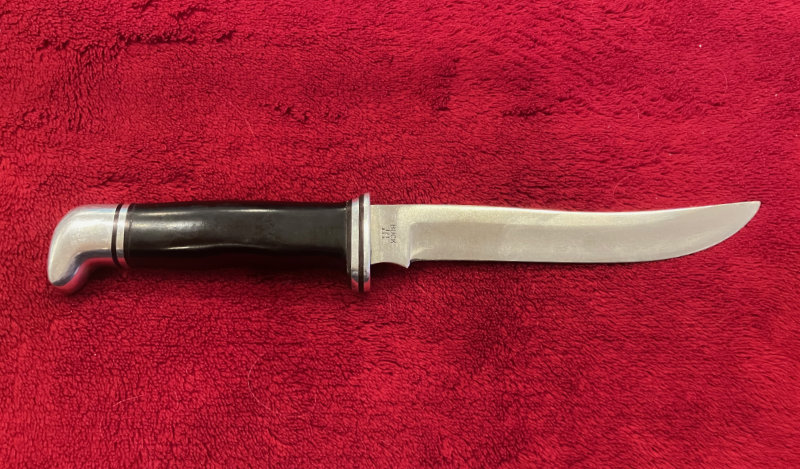
In 1975 I wanted to buy a lifetime fixed blade knife.
A lifetime knife is one that will last a lifetime, not one with a lifetime warranty. Lifetime warranties do you no good if the company isn’t around in 20 or 50 years.
My Buck knife will probably outlive me. It will be bequeathed in my last will and testament.
Quality vs. Cost
Buck knives are top-notch products, but many people think quality gear is pricey. There are tons of online stores selling cheap copies of everything. “Expensive” is subjective. Buck knives aren’t really expensive. Most of their knives are under $100, while many of the “best-rated” knives can cost $200 – $300 or even more.
In 1975 I paid around $18 for this knife. The dollar/cost average over 50 years comes out to 36 cents per year.
Quality
If a product lasts 50+ years, it is probably a quality product. But more importantly, does the product function as intended? Buck makes several different knife models (folding and fixed blade) for different purposes.
When discussing the quality of Buck knives I am restricting my comments to the Buck Knives 100 series fixed blade knives, the only Buck knife I have experience with. Buck makes most of their knives in the USA. The company imports their least expensive knives (I have read around 15% of the total).
Materials
I am not an expert when it comes to the manufacture of knives. Actually I’m clueless about these materials. So what I’m sharing is information I’ve gathered via internet searches.
Steel
Today most Buck knives are made from 420HC (High Carbon) stainless steel. My 50 year old knife is made from 440C (Carbon) steel. Some differences between the two steels:
440C typically achieves higher hardness levels than 420HC, resulting in better edge retention.
440C generally exhibits superior wear resistance, meaning it can withstand abrasion and resist dulling better than 420HC.
Both steels offer good corrosion resistance, but 420HC is often favored for its slightly better resistance to rust and staining.
420HC is known for its toughness, meaning it can withstand impacts and bending without breaking or chipping as easily as some other steels.
440C generally holds a sharper edge for longer periods than 420HC.
Phenolic Handle
Today Buck sells six models of the 100 Series Fixed Blades with a Phenolic handle.
Phenolic is a very hard plastic that can handle sanding and buffing. It is weather proof and tough. Most of these knives have black phenolic handles, although other material and colors are available at additional cost. Mine has held up well.
Leather Sheath
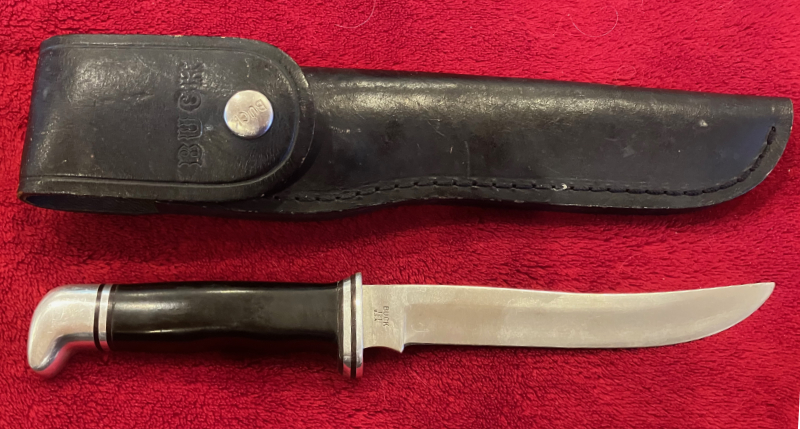
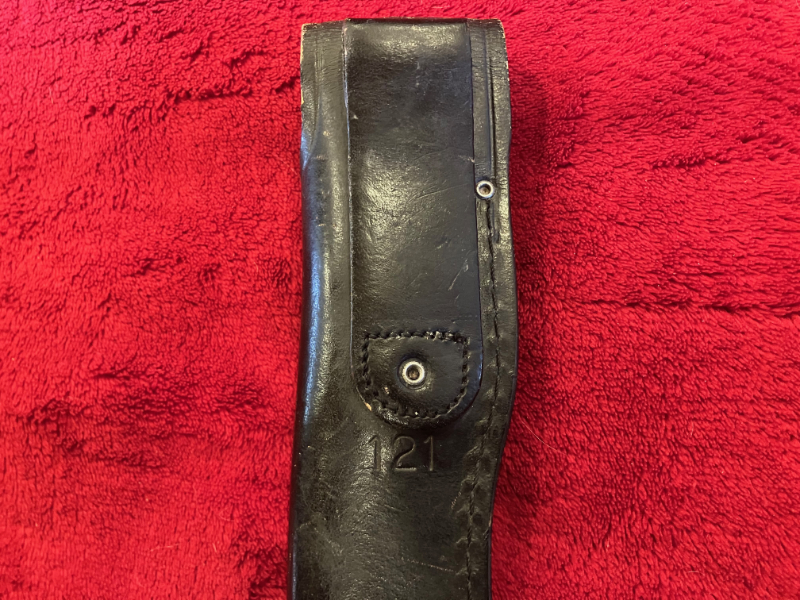
All models of the Phenolic Fixed Blade knives come with a leather sheath (imported). Mine has a fold-over flap (above). Current sheaths have a wrap around strap (below).
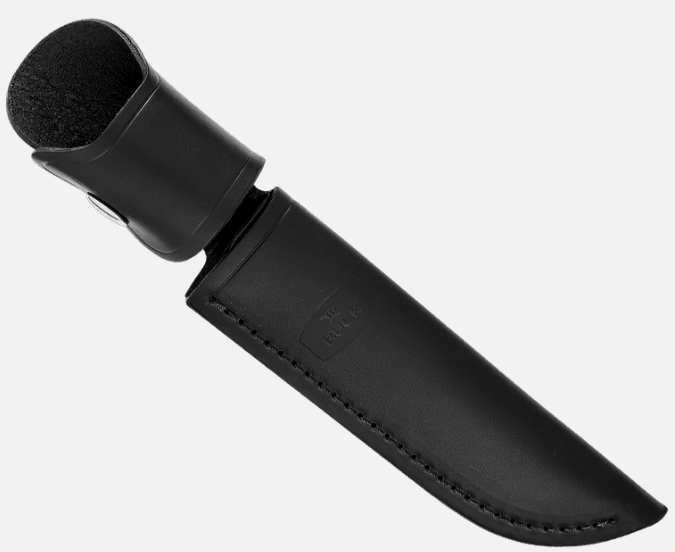
I can’t speak to the quality of the current knife sheaths. But mine has been bomb-proof. I have not handled the sheath with any care during the 50 years I’ve owned it. It is stored in my garage between trips without any ill-effects. In summer many things fall apart when stored in our garage, which usually sees several days during summer with temperatures above 120°F. The extreme weather conditions haven’t affected the sheath at all!
Other than scratches, the sheath is as good as new. Not a single stitch is out of place and the leather is in great condition. I have never cleaned or conditioned the leather.
My Use Case
I bought this knife for cleaning fish trout and performing campground chores. I did take it backpacking for the first three years to clean fish. It was around this time that fishing regulations became quite restrictive in the back country of the Sierra Nevada, so I simply quit fishing on backpacking trips for the most part.
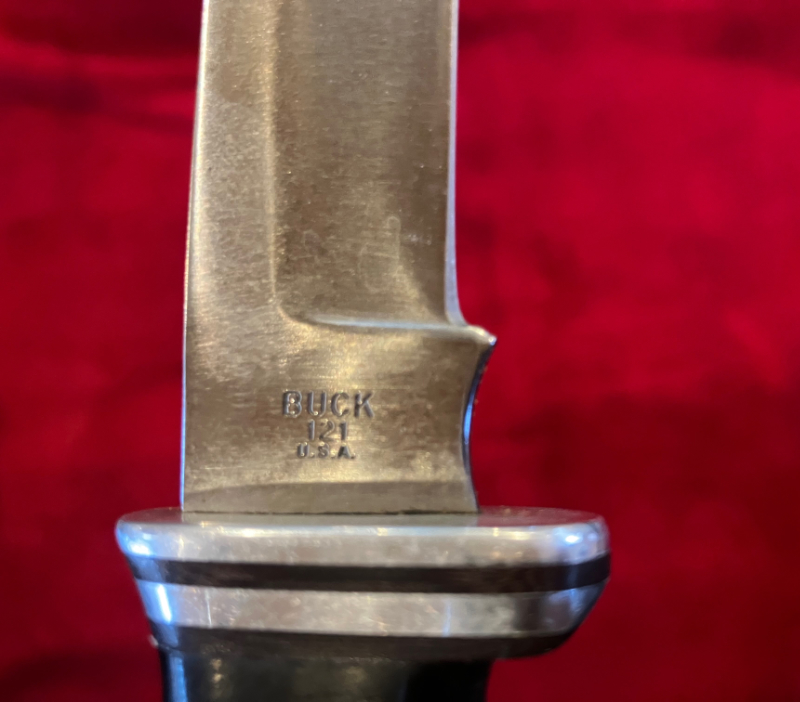
During the same time-frame I started to do more car camping in the Sierra and more trout fishing. Over the past 50 years of camping trips (thousands of days) I have brought the Buck 121 knife with me on every one of them.
Buck no longer manufactures the model 121 knife. Buck introduced it in 1964, calling it the “Fisherman.” This first iteration of the knife had serration and a fish scaler. The company removed the serrations in 1966 implementing a more standard filet blade with a gentle curve. The Fisherman became the “Guide” in 1984. Buck discontinued the model in 2000.
Sometime during the evolution of the Buck 121 from the Fisherman to the Guide model, Buck switched from the 440C steel to the 420HC steel. Buck’s version of the newer 420HC was a little thicker than the 400C used previously.
So there you have it. 50 years and as good as new.
Current Models of Buck Phenolic Fixed Knives
This website may be compensated for linking to other sites for sales of products. As an Amazon Associate I earn a small fee from qualifying purchases at no additional cost to the purchaser.
One option is to purchase directly from Buck. Buck offers personalization laser engraving from $9 and up. Also for most models Buck offers handles made from different materials and colors. Shipping is free with orders over $99. Amazon carries all of these knives usually at a small discount over the list price.
Below is a comparison table of all the Buck Knives with a phenolic handle. I have also included my discontinued Fisherman model, which for me is the perfect size for blade and overall length, balance, and usage.
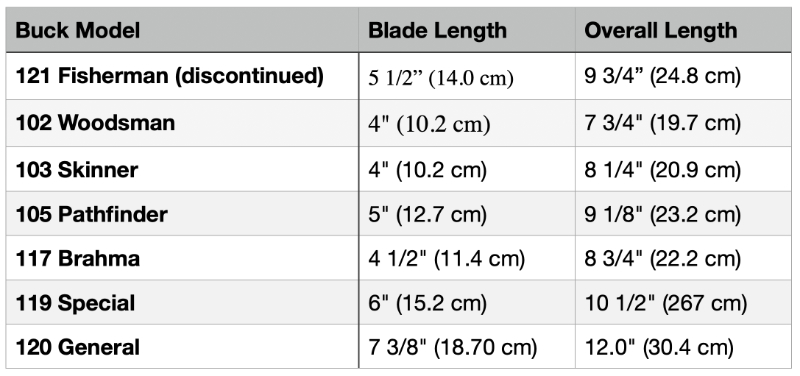
Where I to loose my Buck knife, I would purchase another. Either a model 102 or 105, which are similar to my Fisherman model, although both are a bit smaller.
What follows is a brief description of each knife along with a link to the Buck Knives website and also Amazon for comparison.
102 Woodsman
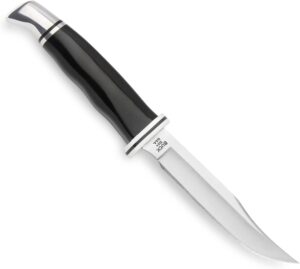
The classic 102 Woodsman® is a true hunting knife, designed with a fine clip blade perfect for fish and small game. Features include full tang construction, a finger guard integrated into the blade, thumb grip ridges, and a deep choil. Blade length: 4″ (10.2 cm). Overall length: 7 3/4″ (19.7 cm). Includes a genuine, leather sheath. Imported sheath.
103 Skinner
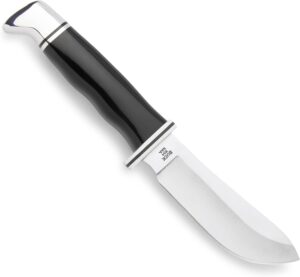 Classic, heavy-duty skinning knife. This fixed blade was designed for easily skinning game. The tip is narrow, while the curved belly aids in getting through thick layers. Blade Length: 4″ (10.2 cm). Overall Length: 8 1/4″ (20.9 cm). Imported sheath.
105 Pathfinder
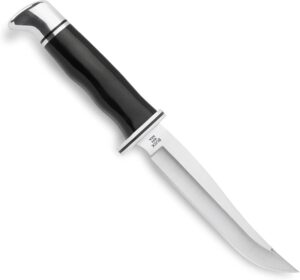
Classic, all-purpose, heavy-duty. This smaller version of the 119 Special is perfect for general outdoor use. Features including full tang construction, a finger guard integrated into the blade, thumb grip ridges and a deep choil help make this knife one of the best options for the serious hunter. Blade Length: 5″ (12.7 cm). Overall length: 9 1/8″ (23.2 cm). Imported Sheath.
117 Brahma
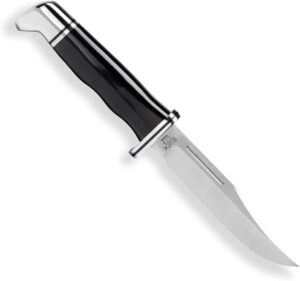 The 117 Brahma knife is an all-purpose hunting and outdoor knife. Known as the mini 119 Special, the classic styling stems from Buck’s early fixed blades. Use the tip of the clip blade for detailed work or the belly of the blade for rugged use. This knife features a traditional guard and pommel. Includes a black, genuine leather sheath with a belt loop. Blade length: 4 1/2″ (11.4 cm). Overall length: 8 3/4″ (22.2 cm). The Brahma carries on the tradition of classic, rugged, dependable Buck Knives. Imported sheath.
119 Special
Since 1942, the 119 Special has become one of the most relied-upon knives by hunters and outdoorsmen. This fixed-blade hunting knife has a large, hand-sharpened clip blade, which allows for control at the tip with a larger cutting surface at the belly of the blade. The aluminum guard at the base of the blade provides protection for your hand. The handle is built to withstand years of tough work. Blade length: 6″ (15.2 cm). Overall length: 10 1/2″ (267 cm). The knife is finished with an aluminum pommel for a classic look. Includes a black, genuine leather sheath for convenient carry on your belt or in a pack. Imported sheath.
120 General
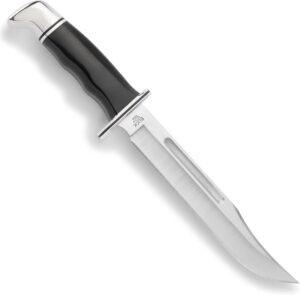
The long blade enhances the exquisite appearance while creating a hunting knife that makes de-boning a lot simpler. Exclusive, elite, and luxurious, the General remains an exceptional choice for a hunting knife or simply as a collectible. Either way, it is a conversation starter. Blade Length: 7 3/8″ (18.70 cm). Overall Length: 12.0″ (30.4 cm). Imported sheath.
How About Folding Knives?
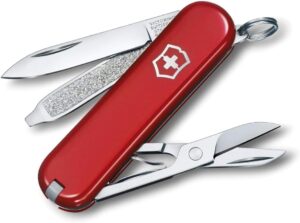
My go to pocket knife when backpacking is a Victorinox Swiss Army ClassicSD Pocket knife.

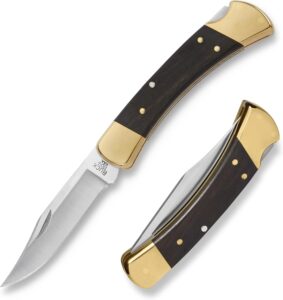
For camping (and it is kept in our truck) I have a Buck Model 100 folding knife. It is Buck Knives’ most popular knife.