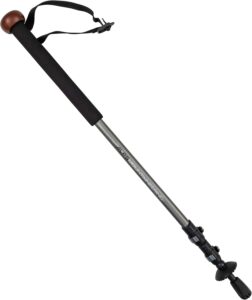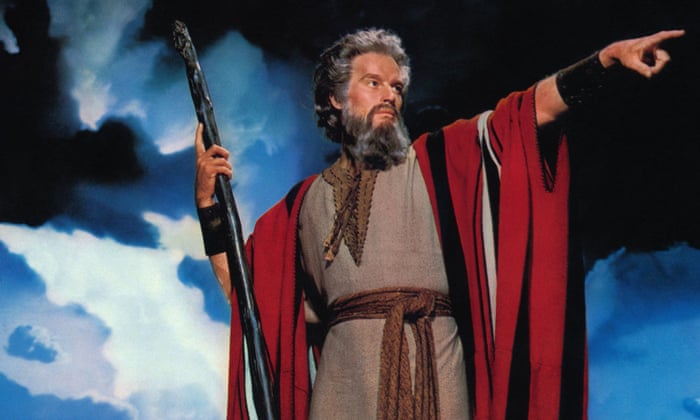
It’s a hiking stick! It’s a trekking pole! No it’s a hiking staff!
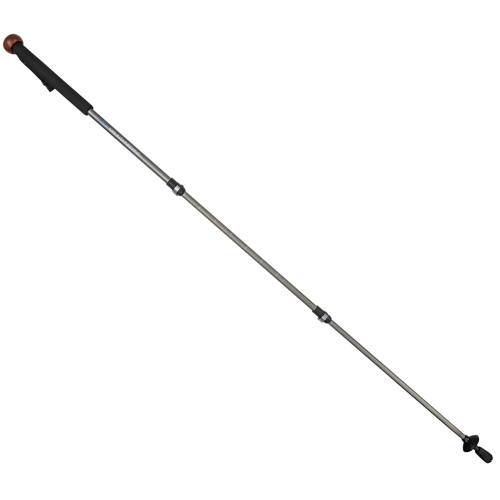
This is my first impression of the ALPS Mountaineering Classic Trekker Trekking Pole. It is not a product review because, as my readers know, I usually don’t review a product unless I have used it for 10 or more years.
Tracks Hiking Staff
Five years ago, in this post: Tracks Hiking Staff: Better Than Trekking Poles, I wrote about the Tracks Hiking Staff I had been using for over 3 decades.
In that post I shared by unsatisfactory experiments with trekking poles, along with a couple of collapsible hiking staffs that would fit into checked luggage. I disliked all of them and went back to my old friend, the Tracks Hiking Staff I purchased in the 1980s.
I also lamented that the Tracks staff and it’s “upgraded” version the Tracks Sherlock Staff were not longer available. Probably another victim of Herblock’s Law: “If it’s good, they’ll stop making it.”
Well, my Tracks Hiking Staff is starting to show its age. It is 40 years old. I had to replace the top knob a few years ago.
Lately I’ve been having problems with the twist locks, despite several cleanings. They are just wearing out and I don’t want to have an accident should the staff collapse at the wrong time with my weight on it.
So I started looking for a Tracks replacement. I found the ALPS Mountaineering Classic Trekker Trekking Pole, which looks promising. However, why do they call this thing a trekking pole?
What’s in a Name?
So, ALPS Mountaineering calls this thing the Classic Trekker Trekking Pole. I don’t think there is a specific universal definition for a hiking staff, nor for a trekking pole. General usage over the years seems to indicate that a pair of poles, usually modern lightweight things are called trekking poles. These are sold in pairs. A single pole, sold as a single pole is often understood to be a hiking staff.
Given all this, and being old and set in my ways, I can’t bring myself to call the ALPS thingy a “trekking” pole. Nor a hiking pole. To me it is a Hiking Staff — thus the title of this article, ALPS Mountaineering Classic Hiking Staff.
Onward and upward . . .
Okay, we’ve addressed the nomenclature. We’ve determined that I hate trekking poles, and that I have been dissatisfied with a couple of hiking staff I bought a few years ago. We also know I love my Tracks Hiking Staff, which is approaching its untimely demise.
First Impressions
Remember this isn’t a review. I’ve only used it on a couple hikes so far. First, let’s start with a comparison to my beloved Tracks Hiking Staff. The staffs are somewhat similar. Biggest differences is the ALPS has 3 telescoping sections (two on the Tracks) and the ALPS uses flip locks to secure the sections versus the old school (and not a good) twist locks on the Tracks.

The ALPS is lighter and longer when fully extended. Lighter because the outer diameter is 1 mm smaller at the top and 2 mm smaller at the bottom than the Tracks staff. The pole sections are made from 7075 aluminum.
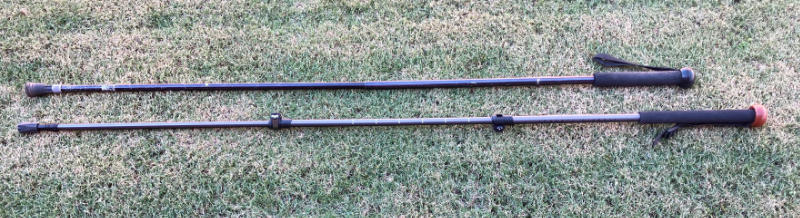
Top Knob
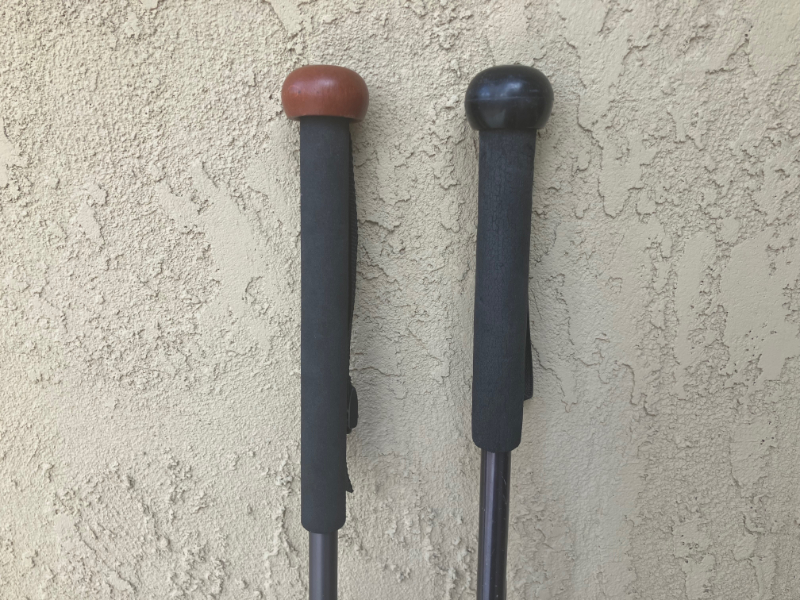
The top knobs are the same rounded shape and easily removed to expose a 1/4-20 camera mount stud. The black knob on the Tracks in the picture above is a replacement for the original wooden knob that I discussed in this post:
I appreciate the round knobs when a staff is used as the support pole in my shelters.

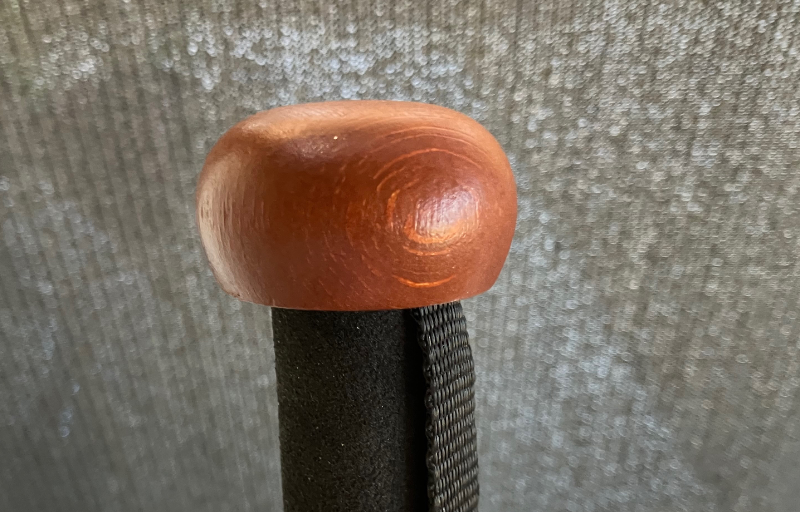

Camera Monopod
Okay, I admit it. I’ve never needed the monopod feature. Given today’s almost weightless compact cameras or smart phones, I’d venture to guess it is the rare individual that needs or wants a hiking staff monopod. But it’s there if needed.
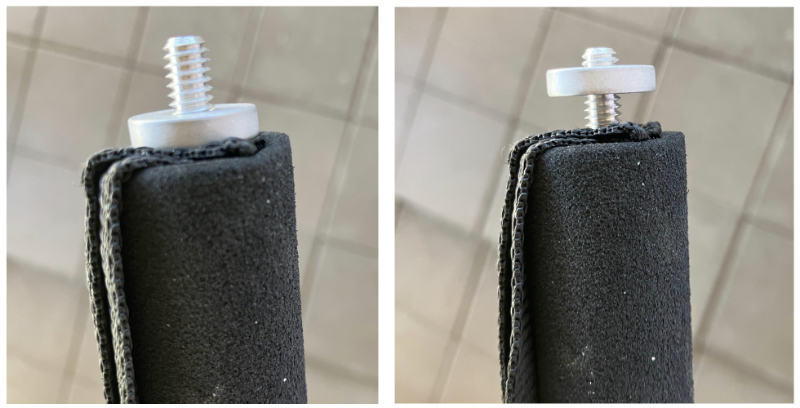
An advantage of the monopod design is it is easy to remove or replace the nylon strap. Remove the top knob also provides access to the foam grip should it need replacement.
Foam Grip
Ah, the foam isn’t as thick or dense as the one on my Tracks hiking staff. The Track’s foam grip has lasted 40 years. The ALPS grip probably will not. However it will be easy to replace with something else, such as tubing insulation or some other exotic source.
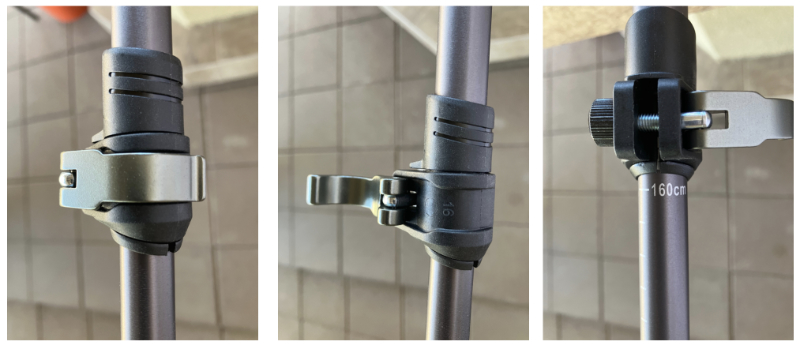
Flip Lock Pole Adjustment
Pretty standard fare here.
Height Adjustment Markings
The center section has markings from 130 cm (51 inches) to 160 cm (63 inches). I’d prefer markings on the lowest section, allowing the thinnest diameter section to telescope up to get the desired length, which would be stronger. It really isn’t that important.
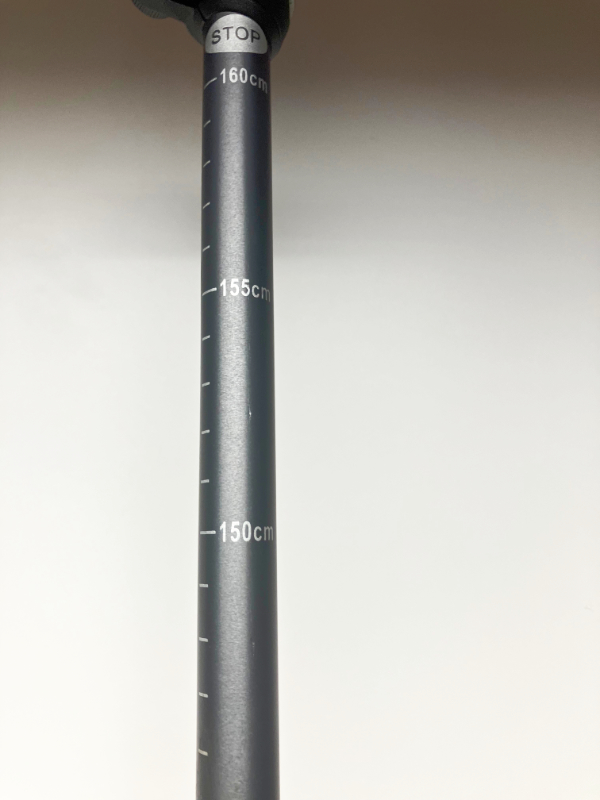
On two of my shelters the most common heights are 49 inches (Six Moon Designs Deschutes CF) and 51 inches (Mountain Laurel Designs Trailstar). So I’ll just paint markings on the lower tube for these adjustments.
Tip
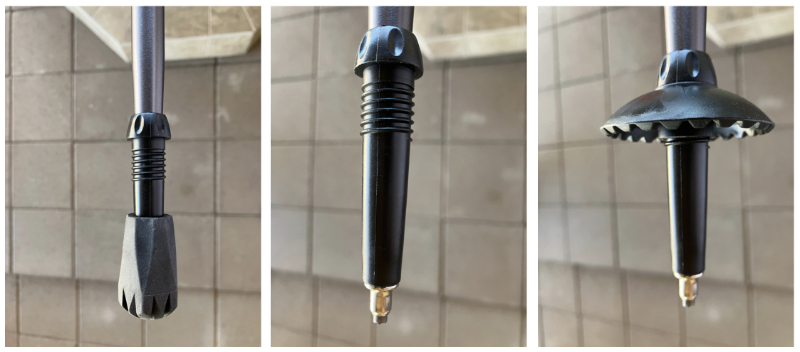
Tungsten Carbide tip with removable protection cap. Like my Tracks staff, I’ll hike with the rubber cap in place most of the time. Replacement caps are available from ALPS Mountaineering and probably most trekking pole caps will work. I’ll experiment later.
The pole comes with an accessory basket and appears to be a standard size, so many different basket types will work. I don’t have any need for a basket on my hiking staffs. For snowshoe work I just bring my Black Diamond Alpine Cork adjustable trekking poles — the only time I use trekking poles these days.
Summary
So far the pole looks like it will be a good replacement for my Tracks Hiking Staff. The only concern is the EVA Foam grip may not last 40 years (and I won’t last another 40 years either!).
This website may be compensated for linking to other sites for sales of products. As an Amazon Associate I earn a small fee from qualifying purchases at no additional cost to the purchaser.