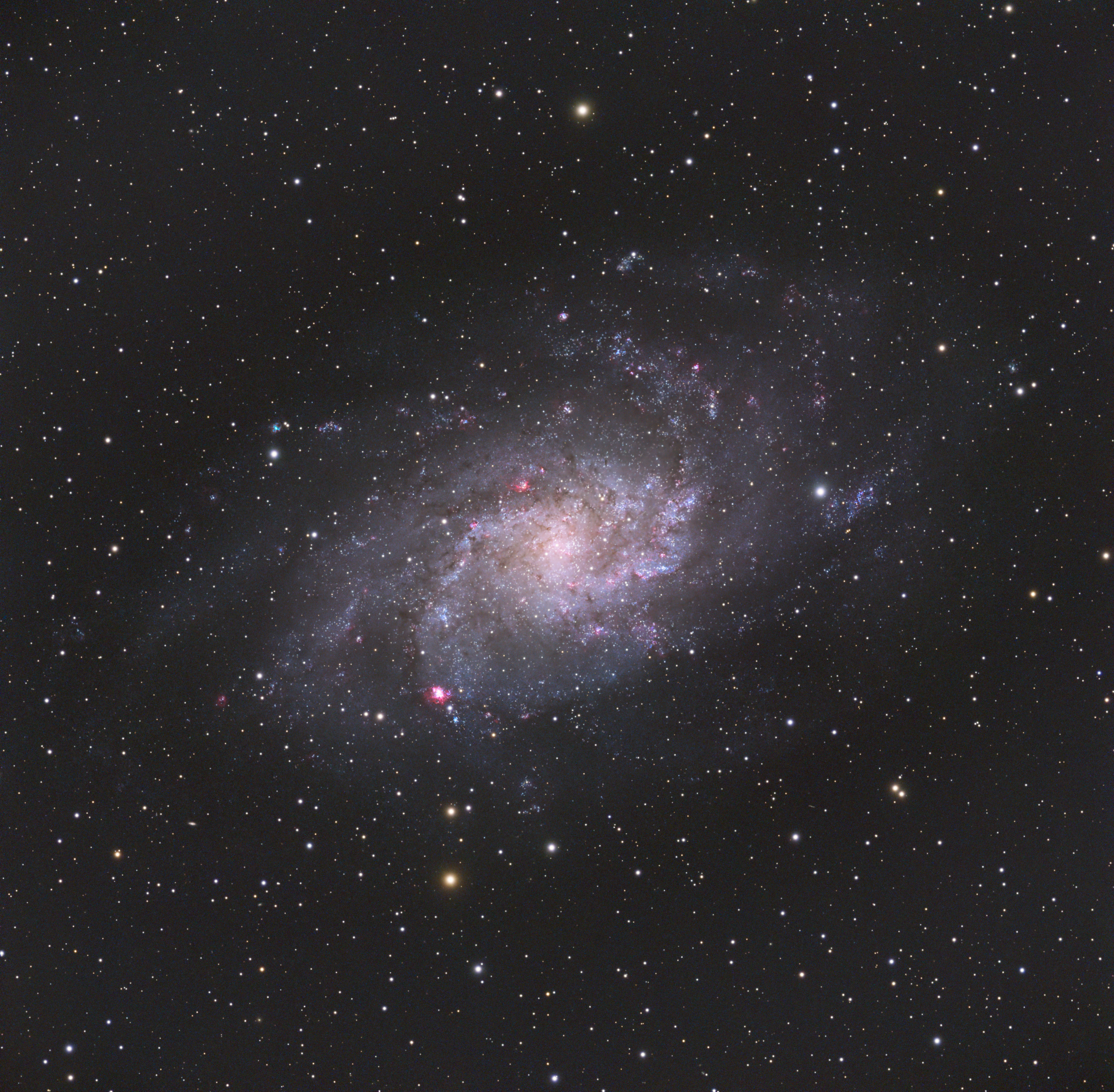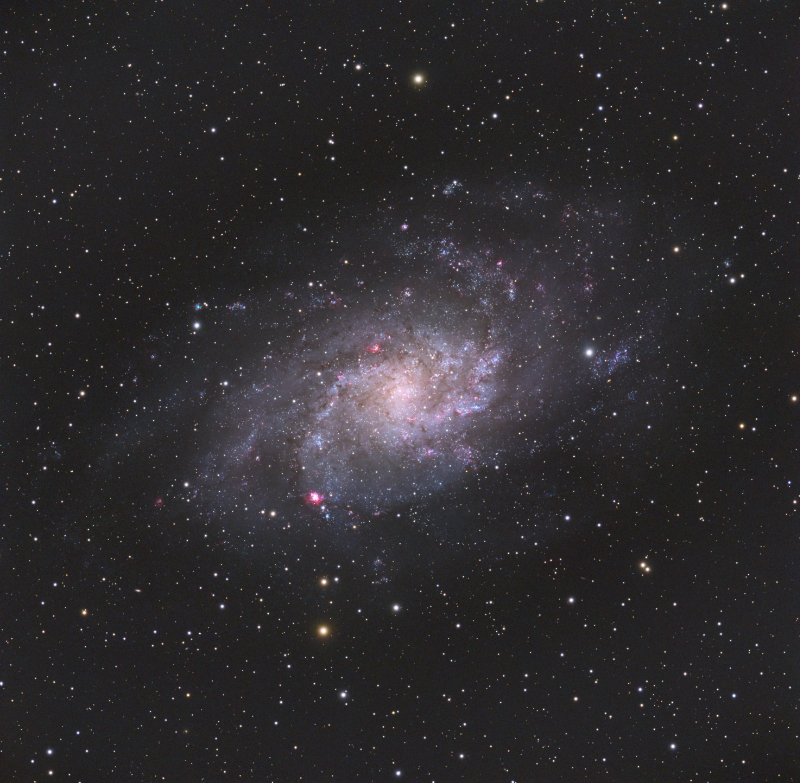
CLICK ON IMAGE TO VIEW A HIGH RESOLUTION VERSION
The Triangulum Galaxy (M33) is a stunning spiral galaxy located about 3 million light-years away in the constellation Triangulum. It is the third-largest member of our Local Group of galaxies, which includes the Milky Way and the Andromeda Galaxy (M31). M33 is notable for its loosely wound spiral arms, abundant star-forming regions, and a relatively small, bright central core.
With a diameter of roughly 60,000 light-years, M33 is smaller than both the Milky Way and Andromeda, but it is rich in young blue stars, nebulae, and open clusters, giving it a vibrant, patchy appearance through telescopes. One of its most famous features is NGC 604, a massive star-forming nebula that shines brightly across the galaxy’s disk.
Although M33 can be seen with the naked eye from very dark skies, it is better appreciated through binoculars or a telescope, where its spiral structure and glowing star-forming regions become more apparent. Its proximity and face-on orientation make M33 an important object for studying galaxy structure, star formation, and the dynamics of the Local Group.
Technical Details
Telescope: Celestron C8 SCT (8″ Schmidt-Cassegrain) with Celestron 0.63 focal reducer
Auto Focus: Celestron Electronic Auto Focuser
Astronomy Camera: ZWO ASI533MC Pro
Filter: Optolong UV-IR cut filter; 780 exposures @ 60 seconds each (11 hours)
Filter: Antlia ALP-T Dual Narrowband (Ha & Oiii) filter; 60 exposures @ 5 minutes each (5hours)
Total Integration Time: 16 hours
Off-Axis Auto Guiding: ZWO OAG-L
Auto Guiding Camera: ZWO ASI174MM Mini Guide Camera
Auto Guiding Software: PHD2
Telescope Mount: Sky- Watcher EQ6-R Pro
Telescope Computer: BeeLink GK-55 Mini PC / Windows 10 Pro
Wireless Communication: GL-iNEt Beryl Travel Router
Telescope Control & Image Capture Software: Nighttime Imaging ‘N’ Astronomy (N.I.N.A.)
Image Integration Software: Astro Pixel Process, by Aries Productions
Image Post Processing Software: PixInsight, by Pleiades Astrophoto
Images captured in Eastern Mojave Desert, CA during Oct 2024. Dark sky classification = Bright suburban sky (Bortle 6)
Visited 41 times, 1 visit(s) today