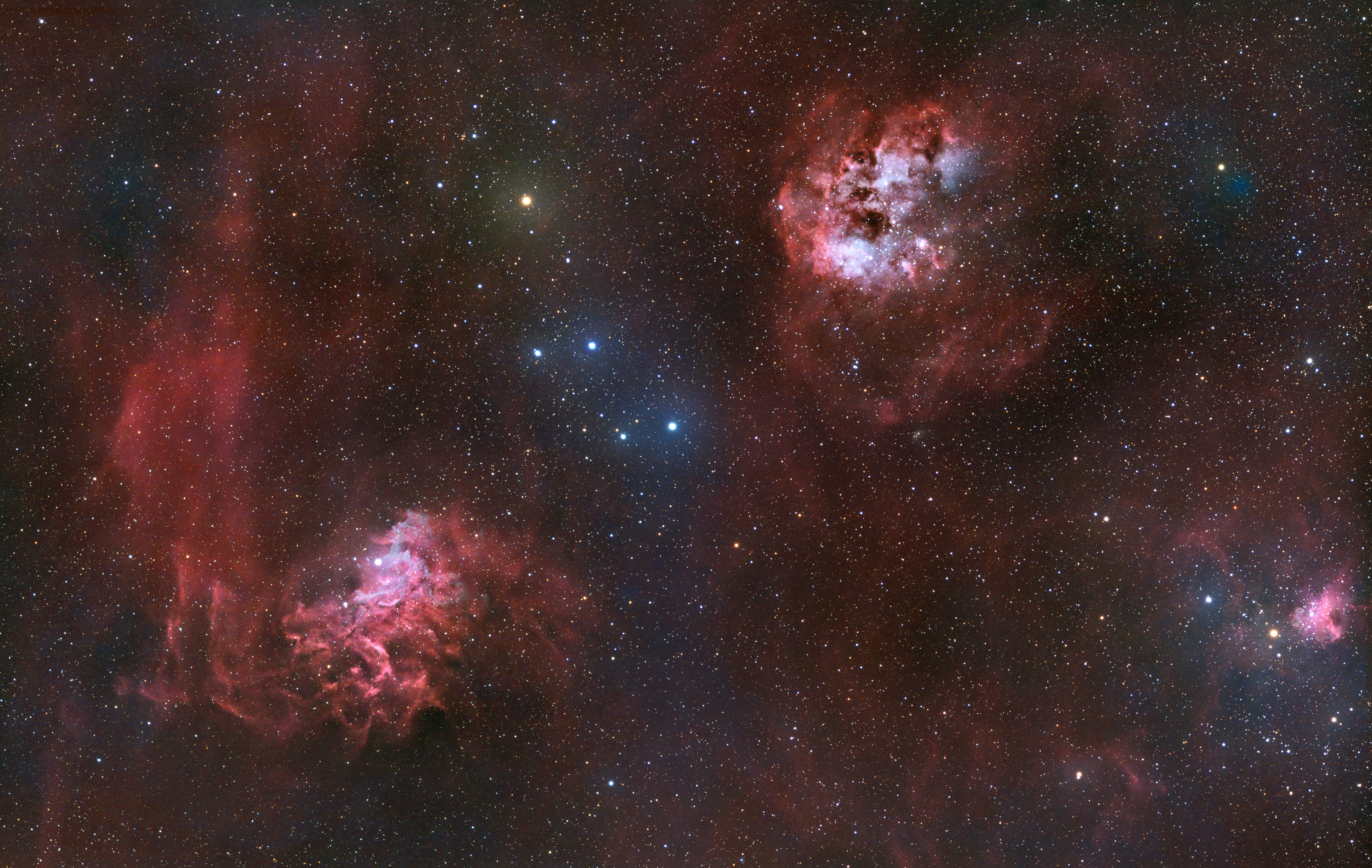
CLICK ON IMAGE TO VIEW A HIGH RESOLUTION VERSION
IC 405, commonly known as the Flaming Star Nebula, is a striking emission and reflection nebula located in the constellation Auriga. It lies roughly 1,500 light-years from Earth and spans about five light-years across, forming a dramatic tapestry of glowing gas and dark dust lanes.
The nebula is illuminated by the hot, runaway star AE Aurigae, whose intense ultraviolet radiation excites surrounding hydrogen gas, causing it to glow a deep red in H-alpha light. At the same time, interstellar dust scatters the star’s blue light, creating sweeping arcs of blue reflection nebulosity that appear to flicker like flames—giving the nebula its evocative name.
IC 405 is a region of active stellar interaction rather than star birth alone. Powerful stellar winds from AE Aurigae are sculpting the nebula’s structure, carving out filaments and shock fronts while compressing nearby material. Dark dust clouds weave through the glowing gas, adding depth and contrast to the scene.
Often imaged in narrowband and broadband astrophotography, the Flaming Star Nebula reveals a rich interplay of color, motion, and energy—an elegant example of how massive stars shape and illuminate the interstellar medium around them.
IC 410, often called the Tadpoles Nebula, is a striking emission nebula located about 12,000 light-years away in the constellation Auriga. This vast cloud of glowing hydrogen surrounds the young open star cluster NGC 1893, whose hot, massive stars flood the region with intense ultraviolet radiation. Their energy causes the nebula to shine in rich shades of red, while also sculpting its complex structure.
The nebula’s most famous features are the two elongated pillars of gas and dust known as the “tadpoles.” Stretching several light-years in length, these dark, sinuous shapes are stellar nurseries in the making—dense regions where gravity may eventually trigger the birth of new stars. Stellar winds and radiation from the cluster erode these pillars over time, carving them into their distinctive forms.
Against the backdrop of Auriga’s star fields, IC 410 is both delicate and dynamic, showcasing the powerful interplay between star formation and destruction. It stands as a vivid example of how young stars can transform their environment, leaving behind a cosmic landscape that is as beautiful as it is transient.
Technical Details
Two 4-panel mosaics combined (HOORGB)
Mosaic #1:
WO Zenithstar 61ii
ZWO ASI183MC Pro
Antlia ALP-T Narrow Band
WO 32mm guide scope
ZWO 120MM mini guide scope
ZWO EAF
Celestron CGX
Each panel = 72 X 300sec @ 111gain (6 hours each panel)
Mosaic #2:
Esprit 100ED
ZWO ASI071MC Pro
Optolong UV-IR cut filter
WO 50mm guide scope
ZWO 120MM mini guide scope
ZWO EAF
EQ6-R Pro mount
Each panel = 360 X 60sec @ 94gain (6 hours each panel)
Integrated with Astro Pixel Processor
Post Processing with PixInsight
RGB stars
Combined HOO with RGB for starless image