CLICK ON IMAGE TO VIEW A HIGH RESOLUTION VERSION
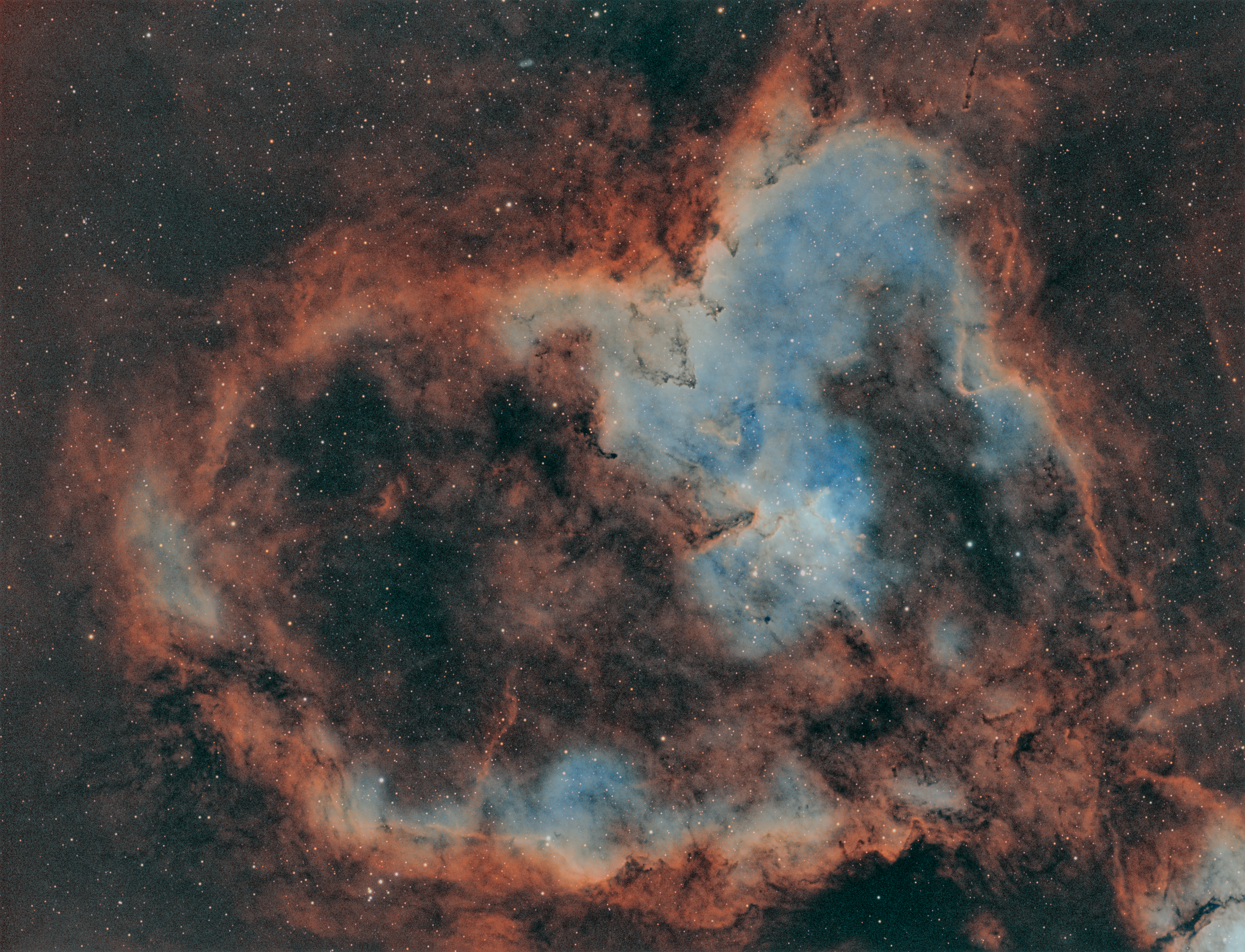
The IC 1805 Heart Nebula is a vast region of glowing gas and dust in the constellation Cassiopeia, its unmistakable heart-like shape etched across the Milky Way. Spanning roughly 150 light-years, this emission nebula lies about 7,500 light-years from Earth and shines primarily in deep reds from ionized hydrogen, energized by intense ultraviolet radiation from young, massive stars.
At the core of the nebula is the open star cluster Melotte 15, whose hot, newly formed stars sculpt the surrounding clouds into intricate ridges, pillars, and dark cavities. Stellar winds and radiation carve out sinuous filaments and towering walls of gas, revealing an ongoing story of star birth and cosmic erosion. Pockets of darker dust trace the boundaries where gravity and radiation compete, hinting at future generations of stars still hidden within the clouds.
Often imaged together with its neighboring Soul Nebula (IC 1848), the Heart Nebula is a favorite target for wide-field astrophotography. Its rich structure, dramatic contrast, and symbolic form make it both scientifically compelling and visually evocative—a luminous reminder of the dynamic processes that shape our galaxy.
Technical Details
Telescope: Sky-Watcher Esprit 100ED Refractor
Auto Focus: ZWO Electronic Auto Focuser
Astronomy Camera: ZWO ASI071MC Pro
Filter: Antlia ALP-T Dual Narrowband Ha/Oiii Filter; 300 exposures @ 5 minutes each (25 hours)
Total Integration Time: 25 hours
Auto Guiding: William Optics Uniguide 50mm Guide Scope
Auto Guiding Camera: ZWO ASI120MM Mini Guide Camera
Auto Guiding Software: PHD2
Telescope Mount: Sky- Watcher EQ6-R Pro Equatorial Mount
Telescope Computer: BeeLink GK-55 Mini PC / Windows 10 Pro
Wireless Communication: GL-iNEt Beryl Travel Router
Telescope Control & Image Capture Software: Nighttime Imaging ‘N’ Astronomy (N.I.N.A.)
Image Integration Software: Astro Pixel Process, by Aries Productions
Image Post Processing Software: PixInsight, by Pleiades Astrophoto
Images captured:
Palm Springs, CA during October 2022. Dark sky classification = Bright suburban sky (Bortle 6)