CLICK ON IMAGE TO VIEW A HIGH RESOLUTION VERSION
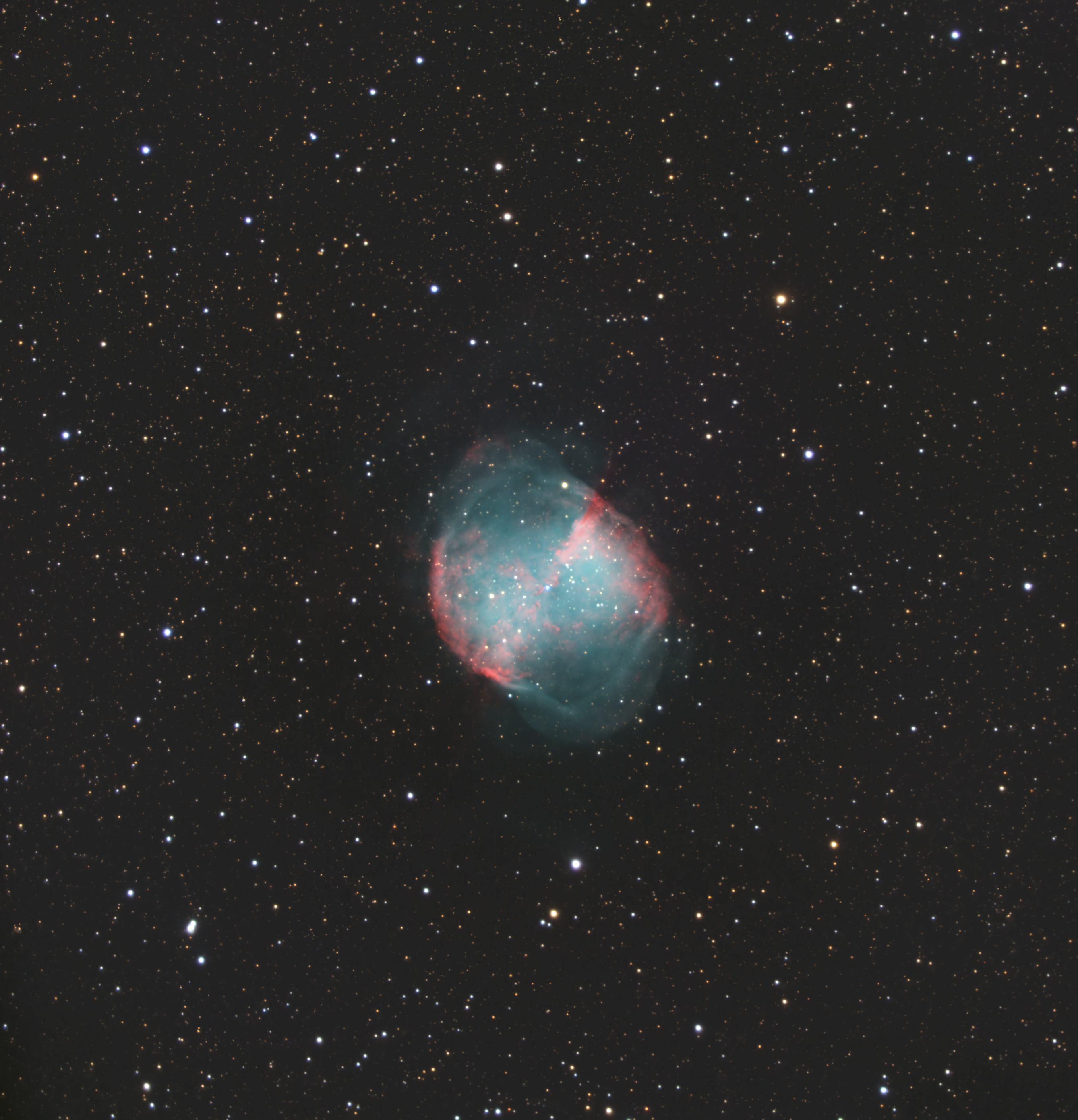
The M27 Dumbbell Nebula, also known as the Apple Core Nebula, is one of the brightest and best-known planetary nebulae in the night sky. Located about 1,300 light-years away in the constellation Vulpecula, it was the first planetary nebula ever discovered, identified by Charles Messier in 1764.
M27 marks the final evolutionary stage of a Sun-like star. As the star exhausted its nuclear fuel, it shed its outer layers into space, forming the nebula’s distinctive dumbbell or hourglass shape. At its center lies a hot white dwarf whose intense ultraviolet radiation causes the surrounding gas to glow in vivid hues of red hydrogen emission and blue-green oxygen.
Delicate filaments, knots, and faint outer halos reveal the complex interactions between stellar winds and expanding gas over tens of thousands of years. Through telescopes and astrophotography, M27 displays remarkable structure and depth, offering a striking glimpse into the future fate of our own Sun and a beautiful example of stellar death giving rise to cosmic art.
Technical Details
Telescope: Celestron C8 SCT (8″ Schmidt-Cassegrain) with Celestron 0.63 Focal Reducer
Auto Focus: Celestron Electronic Auto Focuser
Astronomy Camera: ZWO ASI533MC Pro
Filter: Optolong UV-IR cut filter; 324 exposures @ 60 seconds each (5.4 hours)
Filter: Antlia ALP-T Dual Narrowband Ha/Oiii Filter; 100 exposures @ 5 minutes each (8.3 hours)
Total Integration Time: 13.7 hours
Off-Axis Auto Guiding: ZWO OAG-L
Auto Guiding Camera: ZWO ASI174MM Mini Guide Camera
Telescope Mount: Sky- Watcher EQ6-R Pro Equatorial Mount
Telescope Computer: BeeLink GK-55 Mini PC / Windows 10 Pro
Wireless Communication: GL-iNEt Beryl Travel Router
Telescope Control & Image Capture Software: Nighttime Imaging ‘N’ Astronomy (N.I.N.A.)
Image Integration Software: Astro Pixel Process, by Aries Productions
Image Post Processing Software: PixInsight, by Pleiades Astrophoto
Images captured in Palm Springs, CA during October 2023. Dark sky classification = Bright suburban sky (Bortle 6).