CLICK ON IMAGE TO VIEW A HIGH RESOLUTION VERSION
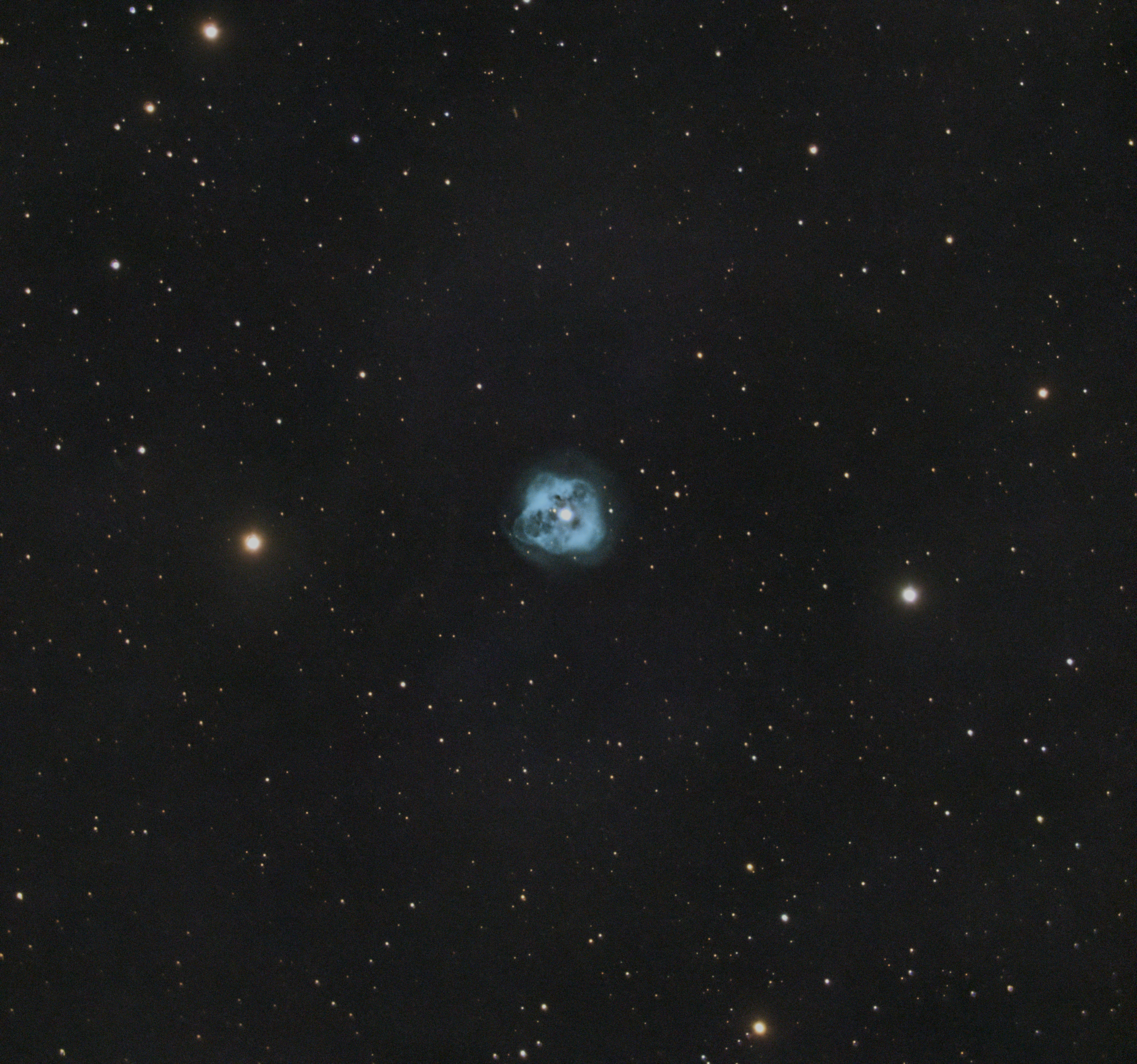
NGC 1514, known as the Crystal Ball Nebula, is a striking planetary nebula located about 1,500 light-years away in the constellation Taurus. Its nickname comes from its translucent, bubble-like appearance, with a softly glowing spherical shell that seems to float against the star-filled background.
At the heart of the nebula lies an unusual binary star system, whose complex interactions have shaped the nebula’s symmetrical form. The central stars illuminate the expanding clouds of gas that were gently shed during the final stages of stellar evolution. These gases glow primarily in blues and subtle reds, revealing delicate internal structures and faint outer halos that hint at multiple episodes of mass loss.
NGC 1514 stands out for its clarity and balance—less chaotic than many planetary nebulae, yet rich in detail upon close inspection. Often overlooked compared to brighter showpieces, the Crystal Ball Nebula offers a serene and elegant glimpse into the fate awaiting Sun-like stars, making it a rewarding target for both visual observers and astrophotographers alike.
Technical Details
Telescope: Celestron C8 SCT (8″ Schmidt-Cassegrain) with Celestron 0.63 Focal Reducer
Auto Focus: Celestron Electronic Auto Focuser
Astronomy Camera: ZWO ASI533MC Pro
Filter: Optolong UV-IR cut filter; 600 exposures @ 60 seconds each (10 hours)
Filter: Antlia ALP-T Dual Narrowband Ha/Oiii Filter; 120 exposures @ 5 minutes each (10 hours)
Total Integration Time: 20 hours
Off-Axis Auto Guiding: ZWO OAG-L
Auto Guiding Camera: ZWO ASI174MM Mini Guide Camera
Telescope Mount: Sky- Watcher EQ6-R Pro Equatorial Mount
Telescope Computer: BeeLink GK-55 Mini PC / Windows 10 Pro
Wireless Communication: GL-iNEt Beryl Travel Router
Telescope Control & Image Capture Software: Nighttime Imaging ‘N’ Astronomy (N.I.N.A.)
Image Integration Software: Astro Pixel Process, by Aries Productions
Image Post Processing Software: PixInsight, by Pleiades Astrophoto
Images captured in Palm Springs, CA during November 2023. Dark sky classification = Bright suburban sky (Bortle 6).