CLICK ON IMAGE TO VIEW A HIGH RESOLUTION VERSION
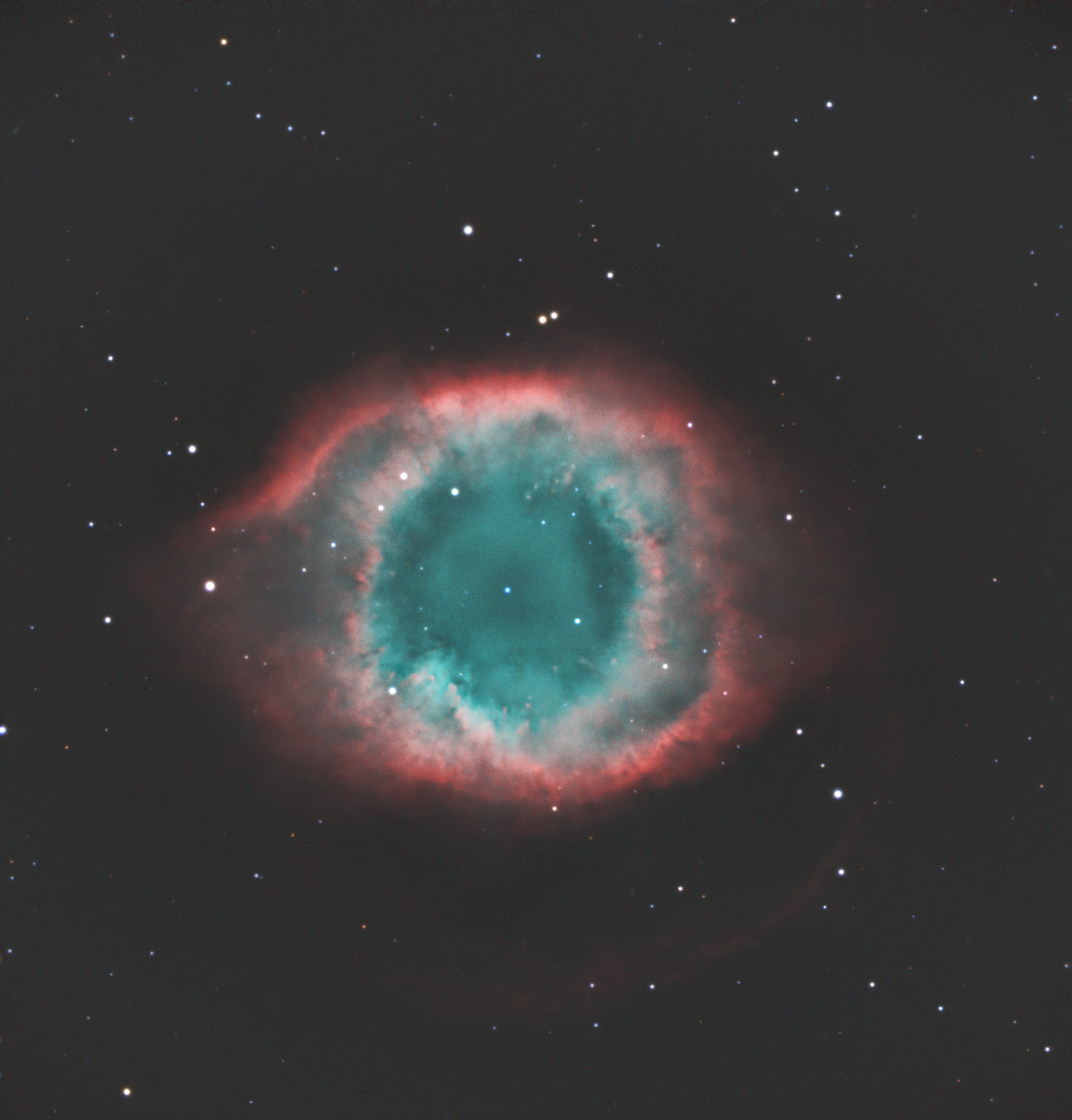
NGC 7293, famously known as the Helix Nebula, is one of the closest and most spectacular examples of a planetary nebula, located roughly 700 light-years away in the constellation Aquarius. Often nicknamed the “Eye of God” because of its striking appearance, the Helix Nebula is the glowing shell of gas expelled by a dying sun-like star.
Spanning about 2.5 light-years across, it displays a complex structure of concentric rings, wispy filaments, and comet-like knots of gas and dust, which are being sculpted by the intense radiation from the nebula’s hot central white dwarf. Its colors, often captured in astrophotography, range from vivid reds and pinks (from hydrogen emission) to greens and blues (from oxygen emission), creating an ethereal, almost three-dimensional appearance.
The Helix Nebula offers astronomers a detailed glimpse into the final stages of stellar evolution for medium-sized stars, illustrating how stars like our Sun will one day shed their outer layers, leaving behind a dense, glowing core. Its proximity and size make it a favorite target for both professional telescopes and amateur astrophotographers seeking to capture its mesmerizing beauty.
Technical Details
Telescope: Celestron C8 SCT (8″ Schmidt-Cassegrain) with Celestron 0.63 Focal Reducer
Auto Focus: Celestron Electronic Auto Focuser
Astronomy Camera: ZWO ASI533MC Pro
Filter: Optolong UV-IR cut filter; 360 exposures @ 60 seconds each (6 hours)
Filter: Optolong Lenhance Dual Narrowband Ha/Oiii Filter; 210 exposures @ 5 minutes each (17.5 hours)
Total Integration Time: 23.5 hours
Off-Axis Auto Guiding: ZWO OAG-L
Auto Guiding Camera: ZWO ASI174MM Mini Guide Camera
Telescope Mount: Sky- Watcher EQ6-R Pro Equatorial Mount
Telescope Computer: BeeLink GK-55 Mini PC / Windows 10 Pro
Wireless Communication: GL-iNEt Beryl Travel Router
Telescope Control & Image Capture Software: Nighttime Imaging ‘N’ Astronomy (N.I.N.A.)
Image Integration Software: Astro Pixel Process, by Aries Productions
Image Post Processing Software: PixInsight, by Pleiades Astrophoto
Images captured in Palm Springs, CA during September, 2024. Dark sky classification = Bright suburban sky (Bortle 6).