CLICK ON IMAGE TO VIEW A HIGH RESOLUTION VERSION
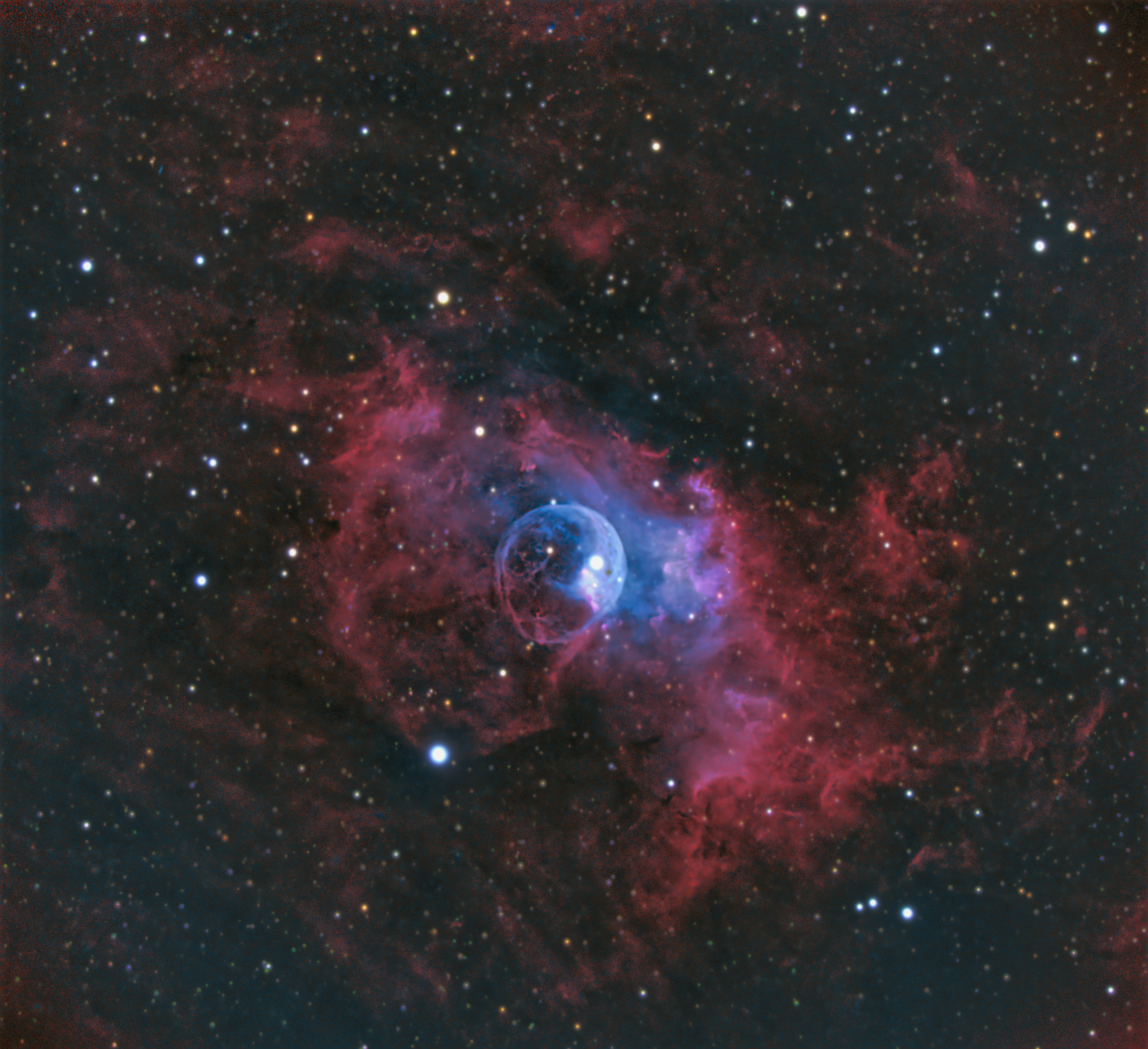
NGC 7635 – The Bubble Nebula is a striking emission nebula located in the constellation Cassiopeia, roughly 7,100 light-years away from Earth. Its most distinctive feature is the enormous, spherical “bubble” of gas and dust, inflated by the powerful stellar wind from a massive, hot O-type star at its center, known as BD+60°2522. The bubble measures about 10 light-years across, glowing vividly as ultraviolet radiation from the central star excites the surrounding hydrogen gas.
The nebula’s surroundings are equally fascinating. Dense molecular clouds and dark dust lanes create a dramatic contrast against the luminous bubble, giving it a sculpted, almost three-dimensional appearance in astrophotography. The interaction between the stellar wind and the interstellar medium produces complex shapes, ripples, and bright edges, making the Bubble Nebula a favorite target for both amateur and professional astronomers.
Visible through medium-sized telescopes, NGC 7635 shines with a soft red hue from ionized hydrogen, while long-exposure images reveal intricate filaments and knots that hint at the turbulent forces shaping this cosmic masterpiece.
Technical Details
Telescope: Celestron C8 SCT (8″ Schmidt-Cassegrain) with Celestron 0.63 Focal Reducer
Auto Focus: Celestron Electronic Auto Focuser
Astronomy Camera: ZWO ASI533MC Pro
Filter: Optolong UV-IR cut filter; 360 exposures @ 60 seconds each (6 hours)
Filter: Optolong Lenhance Dual Narrowband Ha/Oiii Filter; 230 exposures @ 5 minutes each (19.2 hours)
Total Integration Time: 25.2 hours
Off-Axis Auto Guiding: ZWO OAG-L
Auto Guiding Camera: ZWO ASI174MM Mini Guide Camera
Telescope Mount: Sky- Watcher EQ6-R Pro Equatorial Mount
Telescope Computer: BeeLink GK-55 Mini PC / Windows 10 Pro
Wireless Communication: GL-iNEt Beryl Travel Router
Telescope Control & Image Capture Software: Nighttime Imaging ‘N’ Astronomy (N.I.N.A.)
Image Integration Software: Astro Pixel Process, by Aries Productions
Image Post Processing Software: PixInsight, by Pleiades Astrophoto
Images captured in Palm Springs, CA July 2024. Dark sky classification = Bright suburban sky (Bortle 6).