CLICK ON IMAGE TO VIEW A HIGH RESOLUTION VERSION
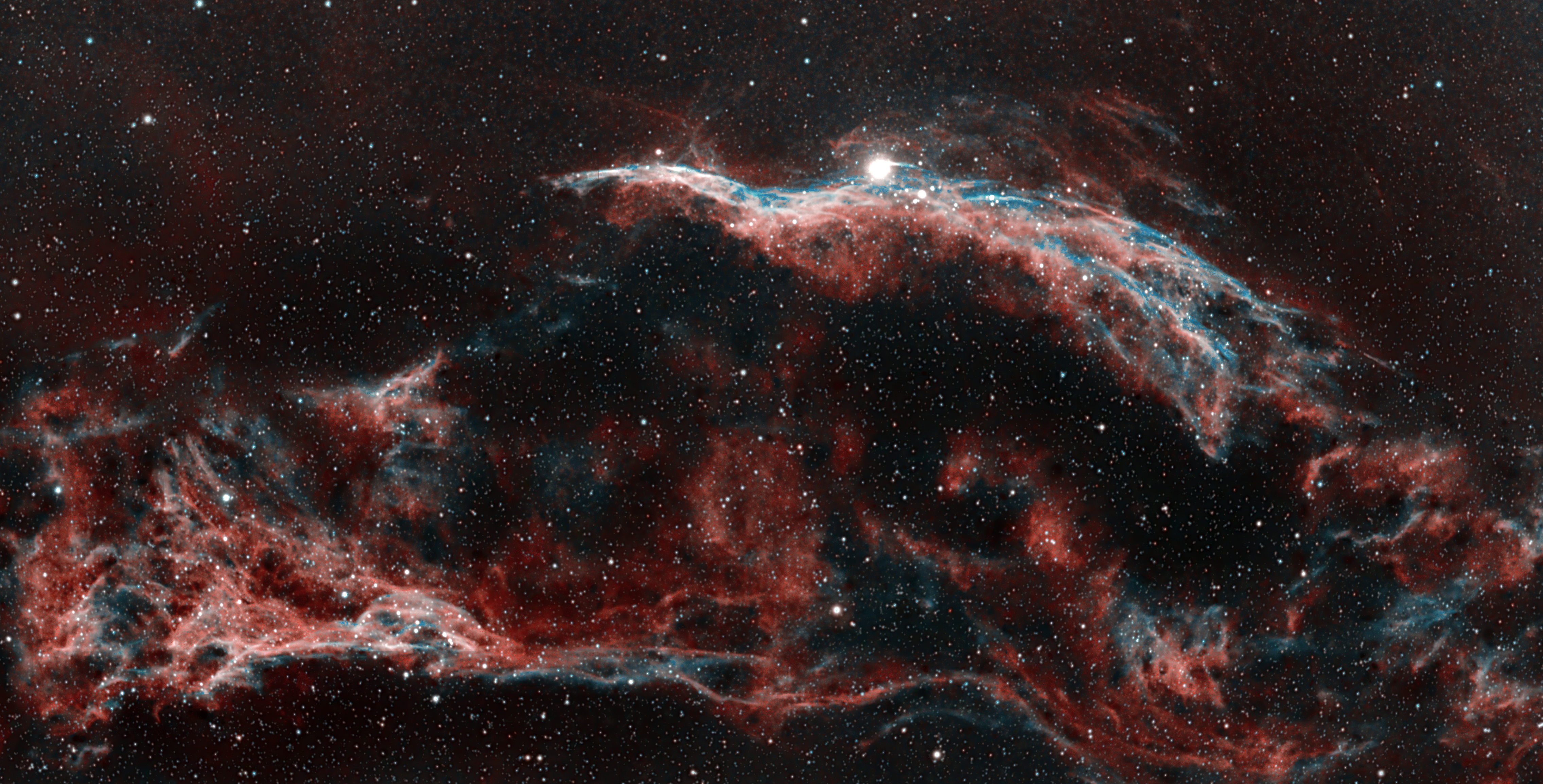
NGC 6992, known as the Eastern Veil Nebula, is a stunning and intricate portion of the larger Veil Nebula, a supernova remnant located in the constellation Cygnus. This nebula represents the expanding remains of a massive star that exploded thousands of years ago, scattering delicate filaments of ionized gas across space.
The Eastern Veil is especially notable for its wispy, lace-like structures, glowing in vivid reds from hydrogen emissionand blues from oxygen emission, which create a striking contrast against the dark backdrop of the Milky Way. Its intricate filaments and arcs give it an almost ethereal appearance, as if painted with cosmic brushstrokes.
At a distance of roughly 2,400 light-years from Earth, NGC 6992 spans several light-years across, making it a favorite target for astrophotographers who capture its complex, glowing tendrils. The nebula’s beauty is not only visual—it also provides astronomers with insight into the dynamics of supernova explosions and the behavior of interstellar gas.
Technical Details
Telescope: William Optics Zenithstar 61ii Refractor
Auto Focus: ZWO Electronic Auto Focuser
Astronomy Camera: ZWO ASI071MC Pro
Filter: Optolong Lenhance Dual Narrowband Ha/Oiii Filter; 120 exposures @ 5 minutes each (10 hours)
Total Integration Time: 10 hours
Auto Guiding: William Optics Uniguide 32mm Guide Scope
Auto Guiding Camera: ZWO ASI120MM Mini Guide Camera
Auto Guiding Software: PHD2
Telescope Mount: Celestron CGX Equatorial Mount
Telescope Computer: BeeLink GK-55 Mini PC / Windows 10 Pro
Wireless Communication: GL-iNEt Beryl Travel Router
Telescope Control & Image Capture Software: Nighttime Imaging ‘N’ Astronomy (N.I.N.A.)
Image Integration Software: Astro Pixel Process, by Aries Productions
Image Post Processing Software: PixInsight, by Pleiades Astrophoto
Images captured: Palm Springs, CA during August 2021. Dark sky classification = Bright suburban sky (Bortle 6)