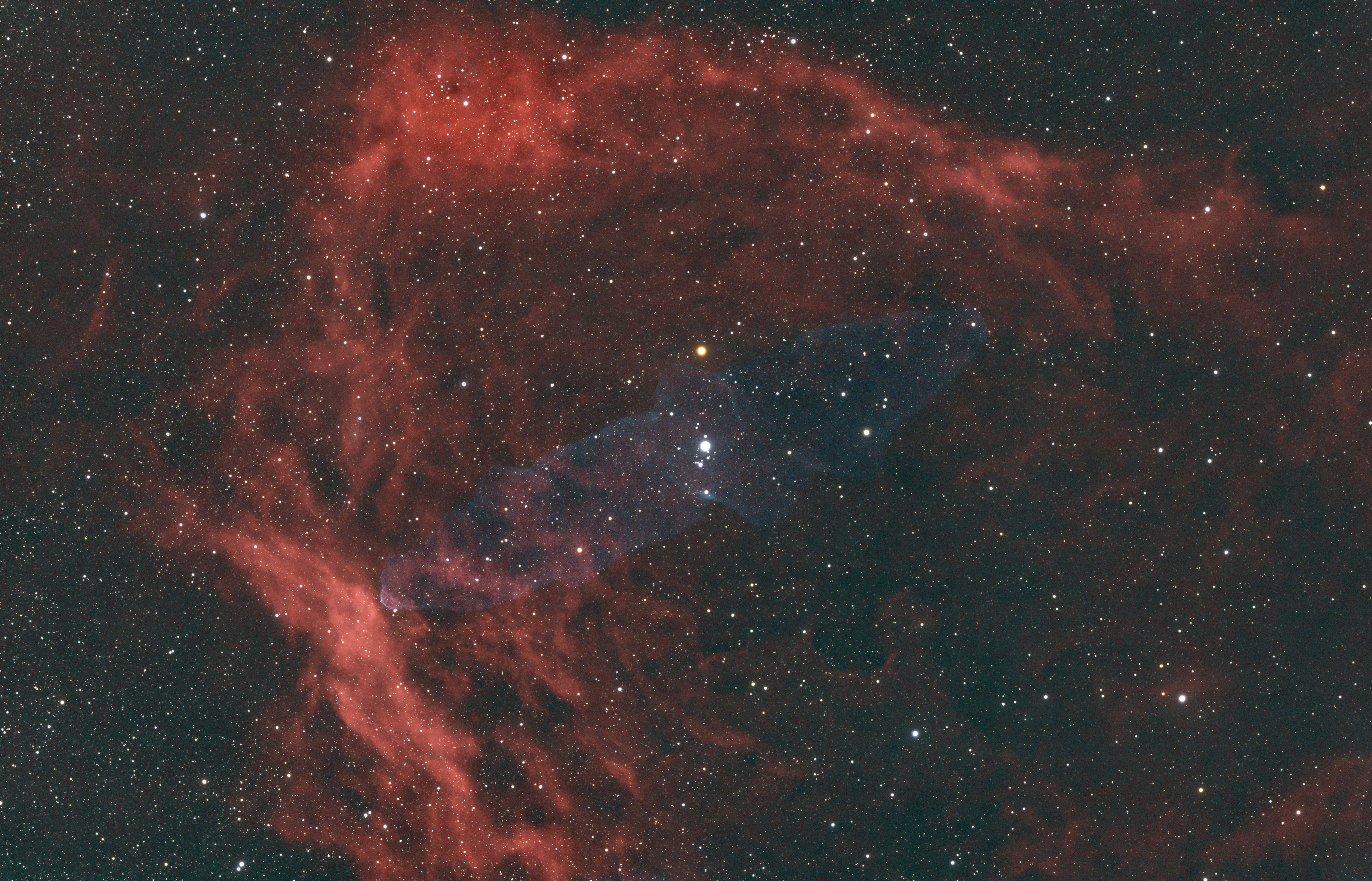
CLICK ON IMAGE TO VIEW A HIGH RESOLUTION VERSION
Sh2-129, commonly known as the Flying Bat Nebula, is a vast and faint emission nebula located in the constellation Cepheus, roughly 1,600 light-years from Earth. Spanning several degrees of sky, its sweeping wings and arched structure give it the unmistakable silhouette of a bat in flight when captured in deep, wide-field images.
This nebula is composed primarily of glowing hydrogen gas, energized by radiation from nearby hot stars. Its low surface brightness makes Sh2-129 a challenging target visually, but long-exposure astrophotography reveals intricate filaments, rippling shock fronts, and subtle variations in color that hint at complex interactions between stellar winds and the surrounding interstellar medium.
Hidden within the nebula is one of its most remarkable features: Ou4, a mysterious and enormous bipolar outflow often nicknamed the Squid Nebula. This rare structure, rich in doubly ionized oxygen, appears to burst outward from the central region of Sh2-129, adding an element of cosmic intrigue and ongoing scientific study.
Sh2-129 is a striking example of the delicate and dynamic nature of nebular structures, where stellar energy sculpts immense clouds of gas into dramatic forms, quietly shaping the future sites of star formation across the Cepheus region.
Technical Details
Telescope: Sky-Watcher Esprit 100ED Refractor
Auto Focus: ZWO Electronic Auto Focuser
Astronomy Camera: ZWO ASI071MC Pro
Filter: Optolong UV-IR cut filter; 180 exposures @ 60 seconds each (3 hours)
Filter: Antlia ALP-T Dual Narrowband Ha/Oiii Filter; 600 exposures @ 5 minutes each (50 hours)
Total Integration Time: 53 hours
Auto Guiding: William Optics Uniguide 50mm Guide Scope
Auto Guiding Camera: ZWO ASI120MM Mini Guide Camera
Auto Guiding Software: PHD2
Telescope Mount: Sky- Watcher EQ6-R Pro Equatorial Mount
Telescope Computer: BeeLink GK-55 Mini PC / Windows 10 Pro
Wireless Communication: GL-iNEt Beryl Travel Router
Telescope Control & Image Capture Software: Nighttime Imaging ‘N’ Astronomy (N.I.N.A.)
Image Integration Software: Astro Pixel Process, by Aries Productions
Image Post Processing Software: PixInsight, by Pleiades Astrophoto
Images captured: Palm Springs, CA during August 2024. Dark sky classification = Bright suburban sky (Bortle 6)