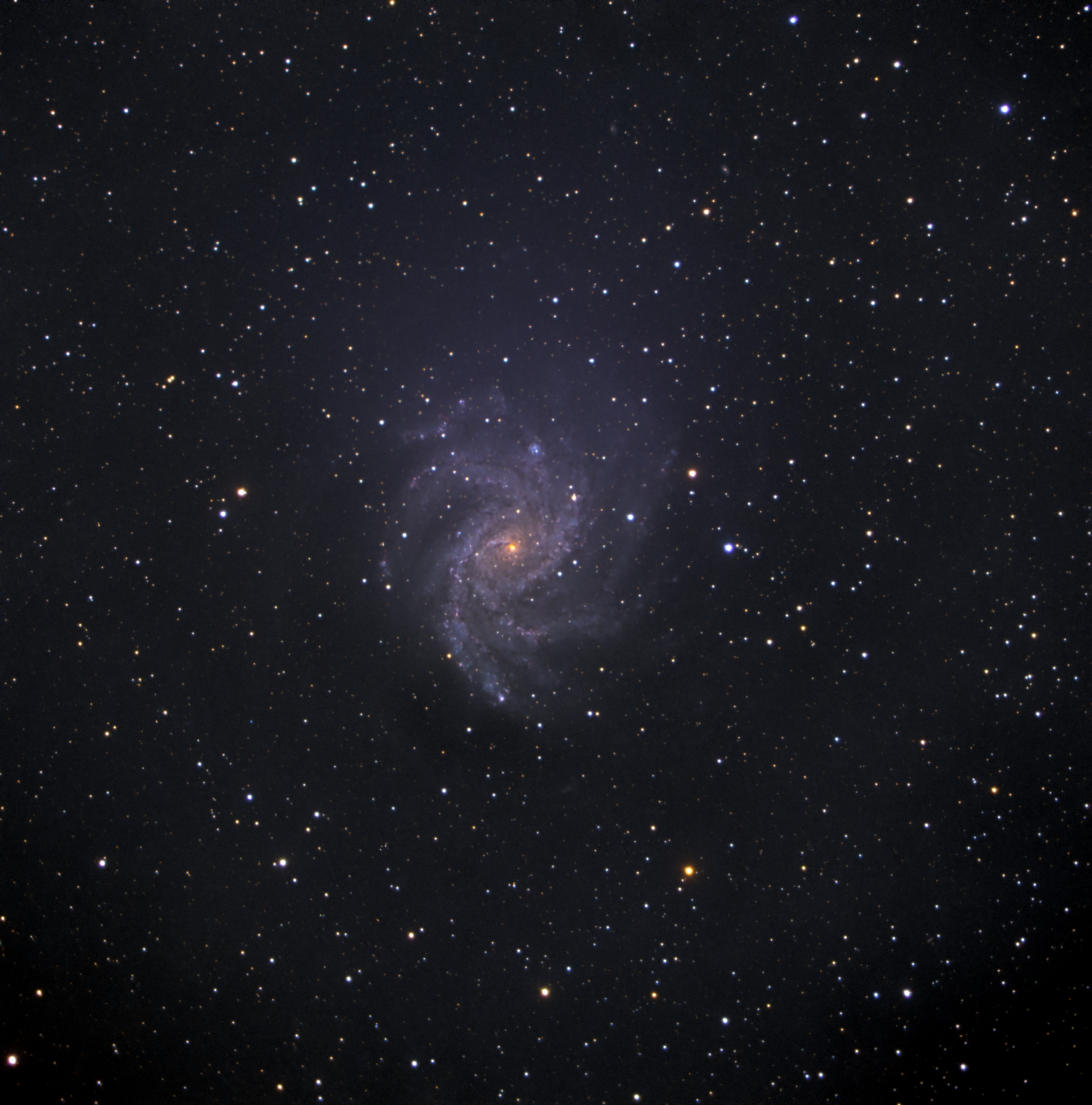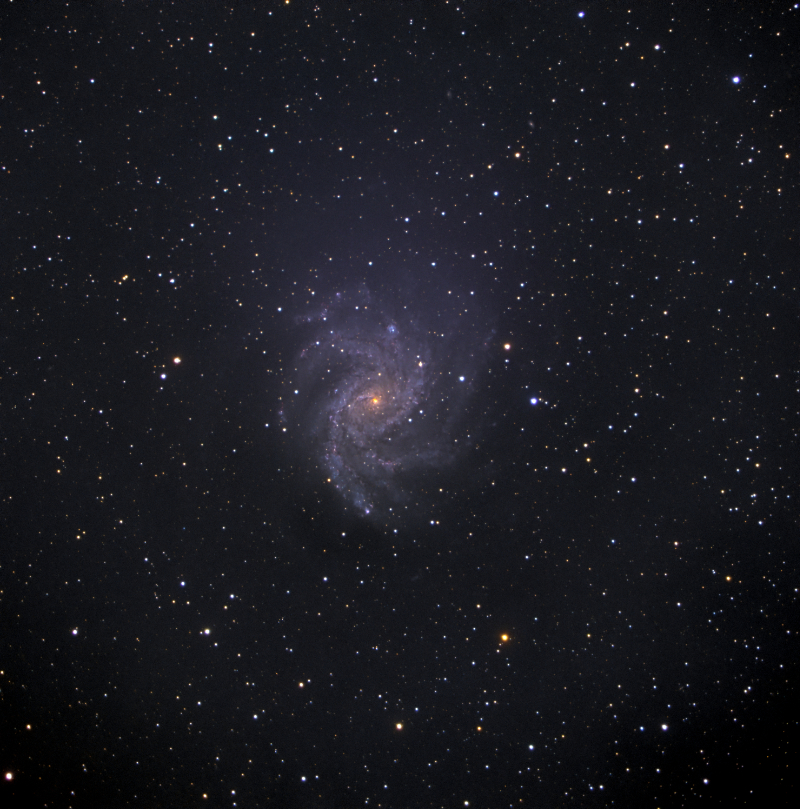
CLICK ON IMAGE TO VIEW A HIGH RESOLUTION VERSION
NGC 6946, known as the Fireworks Galaxy, is a striking face-on spiral galaxy located on the border between the constellations Cepheus and Cygnus, about 22 million light-years from Earth. Its nickname comes from an extraordinary history of stellar explosions—more supernovae have been observed here in the last century than in any other known galaxy, making it one of the most prolific star-death factories in the nearby universe.
The galaxy’s structure is rich and complex, with loosely wound spiral arms filled with glowing pink hydrogen-alpha emission regions, dark lanes of interstellar dust, and countless clusters of young, blue stars. These features reveal intense ongoing star formation, especially along the arms, where massive stars are born and quickly evolve to spectacular ends.
At its center lies a relatively small and subdued nucleus compared to many spiral galaxies, but the surrounding disk is vast and active, spanning roughly 40,000 light-years. Despite its brightness, NGC 6946 is somewhat challenging to observe because it lies close to the plane of the Milky Way, where foreground dust dims and reddens its light.
For astronomers and astrophotographers alike, the Fireworks Galaxy is a favorite target—a dynamic, energetic system that vividly illustrates the life cycle of stars and the dramatic processes shaping spiral galaxies.
Technical Details
Telescope: Celestron C8 SCT (8″ Schmidt-Cassegrain) with Celestron 0.63 Focal Reducer
Auto Focus: Celestron Electronic Auto Focuser
Astronomy Camera: ZWO ASI533MC Pro
Filter: Optolong UV-IR cut filter; 706 exposures @ 60 seconds each (11.8 hours)
Total Integration Time: 11.8 hours
Off-Axis Auto Guiding: ZWO OAG-L
Auto Guiding Camera: ZWO ASI174MM Mini Guide Camera
Telescope Mount: Sky- Watcher EQ6-R Pro Equatorial Mount
Telescope Computer: BeeLink GK-55 Mini PC / Windows 10 Pro
Wireless Communication: GL-iNEt Beryl Travel Router
Telescope Control & Image Capture Software: Nighttime Imaging ‘N’ Astronomy (N.I.N.A.)
Image Integration Software: Astro Pixel Process, by Aries Productions
Image Post Processing Software: PixInsight, by Pleiades Astrophoto
Images captured in Palm Springs, CA during December 2023. Dark sky classification = Bright suburban sky (Bortle 6).
Visited 24 times, 1 visit(s) today