CLICK ON IMAGE TO VIEW A HIGH RESOLUTION VERSION
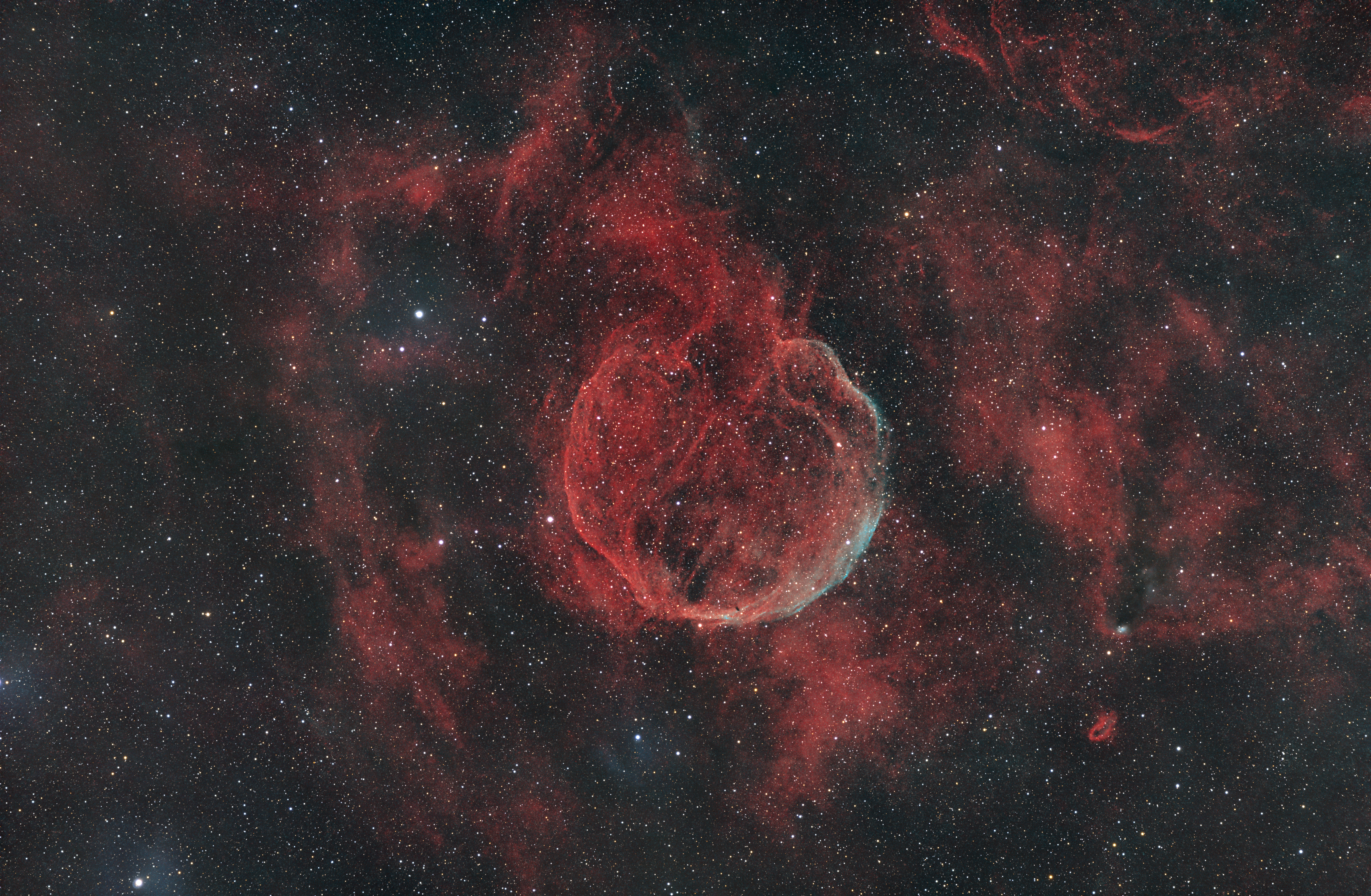
Abell 85, commonly known as the Garlic Nebula, is a faint and expansive planetary nebula drifting through the constellation Sagitta. Its whimsical nickname comes from its irregular, bulbous shape, which—when revealed through long-exposure imaging—resembles a clove of garlic floating against the star-filled background of the Milky Way.
Formed from the outer layers of a dying Sun-like star, Abell 85 represents a late and delicate stage of stellar evolution. The nebula’s ghostly shell glows subtly in hydrogen and oxygen emission, making it a challenging but rewarding target for astrophotographers. Wispy filaments and uneven arcs hint at complex mass loss and interactions with the surrounding interstellar medium as the nebula slowly disperses into space.
At its center lies a faint white dwarf—the exposed core of the original star—quietly cooling after shedding its atmosphere. Abell 85’s low surface brightness and large apparent size give it an ethereal presence, reminding us that even modest stars leave behind intricate and beautiful remnants as they reach the end of their lives.
Technical Details
Telescope: Sky-Watcher Esprit 100ED Refractor
Auto Focus: ZWO Electronic Auto Focuser
Astronomy Camera: ZWO ASI071MC Pro
Filter: Optolong UV-IR cut filter; 420 exposures @ 60 seconds each (7 hours)
Filter: Antlia ALP-T Dual Narrowband Ha/Oiii Filter; 300 exposures @ 5 minutes each (25 hours)
Total Integration Time: 32 hours
Auto Guiding: William Optics Uniguide 50mm Guide Scope
Auto Guiding Camera: ZWO ASI120MM Mini Guide Camera
Auto Guiding Software: PHD2
Telescope Mount: Sky- Watcher EQ6-R Pro
Telescope Computer: BeeLink GK-55 Mini PC / Windows 10 Pro
Wireless Communication: GL-iNEt Beryl Travel Router
Telescope Control & Image Capture Software: Nighttime Imaging ‘N’ Astronomy (N.I.N.A.)
Image Integration Software: Astro Pixel Process, by Aries Productions
Image Post Processing Software: PixInsight, by Pleiades Astrophoto
Images captured:
Palm Springs, CA during October 2024. Dark sky classification = Bright suburban sky (Bortle 6)