CLICK ON IMAGE TO VIEW A HIGH RESOLUTION VERSION
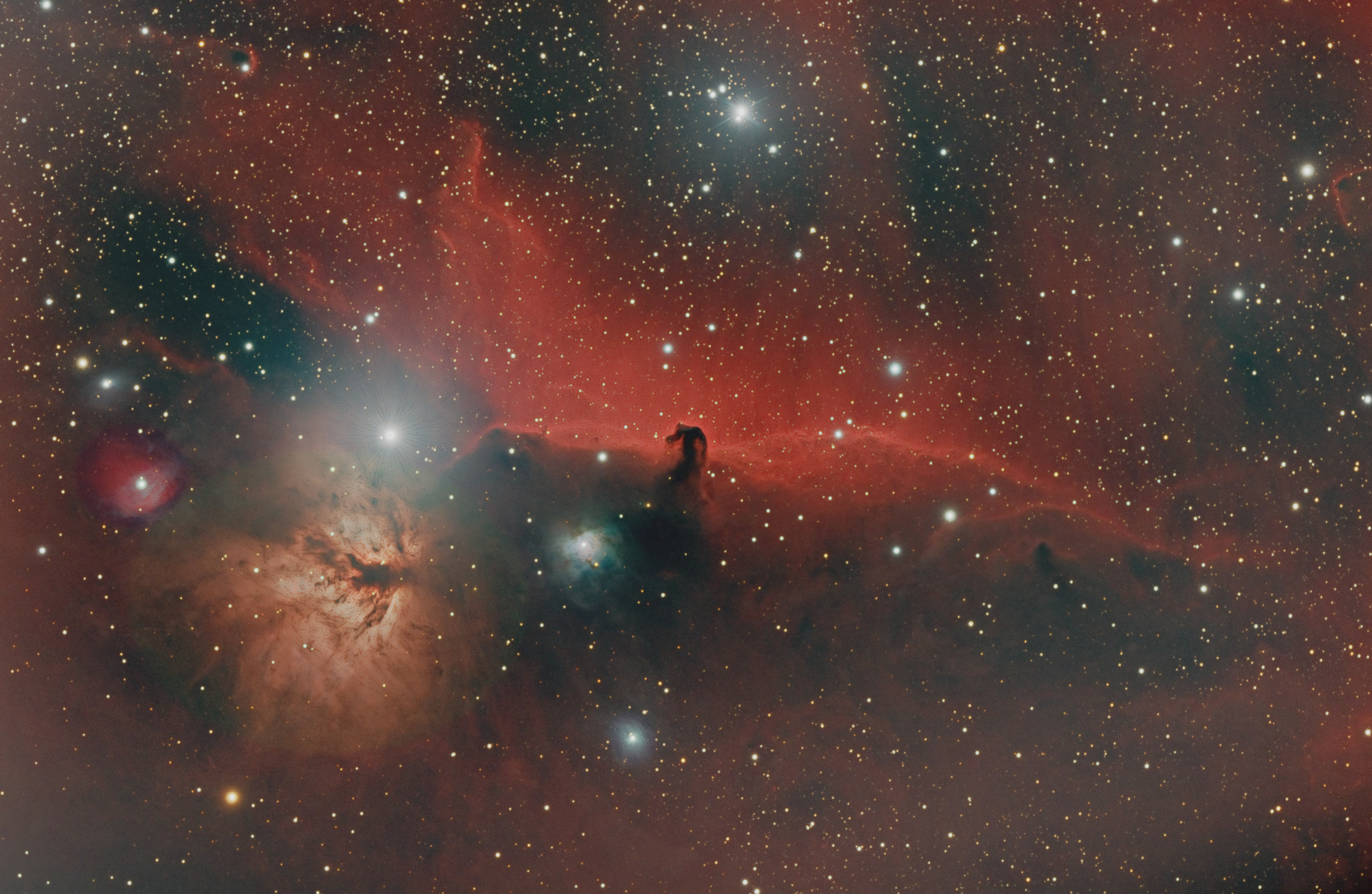
The Horsehead Nebula is one of the most recognizable and iconic dark nebulae in the night sky. Located in the constellation Orion, it lies about 1,300 light-years from Earth and forms part of the vast Orion Molecular Cloud Complex, a region rich in gas, dust, and active star formation.
Seen in silhouette against the glowing red hydrogen gas of the background nebula IC 434, the Horsehead’s distinctive shape—resembling a horse’s head and neck—comes from dense, cold clouds of dust that block visible light. This dust is the raw material for future stars, slowly sculpted by radiation and stellar winds from nearby young, massive stars.
Although visually striking in long-exposure astrophotography, the Horsehead Nebula is extremely faint to observe visually and requires dark skies and specialized filters. Over time, the intense ultraviolet radiation from nearby stars is eroding the nebula, gradually reshaping its form on cosmic timescales.
Both scientifically important and visually dramatic, the Horsehead Nebula stands as a classic example of how light and shadow reveal the dynamic processes of star birth within our galaxy.
Technical Details
Telescope: Sky-Watcher Esprit 100ED Refractor
Auto Focus: ZWO Electronic Auto Focuser
Astronomy Camera: ZWO ASI071MC Pro
Filter: Optolong UV-IR cut filter; 400 exposures @ 60 seconds each (6.66 hours)
Filter: Optolong Lenhance Dual Narrowband Ha/Oiii Filter; 132 exposures @ 5 minutes each (11 hours)
Total Integration Time: 17.66hours
Auto Guiding: William Optics Uniguide 50mm Guide Scope
Auto Guiding Camera: ZWO ASI120MM Mini Guide Camera
Auto Guiding Software: PHD2
Telescope Mount: Sky- Watcher EQ6-R Pro
Telescope Computer: BeeLink GK-55 Mini PC / Windows 10 Pro
Wireless Communication: GL-iNEt Beryl Travel Router
Telescope Control & Image Capture Software: Nighttime Imaging ‘N’ Astronomy (N.I.N.A.)
Image Integration Software: Astro Pixel Process, by Aries Productions
Image Post Processing Software: PixInsight, by Pleiades Astrophoto
Images captured:
Palm Springs, CA during November 2021. Dark sky classification = Bright suburban sky (Bortle 6)