CLICK ON IMAGE TO VIEW A HIGH RESOLUTION VERSION
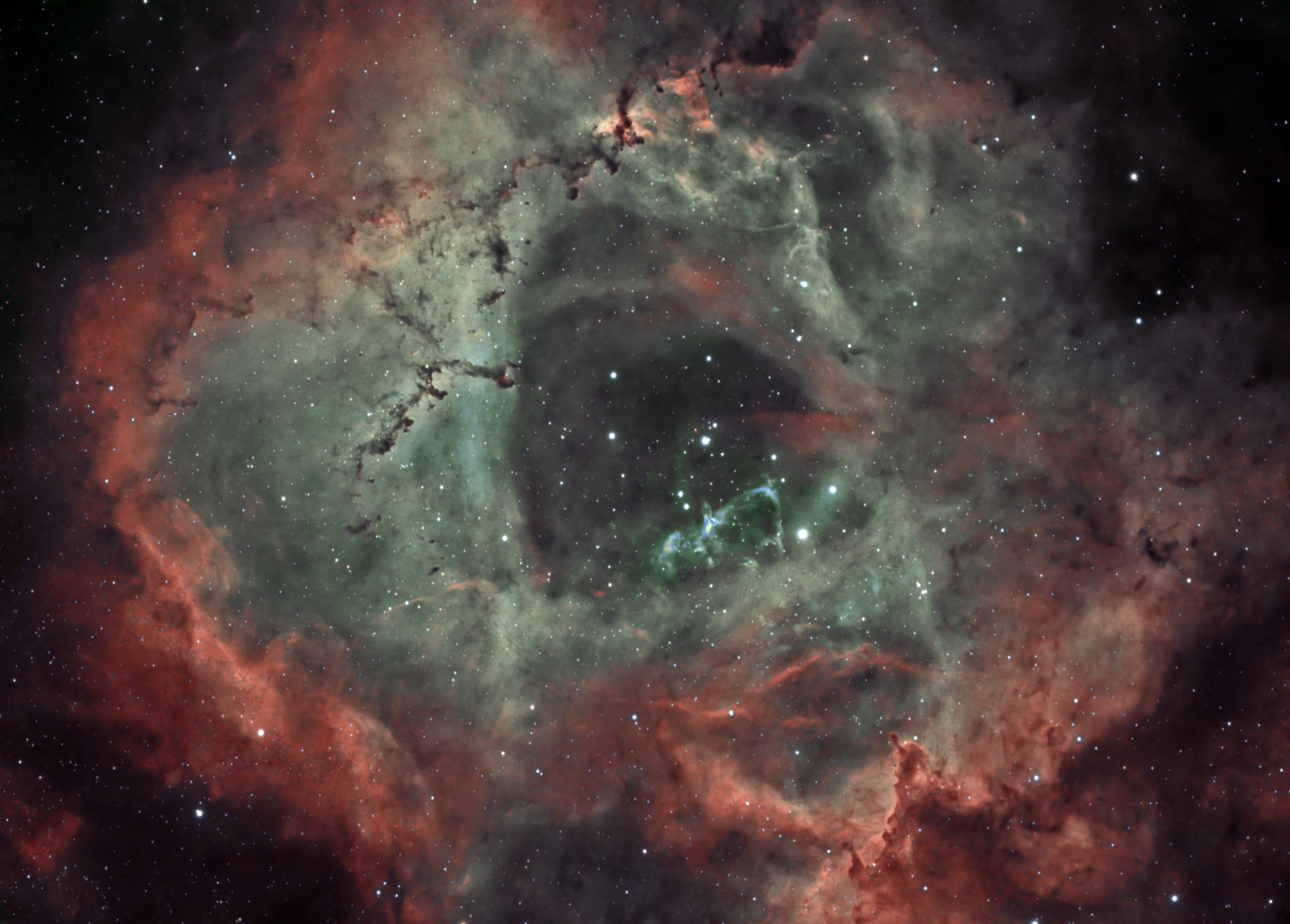
The Rosette Nebula is a vast and beautifully intricate cloud of glowing gas and dark dust located about 5,000 light-years away in the constellation Monoceros. Spanning roughly 130 light-years across, this immense emission nebula resembles the layered petals of a cosmic rose, with delicate arcs and filaments sculpted by powerful stellar forces.
At its heart lies the young open star cluster NGC 2244, whose hot, massive stars flood the surrounding hydrogen gas with intense ultraviolet radiation. This energy causes the nebula to glow a rich red in hydrogen-alpha light while also carving out a central cavity, giving the Rosette its characteristic hollowed appearance. Dark Bok globules and twisting dust lanes weave through the brighter regions, hinting at ongoing and future star formation.
To astrophotographers, the Rosette Nebula is a winter showpiece—striking in both broadband and narrowband imaging. Its combination of soft, flowing structure and dramatic contrast between light and shadow makes it a favorite target, revealing the delicate balance between stellar creation and the forces that slowly erode the clouds that gave those stars life.
Technical Details
Telescope: Sky-Watcher Esprit 100ED Refractor
Auto Focus: ZWO Electronic Auto Focuser
Astronomy Camera: ZWO ASI183MC Pro
Filter: Optolong UV-IR cut filter; 120 exposures @ 60 seconds each (2 hours) — Palm Springs, CA
Filter: Antlia ALP-T Dual Narrowband Ha/Oiii Filter; 72 exposures @ 5 minutes each (6 hours)
Total Integration Time: 8 hours
Auto Guiding: William Optics Uniguide 50mm Guide Scope
Auto Guiding Camera: ZWO ASI120MM Mini Guide Camera
Auto Guiding Software: PHD2
Telescope Mount: Celestron CGX Equatorial Mount
Telescope Computer: BeeLink GK-55 Mini PC / Windows 10 Pro
Wireless Communication: GL-iNEt Beryl Travel Router
Telescope Control & Image Capture Software: Nighttime Imaging ‘N’ Astronomy (N.I.N.A.)
Image Integration Software: Astro Pixel Process, by Aries Productions
Image Post Processing Software: PixInsight, by Pleiades Astrophoto
Images captured:
Palm Springs, CA during February 2022. Dark sky classification = Bright suburban sky (Bortle 6)