CLICK ON IMAGE TO VIEW A HIGH RESOLUTION VERSION
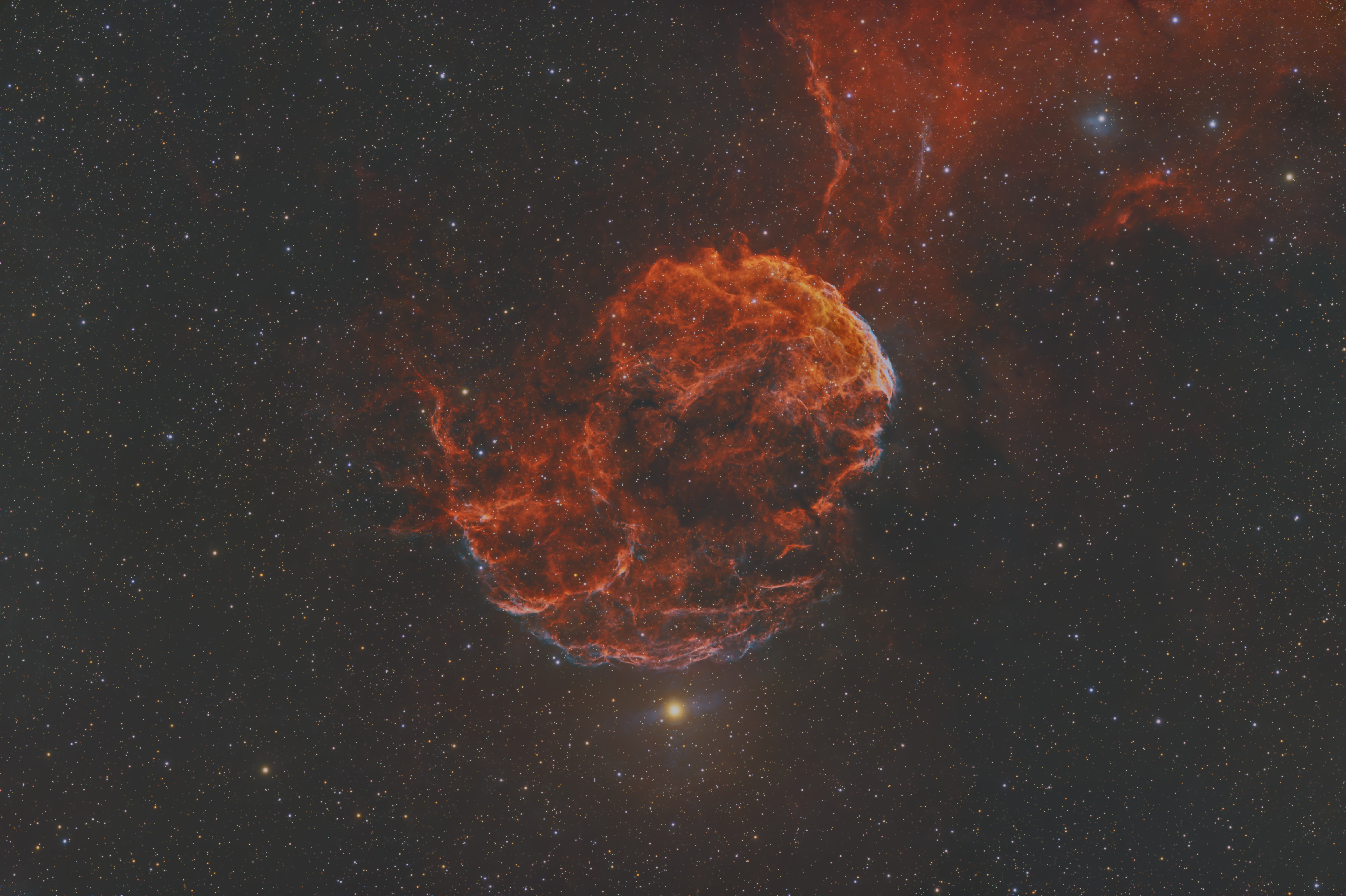
C 443, commonly known as the Jellyfish Nebula, is a dramatic supernova remnant located in the constellation Gemini, roughly 5,000 light-years from Earth. The nebula is the expanding aftermath of a massive star that exploded tens of thousands of years ago, sending shockwaves rippling through the surrounding interstellar medium.
Visually, IC 443 resembles a translucent, drifting jellyfish, with tangled filaments and sweeping arcs of gas forming its “tentacles.” These glowing structures are created as the supernova’s shock front collides with nearby molecular clouds, compressing and heating the gas until it radiates in vivid reds, oranges, and faint blues. Hydrogen, sulfur, and oxygen emissions reveal a complex web of turbulence and motion frozen in light.
Scientifically, the Jellyfish Nebula is especially intriguing because it interacts strongly with its environment. It is associated with high-energy X-ray and gamma-ray sources, and it contains a neutron star—likely the collapsed core of the original star—speeding away from the explosion site. This makes IC 443 a valuable laboratory for studying how supernova remnants seed space with heavy elements and trigger future star formation.
For observers and astrophotographers, IC 443 is a challenging but rewarding target. Its delicate filaments are faint and require long exposures and narrowband imaging to fully reveal, but the result is a haunting portrait of stellar death and renewal, suspended against the rich star fields of Gemini.
Technical Details
Telescope: Sky-Watcher Esprit 100ED Refractor
Auto Focus: ZWO Electronic Auto Focuser
Astronomy Camera: ZWO ASI071MC Pro
Filter: Optolong UV-IR cut filter; 120 exposures @ 60 seconds each (2 hours)
Filter: Antlia ALP-T Dual Narrowband Ha/Oiii Filter; 162 exposures @ 5 minutes each (13.2 hours)
Total Integration Time: 15.2 hours
Auto Guiding: William Optics Uniguide 50mm Guide Scope
Auto Guiding Camera: ZWO ASI120MM Mini Guide Camera
Auto Guiding Software: PHD2
Telescope Mount: Celestron CGX Equatorial Mount
Telescope Computer: BeeLink GK-55 Mini PC / Windows 10 Pro
Wireless Communication: GL-iNEt Beryl Travel Router
Telescope Control & Image Capture Software: Nighttime Imaging ‘N’ Astronomy (N.I.N.A.)
Image Integration Software: Astro Pixel Process, by Aries Productions
Image Post Processing Software: PixInsight, by Pleiades Astrophoto
Images captured:
Palm Springs, CA during March 2025. Dark sky classification = Bright suburban sky (Bortle 6)