CLICK ON IMAGE TO VIEW A HIGH RESOLUTION VERSION
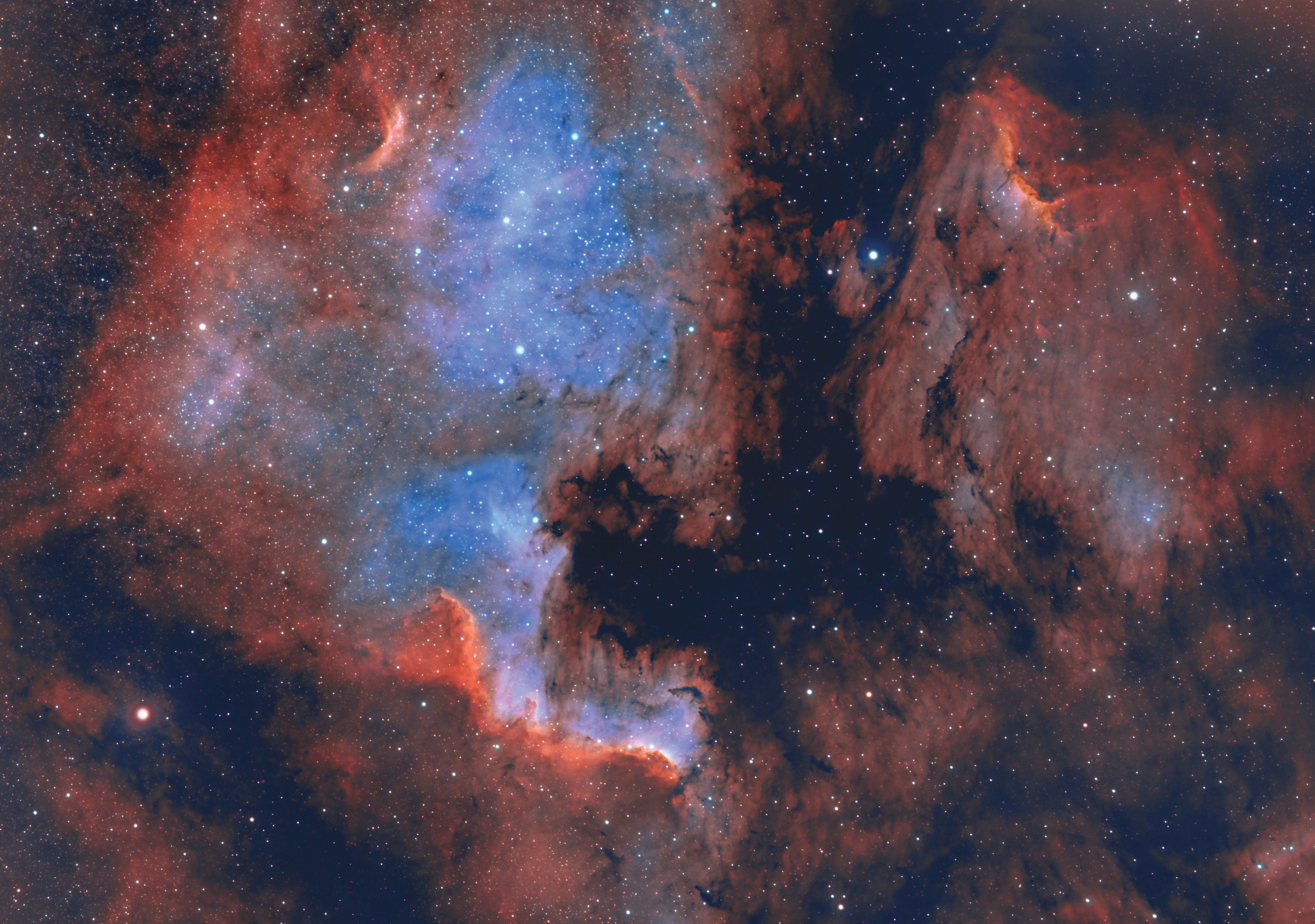
IC 5070 – Pelican Nebula
IC 5070, popularly known as the Pelican Nebula, is an emission nebula located in the constellation Cygnus, roughly 1,800 light-years away from Earth. Its glowing hydrogen gas is sculpted into intricate shapes by the intense radiation and stellar winds of nearby young, massive stars, giving it the distinctive appearance of a pelican in flight. Rich in star-forming regions, IC 5070 is a stellar nursery where new stars are born from dense clouds of gas and dust. The nebula is often captured alongside the nearby North America Nebula due to their close proximity and shared stellar environment.
NGC 7000 – North America Nebula
NGC 7000, or the North America Nebula, is an expansive emission nebula in Cygnus, named for its striking resemblance to the North American continent. Like the Pelican Nebula, it lies around 1,600–1,800 light-years away and is composed primarily of hydrogen gas glowing under the influence of nearby hot stars. The “Gulf of Mexico” region is a dark dust lane that cuts across the nebula, creating a dramatic contrast against the bright, glowing hydrogen regions. This nebula is part of a larger complex of star-forming regions, including the Pelican Nebula, and is a favorite target for astrophotographers due to its vivid structures and vast, intricate details.
Technical Details
Telescope: William Optics Zenithstar 61ii Refractor
Auto Focus: ZWO Electronic Auto Focuser
Astronomy Camera: ZWO ASI071MC Pro
Filter: Optolong UV-IR cut filter; 240 exposures @ 60 seconds each (4 hours)
Filter: Optolong Lenhance Dual Narrowband Ha/Oiii Filter; 480 exposures @ 5 minutes each (40 hours)
Total Integration Time: 44 hours
Auto Guiding: William Optics Uniguide 50mm Guide Scope
Auto Guiding Camera: ZWO ASI120MM Mini Guide Camera
Auto Guiding Software: PHD2
Telescope Mount: Celestron CGX Equatorial Mount
Telescope Computer: BeeLink GK-55 Mini PC / Windows 10 Pro
Wireless Communication: GL-iNEt Beryl Travel Router
Telescope Control & Image Capture Software: Nighttime Imaging ‘N’ Astronomy (N.I.N.A.)
Image Integration Software: Astro Pixel Process, by Aries Productions
Image Post Processing Software: PixInsight, by Pleiades Astrophoto
Images captured: Palm Springs, CA during August 2022. Dark sky classification = Bright suburban sky (Bortle 6)