CLICK ON IMAGE TO VIEW A HIGH RESOLUTION VERSION
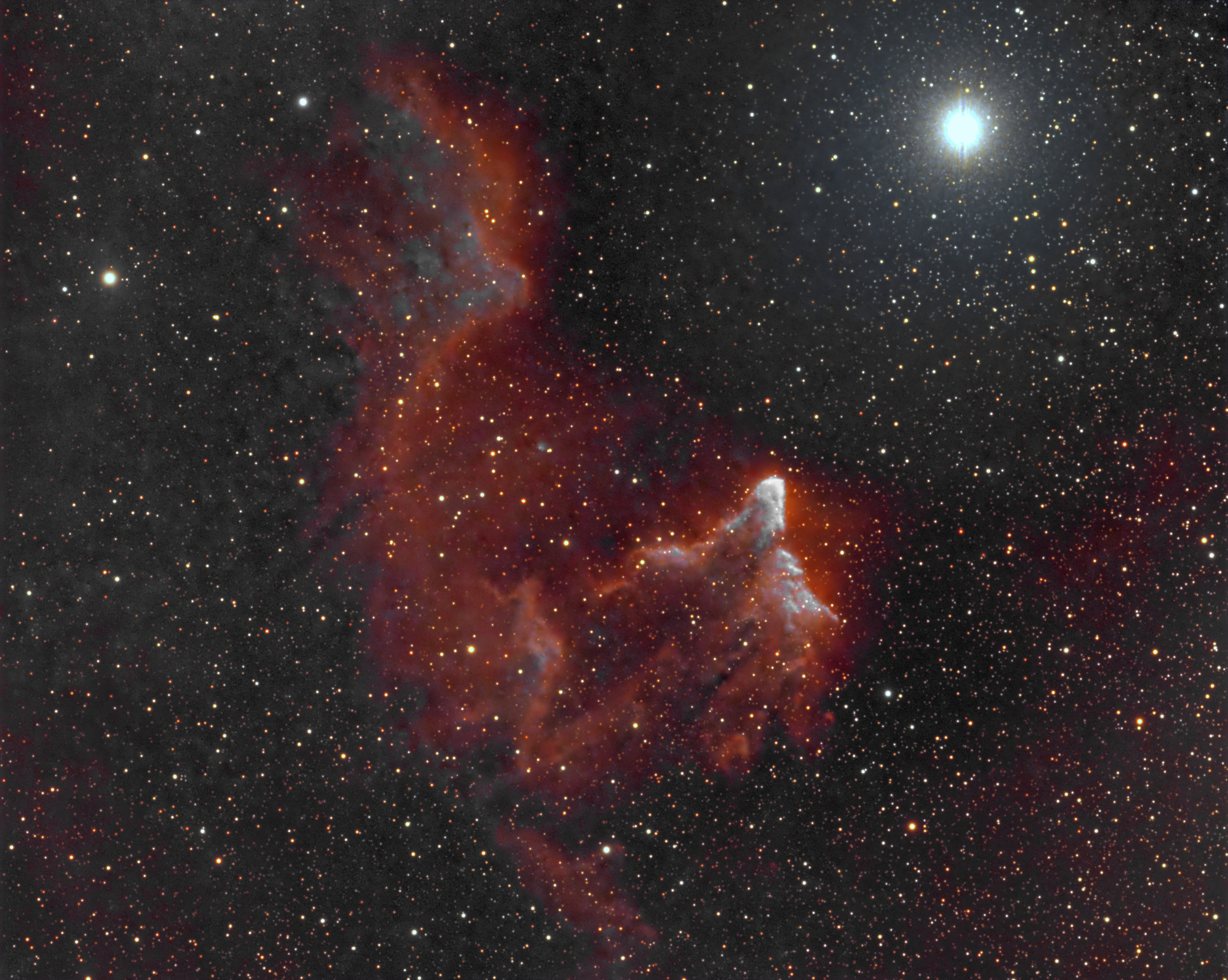
IC 59 and IC 63, collectively known as the Ghost of Cassiopeia Nebula, are a pair of faint and haunting reflection and emission nebulae located in the constellation Cassiopeia, near the bright star Gamma Cassiopeiae (Navi). Shaped by the intense ultraviolet radiation from this hot, massive star, the nebulae appear as wispy, ghost-like forms drifting through interstellar space.
IC 63 glows with a subtle red hue from ionized hydrogen, mixed with bluish reflections from nearby starlight, while IC 59 shines primarily as a blue reflection nebula. These contrasting colors arise from the interaction between stellar radiation and clouds of gas and dust, where some regions fluoresce and others scatter light back toward Earth. Dark dust lanes twist through both nebulae, giving them an ethereal, sculpted appearance.
Located roughly 600 light-years away, the Ghost of Cassiopeia is a challenging but rewarding target for astrophotographers, revealing delicate tendrils, sharp shock fronts, and intricate textures with long exposures. The nebulae offer a striking example of how massive stars shape and illuminate their surroundings, creating a cosmic apparition that truly lives up to its spectral name.
Technical Details
Telescope: Sky-Watcher Esprit 100ED Refractor
Auto Focus: ZWO Electronic Auto Focuser
Astronomy Camera: ZWO ASI533MC Pro
Filter: Antlia ALP-T Dual Narrowband Ha/Oiii Filter; 400 exposures @ 5 minutes each (33.3 hours)
Total Integration Time: 33.3 hours
Auto Guiding: William Optics Uniguide 50mm Guide Scope
Auto Guiding Camera: ZWO ASI120MM Mini Guide Camera
Auto Guiding Software: PHD2
Telescope Mount: Sky- Watcher EQ6-R Pro Equatorial Mount
Telescope Computer: BeeLink GK-55 Mini PC / Windows 10 Pro
Wireless Communication: GL-iNEt Beryl Travel Router
Telescope Control & Image Capture Software: Nighttime Imaging ‘N’ Astronomy (N.I.N.A.)
Image Integration Software: Astro Pixel Process, by Aries Productions
Image Post Processing Software: PixInsight, by Pleiades Astrophoto
Images captured:
Palm Springs, CA during October 2022. Dark sky classification = Bright suburban sky (Bortle 6)