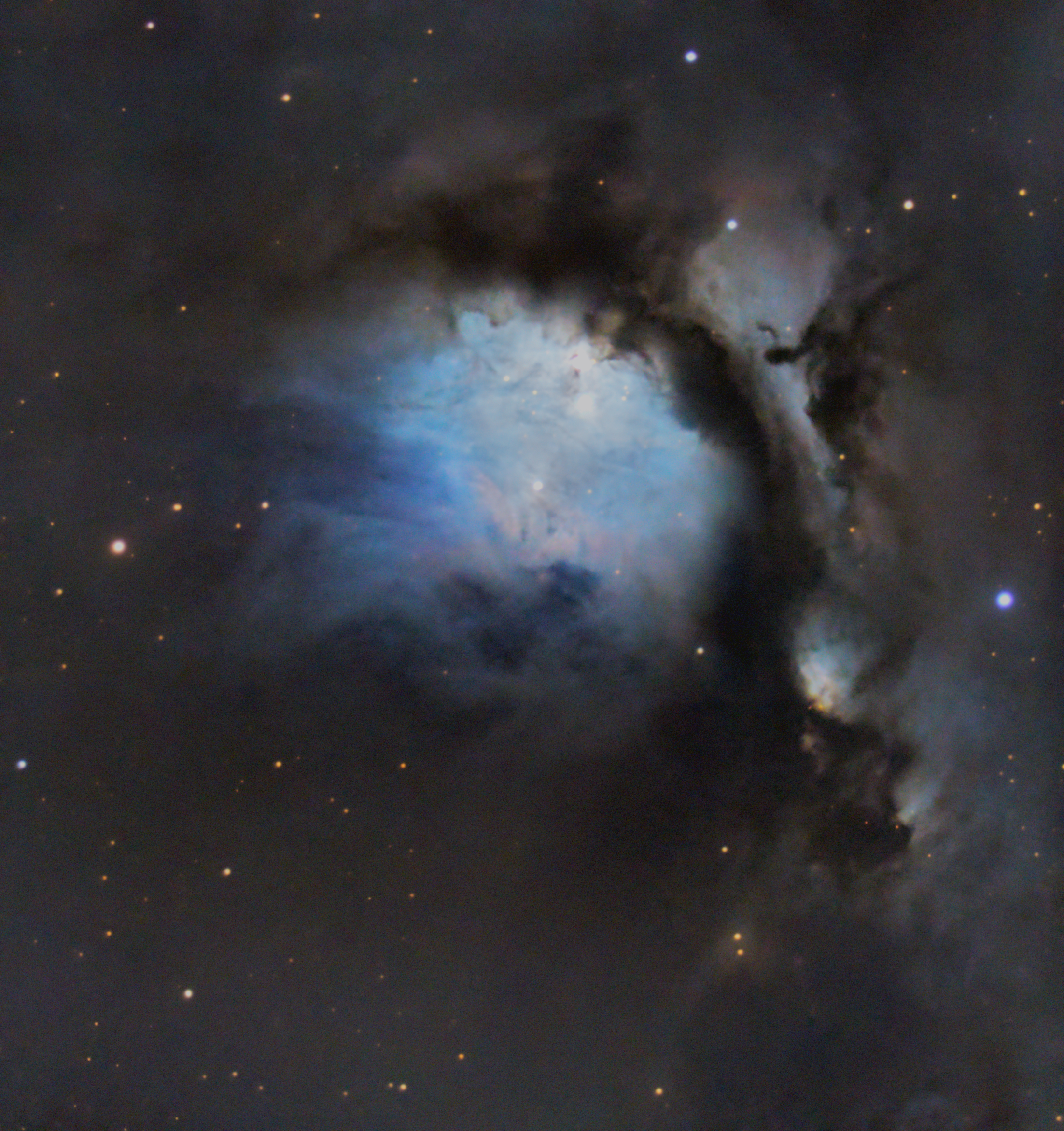
CLICK ON IMAGE TO VIEW A HIGH RESOLUTION VERSION
Messier 78 (M78) is a striking reflection nebula nestled within the rich star-forming complex of the Orion constellation, approximately 1,600 light-years from Earth. Unlike emission nebulae that glow from ionized gas, M78 shines by reflecting the light of nearby young, hot stars, giving it a soft blue glow that contrasts beautifully against the surrounding dark dust lanes.
The nebula’s illumination comes primarily from two embedded stars, which scatter their light off fine interstellar dust, revealing intricate wisps and curved structures shaped by stellar winds and gravity. Surrounding M78 are dense regions of cold molecular gas and opaque dust, where new stars are still forming, making the area an active and evolving stellar nursery.
Often overshadowed by the brighter Orion Nebula (M42), M78 rewards careful observation and astrophotography with subtle detail and depth. Its ethereal blue tones and delicate textures make it one of the finest examples of a reflection nebula in the night sky and a beautiful reminder of the early stages of star formation.
Technical Details
Telescope: Celestron C8 SCT (8″ Schmidt-Cassegrain) with Celestron 0.63 Focal Reducer
Auto Focus: Celestron Electronic Auto Focuser
Astronomy Camera: ZWO ASI533MC Pro
Filter: Optolong UV-IR cut filter; 1,140 exposures @ 60 seconds each (19 hours)
Total Integration Time: 19 hours
Off-Axis Auto Guiding: ZWO OAG-L
Auto Guiding Camera: ZWO ASI174MM Mini Guide Camera
Telescope Mount: Sky- Watcher EQ6-R Pro Equatorial Mount
Telescope Computer: BeeLink GK-55 Mini PC / Windows 10 Pro
Wireless Communication: GL-iNEt Beryl Travel Router
Telescope Control & Image Capture Software: Nighttime Imaging ‘N’ Astronomy (N.I.N.A.)
Image Integration Software: Astro Pixel Process, by Aries Productions
Image Post Processing Software: PixInsight, by Pleiades Astrophoto
Images captured in Palm Springs, CA during December 2022. Dark sky classification = Bright suburban sky (Bortle 6).