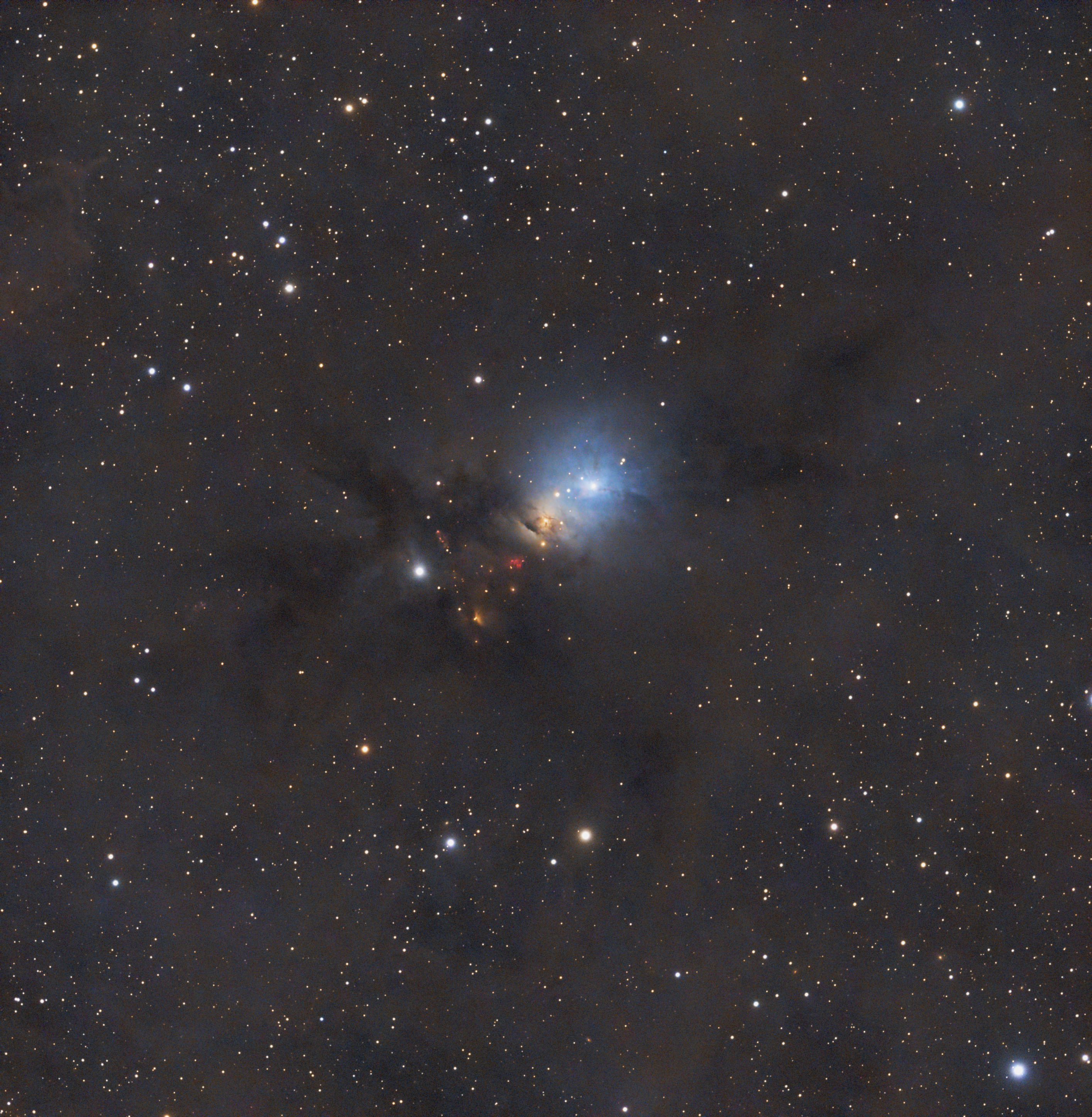
CLICK ON IMAGE TO VIEW A HIGH RESOLUTION VERSION
NGC 1333 is a dynamic star-forming nebula nestled within the Perseus Molecular Cloud, about 1,000 light-years from Earth in the constellation Perseus. Unlike bright emission nebulae dominated by glowing hydrogen, NGC 1333 is primarily a reflection nebula, shining as starlight from young, newly formed stars scatters off surrounding dust. This gives the region its distinctive bluish tones, interwoven with dark, sinuous lanes of obscuring gas.
The nebula is a stellar nursery in its earliest stages, filled with protostars, T Tauri stars, and Herbig–Haro objects—jets of material ejected from infant stars as they carve paths through the surrounding cloud. These energetic outflows collide with nearby gas, creating shock fronts that reveal ongoing and turbulent star birth.
Visually, NGC 1333 presents a textured, chaotic appearance, with wisps of illuminated dust set against inky black molecular clouds. Though modest in size compared to famous nebulae like Orion, it offers a compelling glimpse into the raw beginnings of star formation, capturing a moment when gravity, gas, and radiation are actively shaping the next generation of stars.
Technical Details
Telescope: Sky-Watcher Esprit 100ED Refractor
Auto Focus: ZWO Electronic Auto Focuser
Astronomy Camera: ZWO ASI533MC Pro
Filter: Optolong UV-IR cut filter; 1,400 exposures @ 60 seconds each (23.3 hours)
Total Integration Time: 23.3 hours
Auto Guiding: William Optics Uniguide 50mm Guide Scope
Auto Guiding Camera: ZWO ASI120MM Mini Guide Camera
Auto Guiding Software: PHD2
Telescope Mount: Sky- Watcher EQ6-R Pro Equatorial Mount
Telescope Computer: BeeLink GK-55 Mini PC / Windows 10 Pro
Wireless Communication: GL-iNEt Beryl Travel Router
Telescope Control & Image Capture Software: Nighttime Imaging ‘N’ Astronomy (N.I.N.A.)
Image Integration Software: Astro Pixel Process, by Aries Productions
Image Post Processing Software: PixInsight, by Pleiades Astrophoto
Images captured: Palm Springs, CA during December 2023. Dark sky classification = Bright suburban sky (Bortle 6)