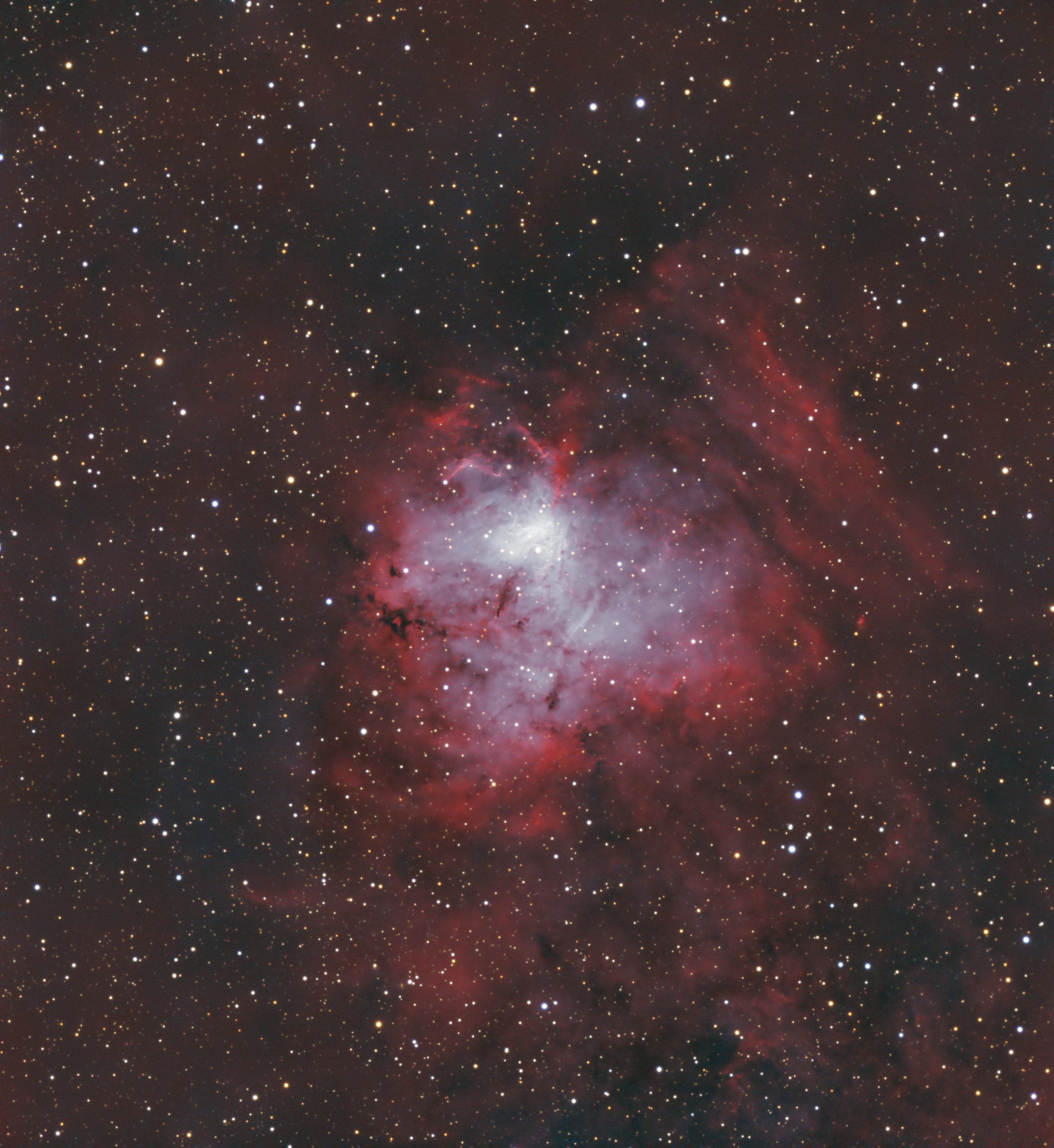
CLICK ON IMAGE TO VIEW A HIGH RESOLUTION VERSION
NGC 1491, often nicknamed the Fossil Footprint Nebula, is a compact but striking emission nebula located in the constellation Perseus, roughly 9,000 light-years from Earth. Illuminated primarily by a small group of hot, young O- and B-type stars embedded within it, the nebula glows strongly in hydrogen-alpha, revealing intricate arcs, filaments, and curved structures that give rise to its footprint-like appearance.
This region is an active site of ongoing star formation, where intense ultraviolet radiation from massive stars ionizes the surrounding gas and sculpts the nebula into complex shapes. Dark lanes of interstellar dust weave through the glowing clouds, adding depth and contrast and hinting at dense pockets where new stars may still be forming.
Though relatively small and faint compared to more famous nebulae, NGC 1491 is a rewarding target for astrophotographers. Narrowband imaging highlights its rich textures and subtle gradients, showcasing a fossil-like imprint of stellar feedback frozen in the interstellar medium—a fleeting snapshot of the dynamic processes that shape our galaxy.
Technical Details
Telescope: Sky-Watcher Esprit 100ED Refractor
Auto Focus: ZWO Electronic Auto Focuser
Astronomy Camera: ZWO ASI533MC Pro
Filter: Optolong UV-IR cut filter; 300 exposures @ 60 seconds each (5 hours)
Filter: Antlia ALP-T Dual Narrowband Ha/Oiii Filter; 270 exposures @ 5 minutes each (22.5 hours)
Total Integration Time: 27.5 hours
Auto Guiding: William Optics Uniguide 50mm Guide Scope
Auto Guiding Camera: ZWO ASI120MM Mini Guide Camera
Auto Guiding Software: PHD2
Telescope Mount: Sky- Watcher EQ6-R Pro Equatorial Mount
Telescope Computer: BeeLink GK-55 Mini PC / Windows 10 Pro
Wireless Communication: GL-iNEt Beryl Travel Router
Telescope Control & Image Capture Software: Nighttime Imaging ‘N’ Astronomy (N.I.N.A.)
Image Integration Software: Astro Pixel Process, by Aries Productions
Image Post Processing Software: PixInsight, by Pleiades Astrophoto
Images captured: Palm Springs, CA during September 2022. Dark sky classification = Bright suburban sky (Bortle 6)