CLICK ON IMAGE TO VIEW A HIGH RESOLUTION VERSION
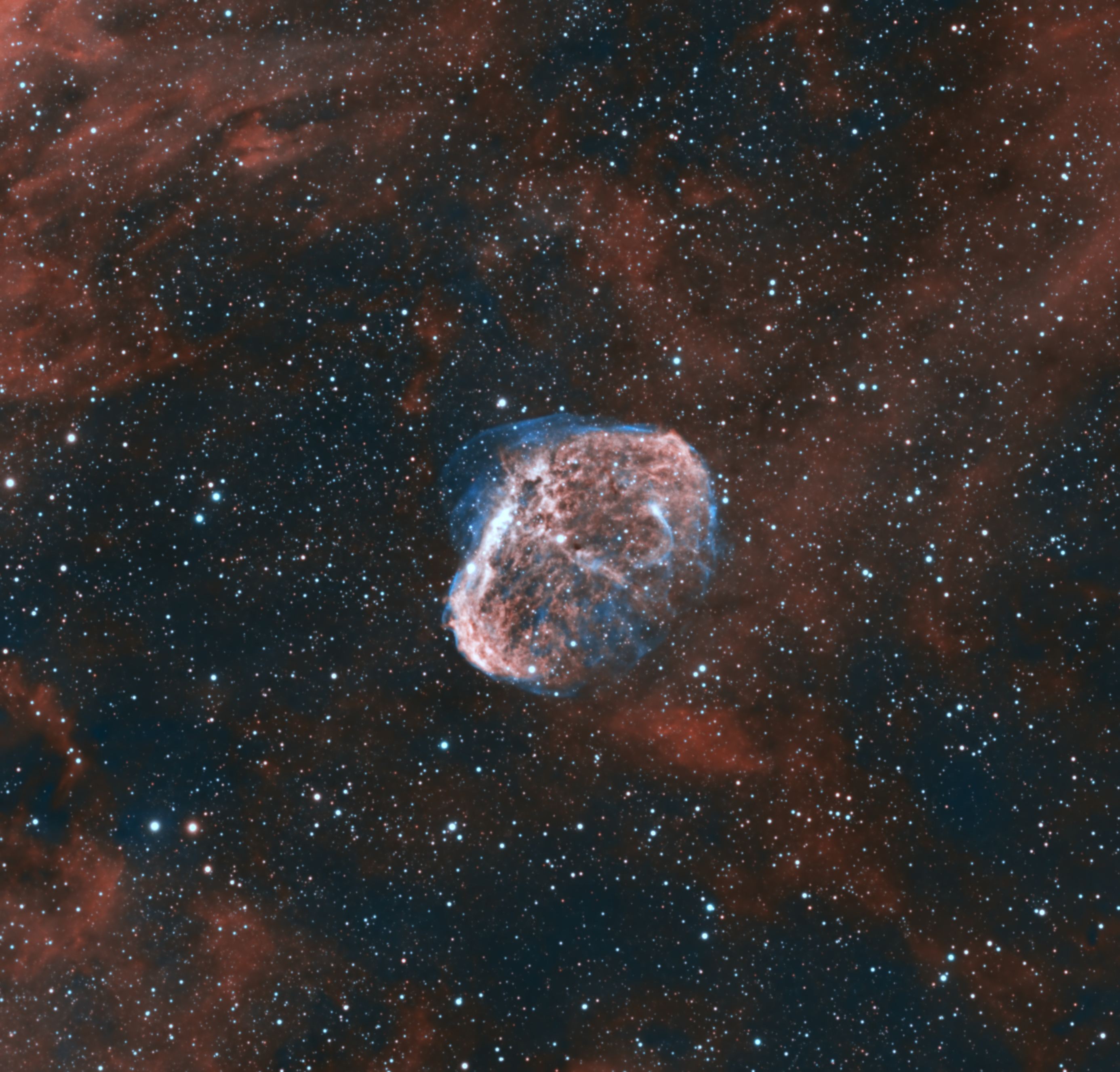
NGC 6888, commonly known as the Crescent Nebula, is a dramatic emission nebula located about 5,000 light-years away in the constellation Cygnus. Shaped like a glowing, wind-swept arc, this nebula is the result of powerful stellar forces at work around a massive Wolf–Rayet star, WR 136, at its center.
The Crescent Nebula formed when intense stellar winds from WR 136 collided with slower material the star had previously shed during an earlier phase of its life. This violent interaction sculpted the surrounding gas into a thin, shell-like structure filled with intricate filaments, knots, and shock fronts. Hydrogen, oxygen, and sulfur gases glow brightly, revealing layers of ionized material and turbulent motion within the nebula.
Spanning roughly 25 light-years, NGC 6888 is a striking example of how massive stars shape and enrich their surroundings before ending their lives in supernova explosions. In astrophotography, the Crescent Nebula stands out for its complex textures and strong contrast between bright arcs and faint, wispy extensions, offering a compelling glimpse into the life cycle of stars and the dynamic nature of the interstellar medium.
Technical Details
Telescope: Sky-Watcher Esprit 100ED Refractor
Auto Focus: ZWO Electronic Auto Focuser
Astronomy Camera: ZWO ASI533MC Pro
Filter: Optolong UV-IR cut filter; 180 exposures @ 60 seconds each (3 hours)
Filter: Antlia ALP-T Dual Narrowband Ha/Oiii Filter; 250 exposures @ 5 minutes each (20,8 hours)
Total Integration Time: 28.8 hours
Auto Guiding: William Optics Uniguide 50mm Guide Scope
Auto Guiding Camera: ZWO ASI120MM Mini Guide Camera
Auto Guiding Software: PHD2
Telescope Mount: Celestron CGX Equatorial Mount
Telescope Computer: BeeLink GK-55 Mini PC / Windows 10 Pro
Wireless Communication: GL-iNEt Beryl Travel Router
Telescope Control & Image Capture Software: Nighttime Imaging ‘N’ Astronomy (N.I.N.A.)
Image Integration Software: Astro Pixel Process, by Aries Productions
Image Post Processing Software: PixInsight, by Pleiades Astrophoto
Images captured: Palm Springs, CA during July 2022. Dark sky classification = Bright suburban sky (Bortle 6)