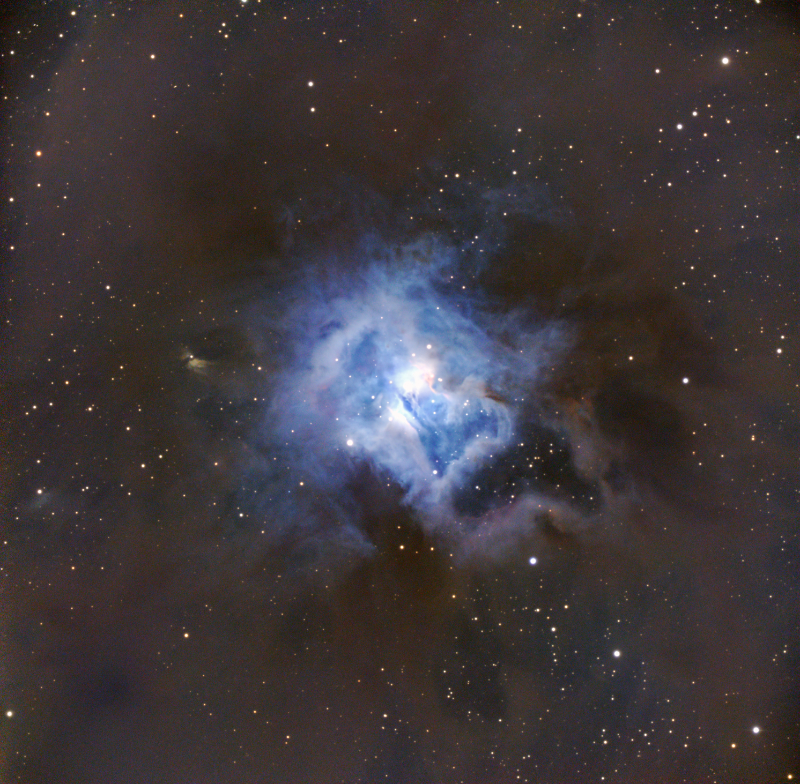
CLICK ON IMAGE TO VIEW A HIGH RESOLUTION VERSION
NGC 7023, famously known as the Iris Nebula, is a stunning reflection nebula located in the constellation Cepheus, about 1,300 light-years from Earth. This nebula is illuminated by a young, massive star at its center, HD 200775, whose bright light scatters off surrounding dust clouds, giving the nebula its characteristic bluish glow. The dense dust lanes and filamentary structures around the star create a floral, almost petal-like appearance, which inspired the name “Iris.”
Surrounding the central star, the nebula transitions from a vibrant blue core to faint reddish and brownish outer regions caused by interstellar dust and emission from hydrogen gas. NGC 7023 is often studied to understand the interaction between young stars and their dusty environments, including how starlight shapes and illuminates surrounding nebulae. Its delicate beauty makes it a favorite target for both amateur and professional astrophotographers.
Technical Details
Telescope: Celestron C8 SCT (8″ Schmidt-Cassegrain) with Celestron 0.63 Focal Reducer
Auto Focus: Celestron Electronic Auto Focuser
Astronomy Camera: ZWO ASI533MC Pro
Filter: Optolong UV-IR cut filter; 1,425 exposures @ 60 seconds each (23.75 hours)
Total Integration Time: 23.75 hours
Off-Axis Auto Guiding: ZWO OAG-L
Auto Guiding Camera: ZWO ASI174MM Mini Guide Camera
Telescope Mount: Sky- Watcher EQ6-R Pro Equatorial Mount
Telescope Computer: BeeLink GK-55 Mini PC / Windows 10 Pro
Wireless Communication: GL-iNEt Beryl Travel Router
Telescope Control & Image Capture Software: Nighttime Imaging ‘N’ Astronomy (N.I.N.A.)
Image Integration Software: Astro Pixel Process, by Aries Productions
Image Post Processing Software: PixInsight, by Pleiades Astrophoto
Images captured in Eastern Mojave Desert, CA during September 2024. Dark sky classification = Rural sky (Bortle 3).