CLICK ON IMAGE TO VIEW A HIGH RESOLUTION VERSION
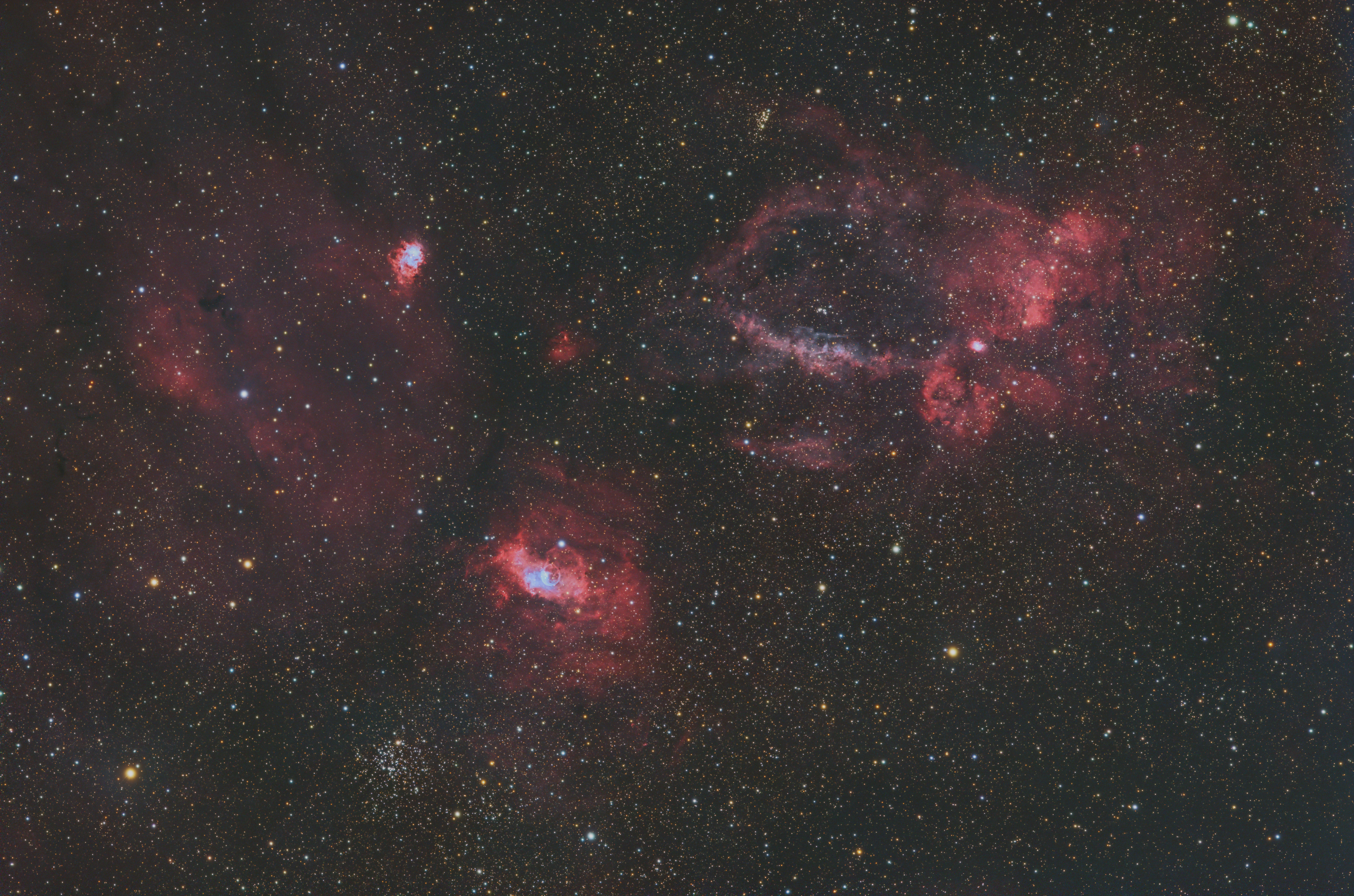
Messier 52 (M52) is a rich open star cluster located in the constellation Cassiopeia, near the border with Cepheus. Discovered by Charles Messier in 1774, M52 lies roughly 5,000 light-years from Earth and spans about 20 light-years across. It contains several hundred stars, most of them relatively young, with an estimated age of around 35 million years.
Visually, M52 appears as a dense, triangular or fan-shaped grouping of stars, with a striking mix of bright blue-white members and fainter background stars. A notable orange giant near the cluster’s edge adds a warm contrast to the cooler hues of its main stellar population. The cluster is embedded in a rich Milky Way star field, giving it a textured, layered appearance in wide-field views.
Often observed alongside the nearby emission nebula NGC 7635 (the Bubble Nebula), M52 is a rewarding target for both visual observers and astrophotographers. Its compact structure and varied stellar colors make it a classic example of a youthful open cluster still shining brightly within its natal region of the Galactic plane.
The Bubble Nebula (NGC 7635) is a striking emission nebula located in the constellation Cassiopeia, about 7,000–11,000 light-years from Earth. Its iconic, nearly spherical “bubble” is created by the powerful stellar winds of a massive, hot O-type star (BD+60°2522) at its center. These winds sweep surrounding gas and dust into a thin, glowing shell roughly 7 light-years across, compressing the interstellar medium and triggering complex shock fronts.
Surrounding the bubble is a richly textured cloud of hydrogen and dust, where dark lanes and bright filaments reveal ongoing interactions between stellar radiation and cold molecular material. Although the bubble itself appears delicate and translucent, it is an energetic and dynamic structure shaped by intense ultraviolet radiation. Often imaged alongside the nearby M52 star cluster, the Bubble Nebula is a vivid example of how massive stars sculpt and reshape their cosmic environments.
Sh2-157, commonly known as the Lobster Nebula, is a compact and dynamic emission nebula located in the constellation Cassiopeia, roughly 9,000 light-years from Earth. This region is a site of active star formation, where dense clouds of hydrogen gas are energized by the intense ultraviolet radiation from young, massive stars embedded within.
The nebula’s nickname comes from its distinctive shape: two bright, claw-like lobes of glowing gas extend outward from a central core, giving it the appearance of a cosmic lobster suspended against the star-filled backdrop of the Milky Way. These structures are sculpted by stellar winds and radiation that carve cavities and sharp edges into the surrounding interstellar material.
In narrowband images, the Lobster Nebula shines vividly in hydrogen-alpha, with intricate filaments and dark dust lanes weaving through the brighter emission. Pockets of obscuring dust hint at ongoing stellar birth, while the contrasting textures reveal the turbulent interplay between gravity, radiation, and gas.
Though relatively small compared to vast nebulae like the Rosette or North America Nebula, Sh2-157 stands out for its rich detail and dramatic form, making it a striking and rewarding target for astrophotographers and a fascinating example of star formation in action.
Technical Details
Telescope: Zenithstar Z61ii Refractor
Auto Focus: ZWO Electronic Auto Focuser
Astronomy Camera: ZWO ASI071MC Pro
Filter: Optolong UV-IR cut filter; 300 exposures @ 60 seconds each (5 hours)
Filter: Optolong Lenhance Dual Narrowband Ha/Oiii Filter; 720 exposures @ 5 minutes each (60 hours)
Total Integration Time: 65 hours
Auto Guiding: William Optics Uniguide 50mm Guide Scope
Auto Guiding Camera: ZWO ASI120MM Mini Guide Camera
Auto Guiding Software: PHD2
Telescope Mount: Celestron CGX Equatorial Mount
Telescope Computer: BeeLink GK-55 Mini PC / Windows 10 Pro
Wireless Communication: GL-iNEt Beryl Travel Router
Telescope Control & Image Capture Software: Nighttime Imaging ‘N’ Astronomy (N.I.N.A.)
Image Integration Software: Astro Pixel Process, by Aries Productions
Image Post Processing Software: PixInsight, by Pleiades Astrophoto
Images captured: Palm Springs, CA during August 2025. Dark sky classification = Bright suburban sky (Bortle 6)