CLICK ON IMAGE TO VIEW A HIGH RESOLUTION VERSION
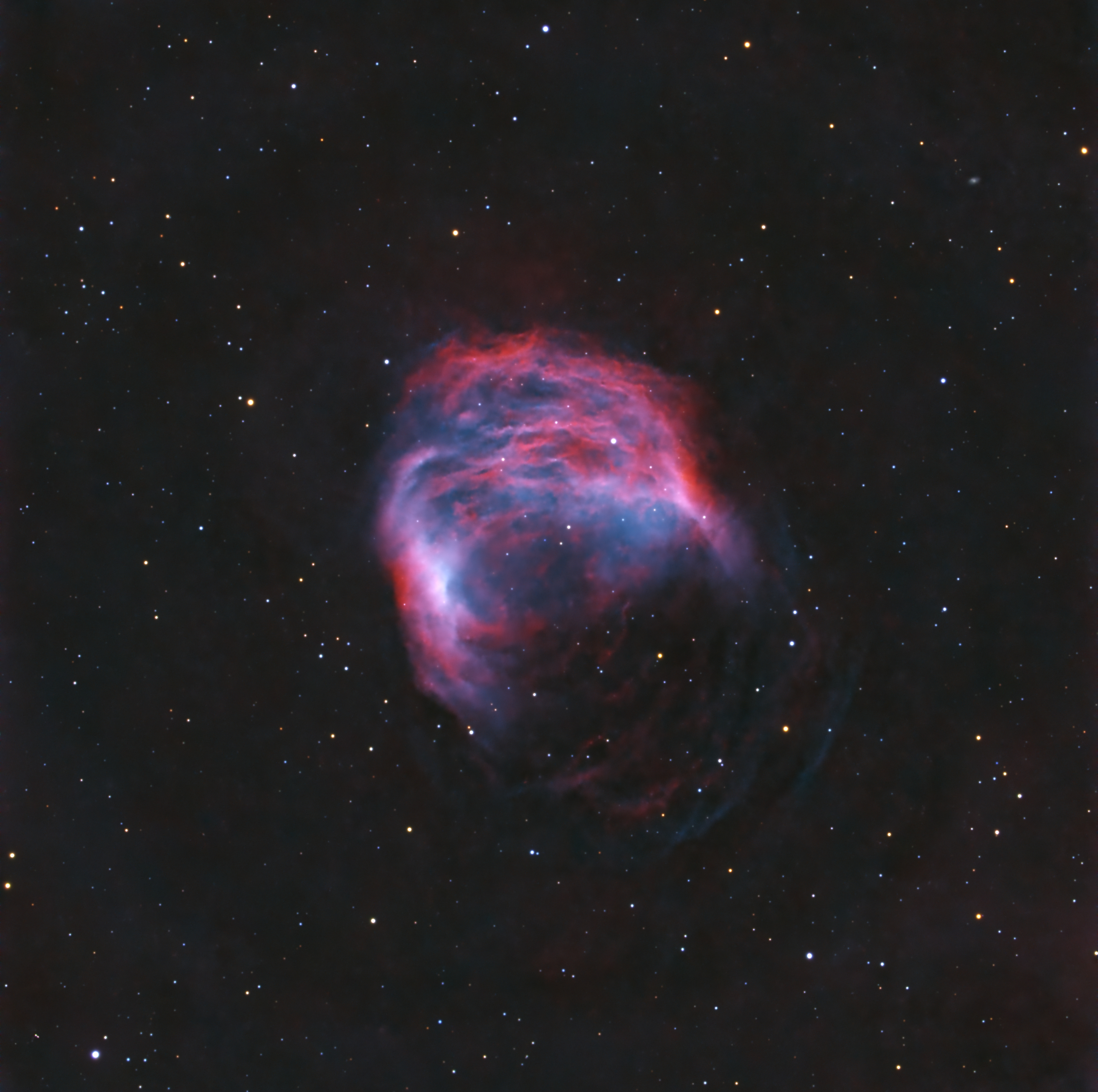
SH2-274, commonly known as the Medusa Nebula, is a striking planetary nebula located in the constellation Gemini. This ethereal object is the glowing remnant of a dying star, where the outer layers have been expelled into space and energized by the intense radiation from the hot central white dwarf. Its intricate structure features delicate, filamentary threads of ionized gas, giving it a wispy, almost serpentine appearance—hence the nickname “Medusa,” reminiscent of the mythological figure with snakes for hair.
The nebula emits predominantly in the characteristic red of hydrogen-alpha, along with greenish-blue hues from doubly ionized oxygen, creating a subtle but captivating color palette. Though relatively faint, it spans a significant portion of the sky, presenting a fine example of how dying stars enrich the interstellar medium with their elemental remnants. Observationally, the Medusa Nebula is often sought after by amateur astronomers and astrophotographers using narrowband filters to bring out its delicate, lace-like filaments.
It serves as both a beautiful celestial spectacle and a fascinating laboratory for studying the late evolutionary stages of medium-mass stars.
Technical Details
Telescope: Celestron C8 SCT (8″ Schmidt-Cassegrain) with Celestron 0.63 Focal Reducer
Auto Focus: Celestron Electronic Auto Focuser
Astronomy Camera: ZWO ASI533MC Pro
Filter: Optolong UV-IR cut filter; 900 exposures @ 60 seconds each (15 hours)
Total Integration Time: 15 hours
Off-Axis Auto Guiding: ZWO OAG-L
Auto Guiding Camera: ZWO ASI174MM Mini Guide Camera
Telescope Mount: Celestron CGX Equatorial Mount
Telescope Computer: BeeLink GK-55 Mini PC / Windows 10 Pro
Wireless Communication: GL-iNEt Beryl Travel Router
Telescope Control & Image Capture Software: Nighttime Imaging ‘N’ Astronomy (N.I.N.A.)
Image Integration Software: Astro Pixel Process, by Aries Productions
Image Post Processing Software: PixInsight, by Pleiades Astrophoto
Images captured in Palm Springs, CA during January 2025. Dark sky classification = Bright suburban sky (Bortle 6).