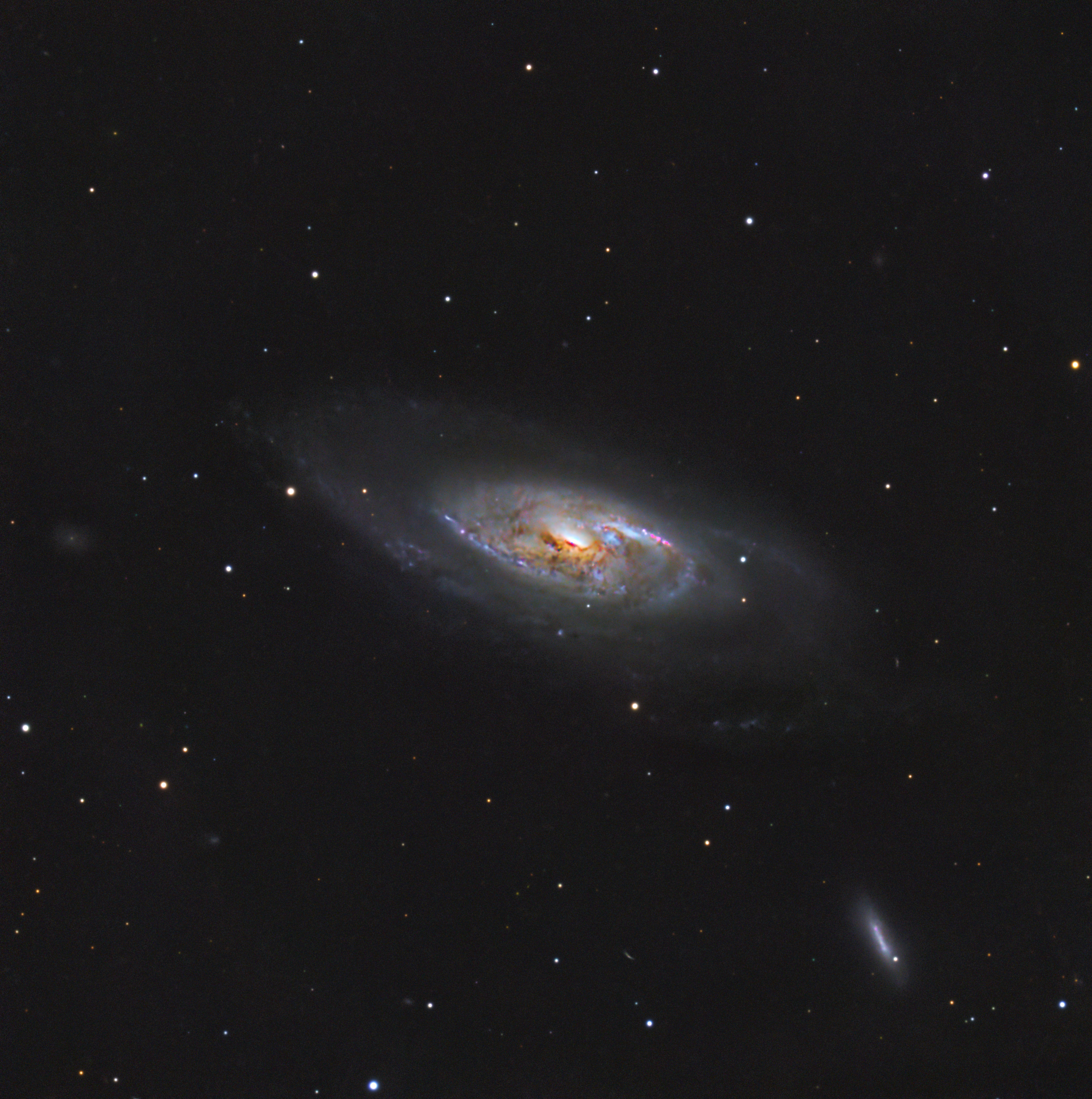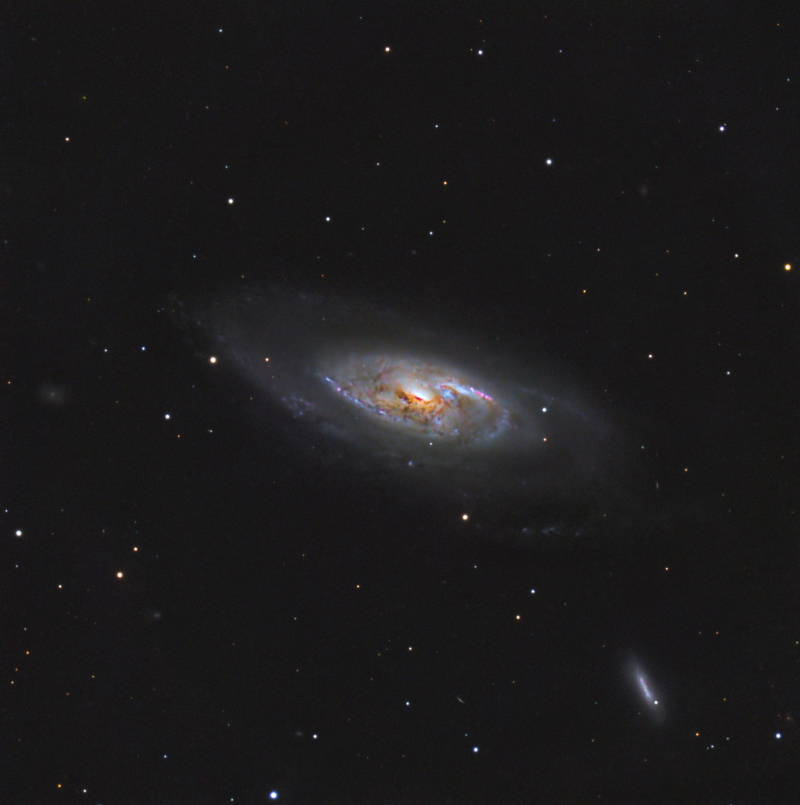
CLICK ON IMAGE TO VIEW A HIGH RESOLUTION VERSION
Messier 106 (M106) is a striking spiral galaxy located about 23 million light-years away in the constellation Canes Venatici. Classified as an intermediate barred spiral, M106 is notable for its bright core and two prominent spiral arms that sweep outward, threaded with dark dust lanes and regions of active star formation.
What makes M106 especially intriguing is its active galactic nucleus, powered by a supermassive black hole at its center. This activity produces powerful jets of energized gas that glow in radio and X-ray wavelengths, creating unusual “anomalous arms” that do not align with the galaxy’s visible spiral structure. These features reveal complex interactions between the black hole and the surrounding interstellar medium.
With an apparent magnitude of around 8.4, M106 is visible in small telescopes and is a rewarding target for astrophotographers, who can capture both its classic spiral beauty and subtle signs of its energetic core. As one of the dominant members of the M106 Group of galaxies, it offers astronomers valuable insight into how black holes influence the evolution of spiral galaxies.
Technical Details
Telescope: Celestron C8 SCT (8″ Schmidt-Cassegrain) with Celestron 0.63 Focal Reducer
Auto Focus: Celestron Electronic Auto Focuser
Astronomy Camera: ZWO ASI533MC Pro
Filter: Optolong UV-IR cut filter; 600 exposures @ 60 seconds each (10 hours)
Total Integration Time: 10 hours
Off-Axis Auto Guiding: ZWO OAG-L
Auto Guiding Camera: ZWO ASI174MM Mini Guide Camera
Telescope Mount: Sky- Watcher EQ6-R Pro Equatorial Mount
Telescope Computer: BeeLink GK-55 Mini PC / Windows 10 Pro
Wireless Communication: GL-iNEt Beryl Travel Router
Telescope Control & Image Capture Software: Nighttime Imaging ‘N’ Astronomy (N.I.N.A.)
Image Integration Software: Astro Pixel Process, by Aries Productions
Image Post Processing Software: PixInsight, by Pleiades Astrophoto
Images captured in Palm Springs, CA during May 2025. Dark sky classification = Bright suburban sky (Bortle 6).
Visited 20 times, 1 visit(s) today