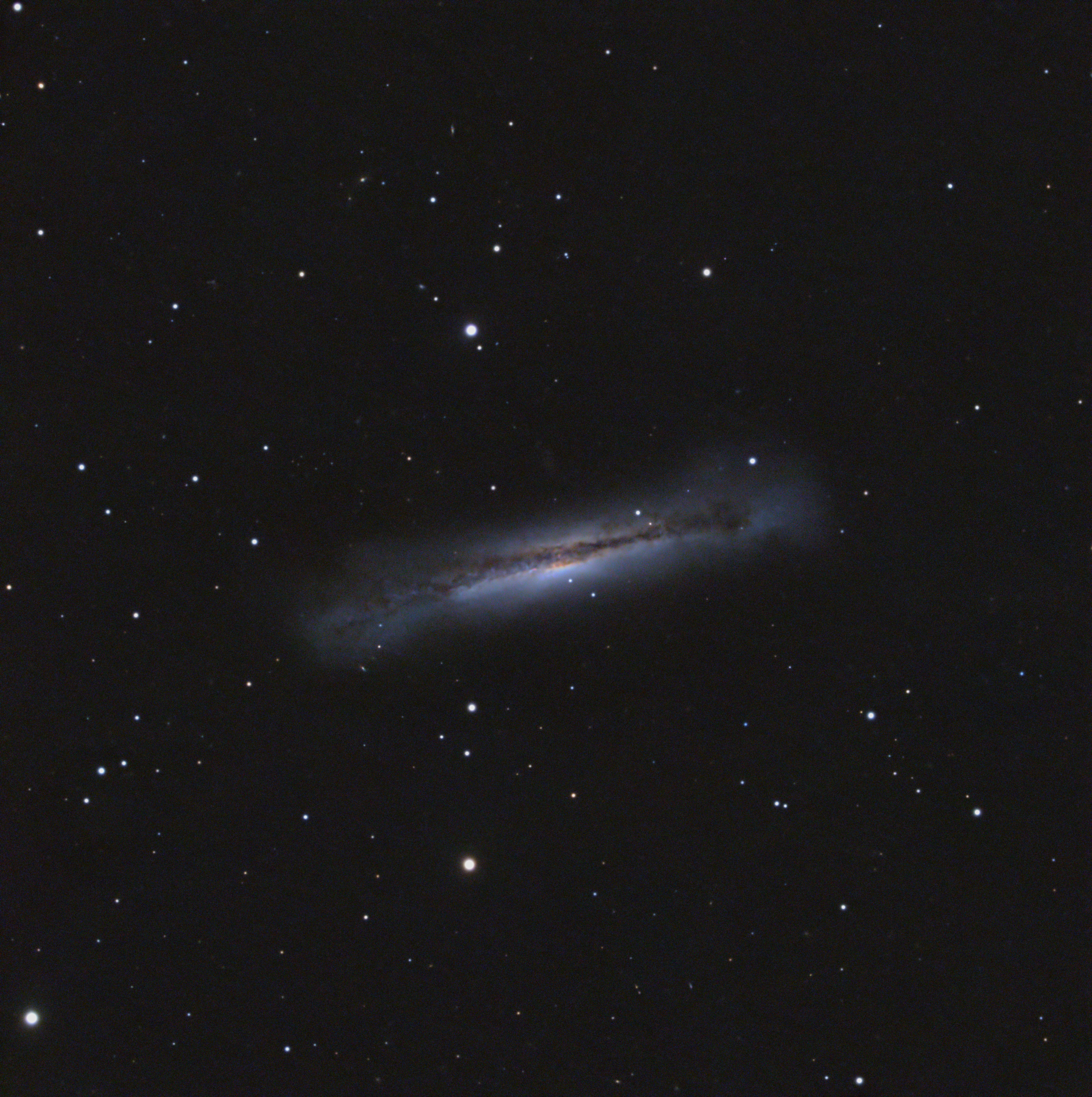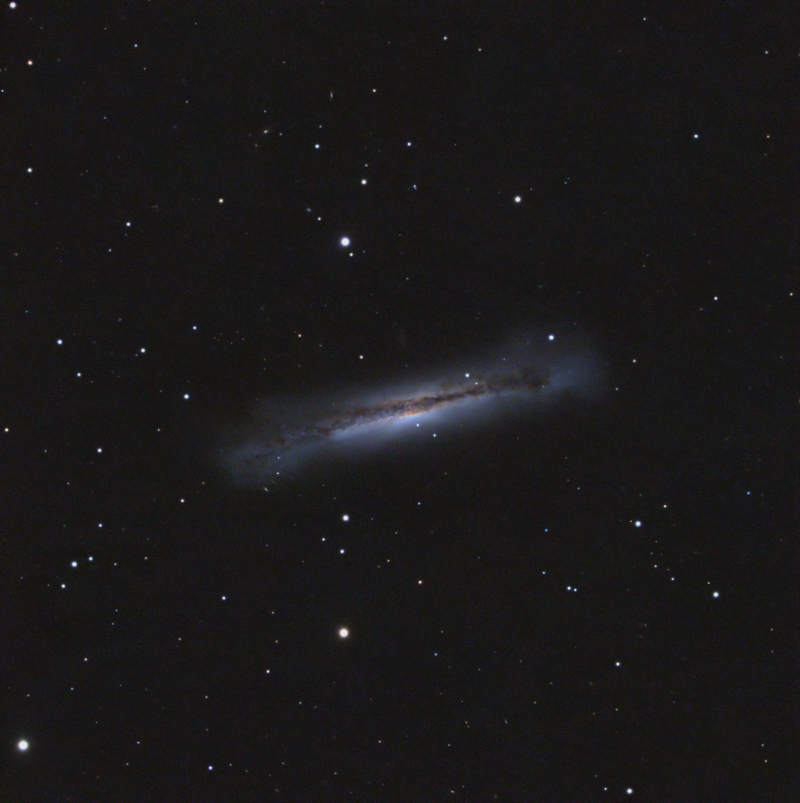
CLICK ON IMAGE TO VIEW A HIGH RESOLUTION VERSION
NGC 3628, commonly known as the Hamburger Galaxy, is a dramatic edge-on spiral galaxy located about 35 million light-years away in the constellation Leo. It is the third and dustiest member of the famous Leo Triplet, alongside Messier 65 and Messier 66.
Seen nearly perfectly edge-on, NGC 3628 is distinguished by a thick, dark dust lane that bisects its bright stellar disk, giving the galaxy its “hamburger” appearance. This prominent dust band obscures much of the galaxy’s central region, while the outer disk glows softly with countless stars. Subtle knots of star formation are hidden within the dust, hinting at ongoing stellar birth despite its subdued appearance.
Gravitational interactions with its neighboring galaxies have distorted NGC 3628’s shape, stretching its disk and pulling out long tidal streams of stars that extend far into space. These interactions are thought to have triggered bursts of star formation and contributed to the galaxy’s warped structure.
For observers and astrophotographers, the Hamburger Galaxy is a striking target, especially under dark skies, where its elongated form and dramatic dust lane stand out clearly. NGC 3628 offers a vivid example of how galactic interactions shape and transform spiral galaxies over cosmic time.
Technical Details
Telescope: Celestron C8 SCT (8″ Schmidt-Cassegrain) with Celestron 0.63 Focal Reducer
Auto Focus: Celestron Electronic Auto Focuser
Astronomy Camera: ZWO ASI533MC Pro
Filter: Optolong UV-IR cut filter; 300 exposures @ 60 seconds each (5 hours)
Total Integration Time: 5 hours
Off-Axis Auto Guiding: ZWO OAG-L
Auto Guiding Camera: ZWO ASI174MM Mini Guide Camera
Telescope Mount: Sky- Watcher EQ6-R Pro Equatorial Mount
Telescope Computer: BeeLink GK-55 Mini PC / Windows 10 Pro
Wireless Communication: GL-iNEt Beryl Travel Router
Telescope Control & Image Capture Software: Nighttime Imaging ‘N’ Astronomy (N.I.N.A.)
Image Integration Software: Astro Pixel Process, by Aries Productions
Image Post Processing Software: PixInsight, by Pleiades Astrophoto
Images captured in Palm Springs, CA during May 2024. Dark sky classification = Bright suburban sky (Bortle 6).
Visited 21 times, 1 visit(s) today