CLICK ON IMAGE TO VIEW A HIGH RESOLUTION VERSION
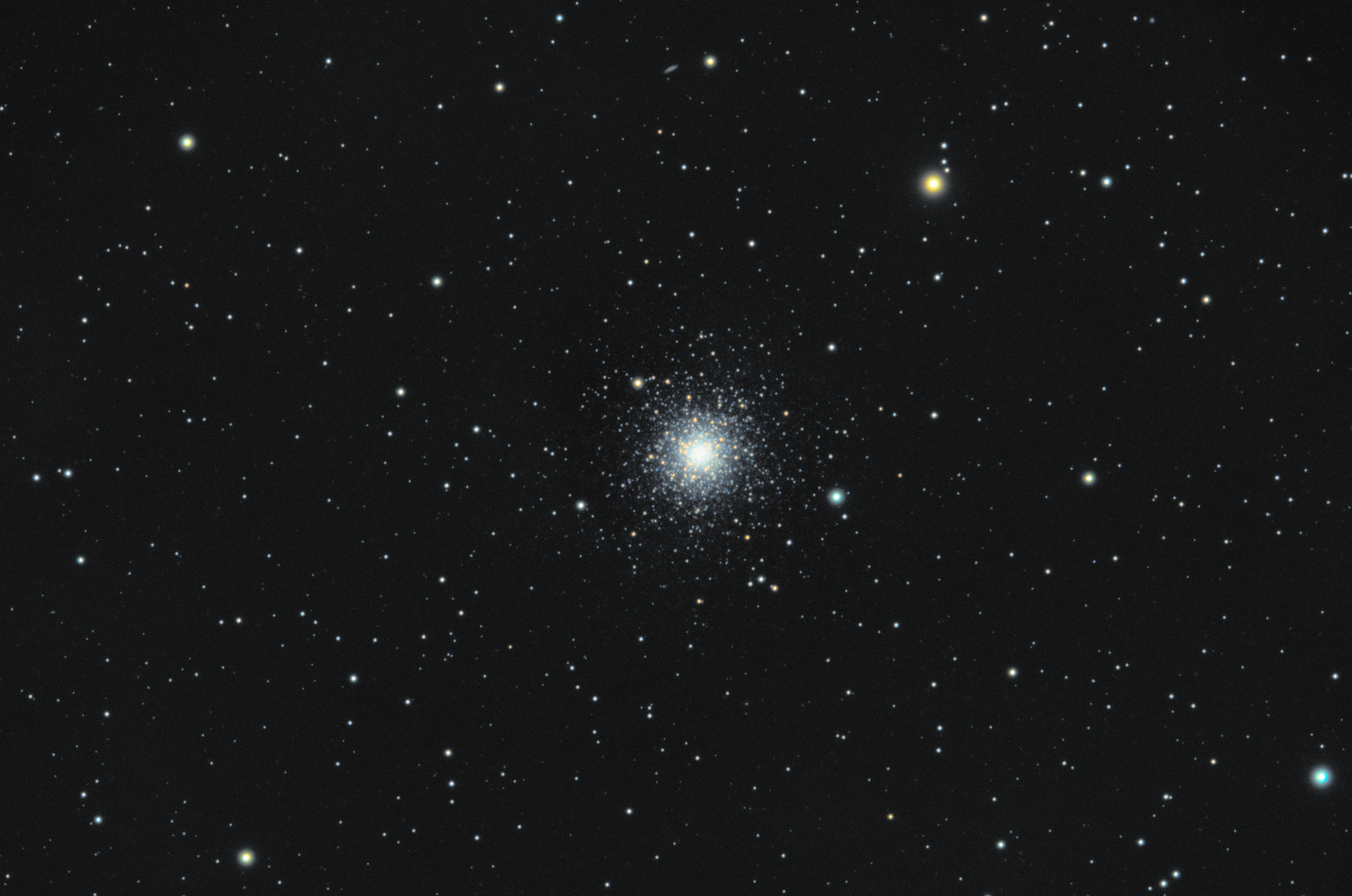
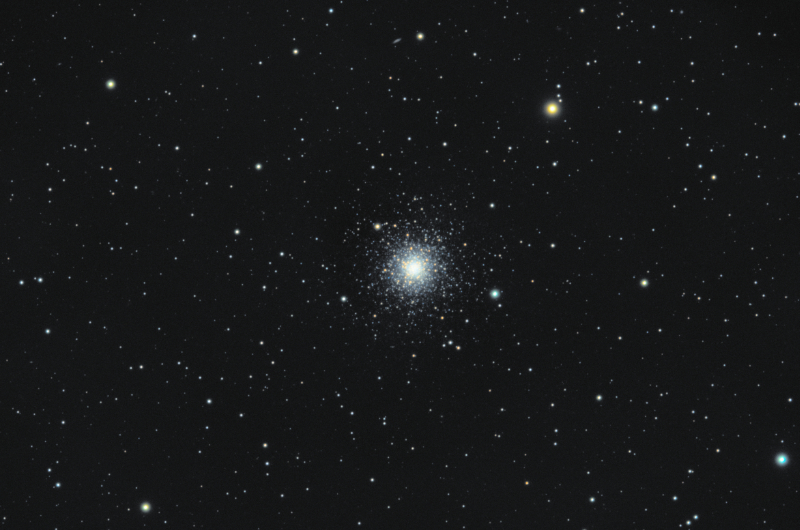
The M3 Star Cluster, also known as Messier 3, is a magnificent globular cluster located in the constellation Canes Venatici, about 33,900 light-years away from Earth. It is one of the largest and brightest globular clusters in the northern sky, spanning roughly 180 light-years in diameter and containing over 500,000 stars densely packed into a spherical shape.
M3 is an ancient stellar system, with stars estimated to be around 8 billion years old. Its densely populated core gives it a bright, almost glittering appearance through telescopes, while its outer regions gradually fade into the surrounding space. The cluster is rich in variable stars, particularly RR Lyrae types, which astronomers use to measure distances in the galaxy.
Visually, M3 appears as a bright, circular patch to the naked eye under very dark skies, but telescopes reveal a stunning collection of stars, densely concentrated at the center and gradually thinning toward the edges. M3 is a favorite target for amateur astronomers due to its brightness, size, and striking structure, making it a spectacular sight in springtime skies.
Technical Details
Telescope: Sky-Watcher Esprit 100ED Refractor
Auto Focus: ZWO Electronic Auto Focuser
Astronomy Camera: ZWO ASI183MC Pro
Filter: Optolong UV-IR cut filter; 120 exposures @ 60 seconds each (2 hours)
Total Integration Time: 2 hours
Auto Guiding: William Optics Uniguide 50mm Guide Scope
Auto Guiding Camera: ZWO ASI120MM Mini Guide Camera
Auto Guiding Software: PHD2
Telescope Mount: Sky- Watcher EQ6-R Pro Equatorial Mount
Telescope Computer: BeeLink GK-55 Mini PC / Windows 10 Pro
Wireless Communication: GL-iNEt Beryl Travel Router
Telescope Control & Image Capture Software: Nighttime Imaging ‘N’ Astronomy (N.I.N.A.)
Image Integration Software: Astro Pixel Process, by Aries Productions
Image Post Processing Software: PixInsight, by Pleiades Astrophoto
Images captured:
Palm Springs, CA during May 2021. Dark sky classification = Bright suburban sky (Bortle 6)
CLICK ON IMAGE TO VIEW A HIGH RESOLUTION VERSION
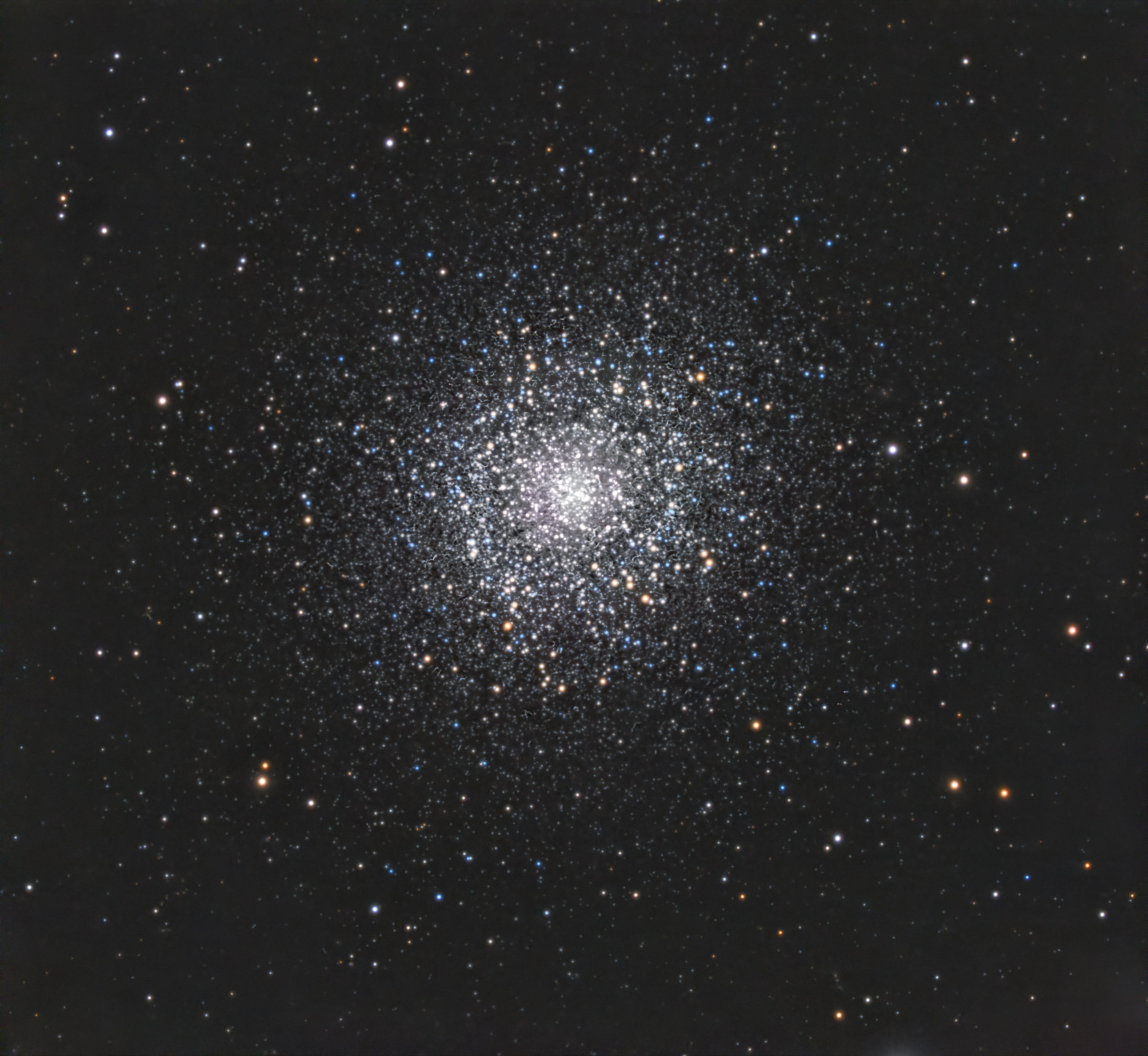
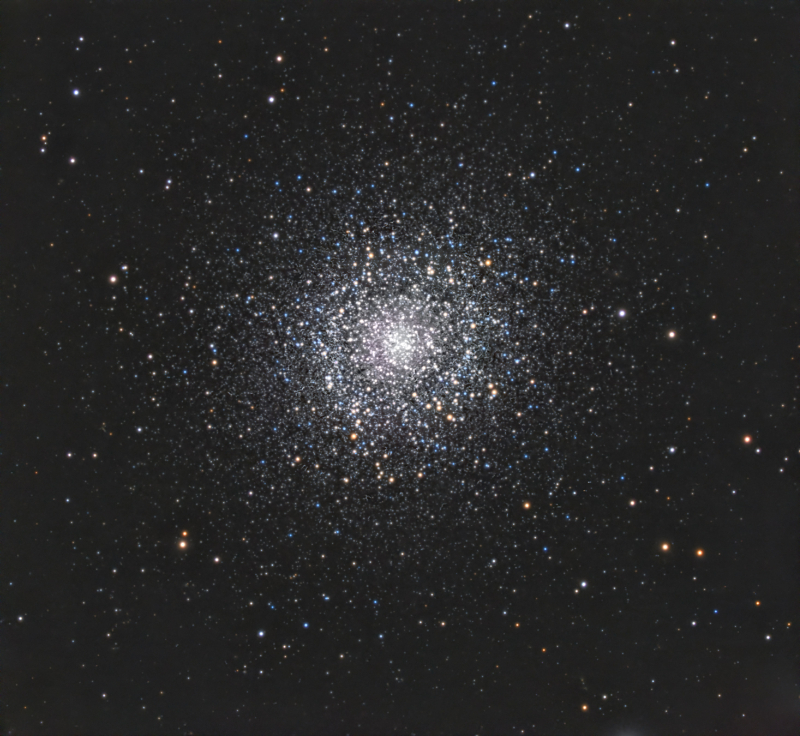
The M13 Hercules Cluster, also known as the Great Hercules Cluster, is one of the brightest and most spectacular globular clusters visible in the northern hemisphere. Located about 22,200 light-years away in the constellation Hercules, it spans roughly 145 light-years in diameter and contains several hundred thousand stars densely packed together.
M13 is a globular cluster, meaning it is a roughly spherical collection of ancient stars, many over 11 billion years old, orbiting the Milky Way’s center. Its core is extremely dense, giving it a shimmering, almost jewel-like appearance when viewed through a telescope. Under dark skies, it is visible to the naked eye as a faint, fuzzy patch, but even a small telescope reveals hundreds of individual stars arranged in a bright, concentrated core.
Astronomers have studied M13 extensively, not only for its stellar population but also because of its historical significance—in 1974, the Arecibo Observatory sent a radio message toward it as part of an interstellar communication experiment.
M13 remains a favorite target for amateur astronomers, offering a striking glimpse of a dense, ancient stellar system that has existed since the early days of our galaxy.
Technical Details
Telescope: Celestron C8 SCT (8″ Schmidt-Cassegrain) with Celestron 0.63 focal reducer
Auto Focus: Celestron Electronic Auto Focuser
Astronomy Camera: ZWO ASI533MC Pro
Filter: Optolong UV-IR cut filter; 360 exposures @ 60 seconds each (6 hours)
Total Integration Time: 6 hours
Off-Axis Auto Guiding: ZWO OAG-L
Auto Guiding Camera: ZWO ASI174MM Mini Guide Camera
Auto Guiding Software: PHD2
Telescope Mount: Sky- Watcher EQ6-R Pro
Telescope Computer: BeeLink GK-55 Mini PC / Windows 10 Pro
Wireless Communication: GL-iNEt Beryl Travel Router
Telescope Control & Image Capture Software: Nighttime Imaging ‘N’ Astronomy (N.I.N.A.)
Image Integration Software: Astro Pixel Process, by Aries Productions
Image Post Processing Software: PixInsight, by Pleiades Astrophoto
Images captured in Palm Springs, CA during June 2022. Dark sky classification = Bright suburban sky (Bortle 6)

CLICK ON IMAGE TO VIEW A HIGH RESOLUTION VERSION
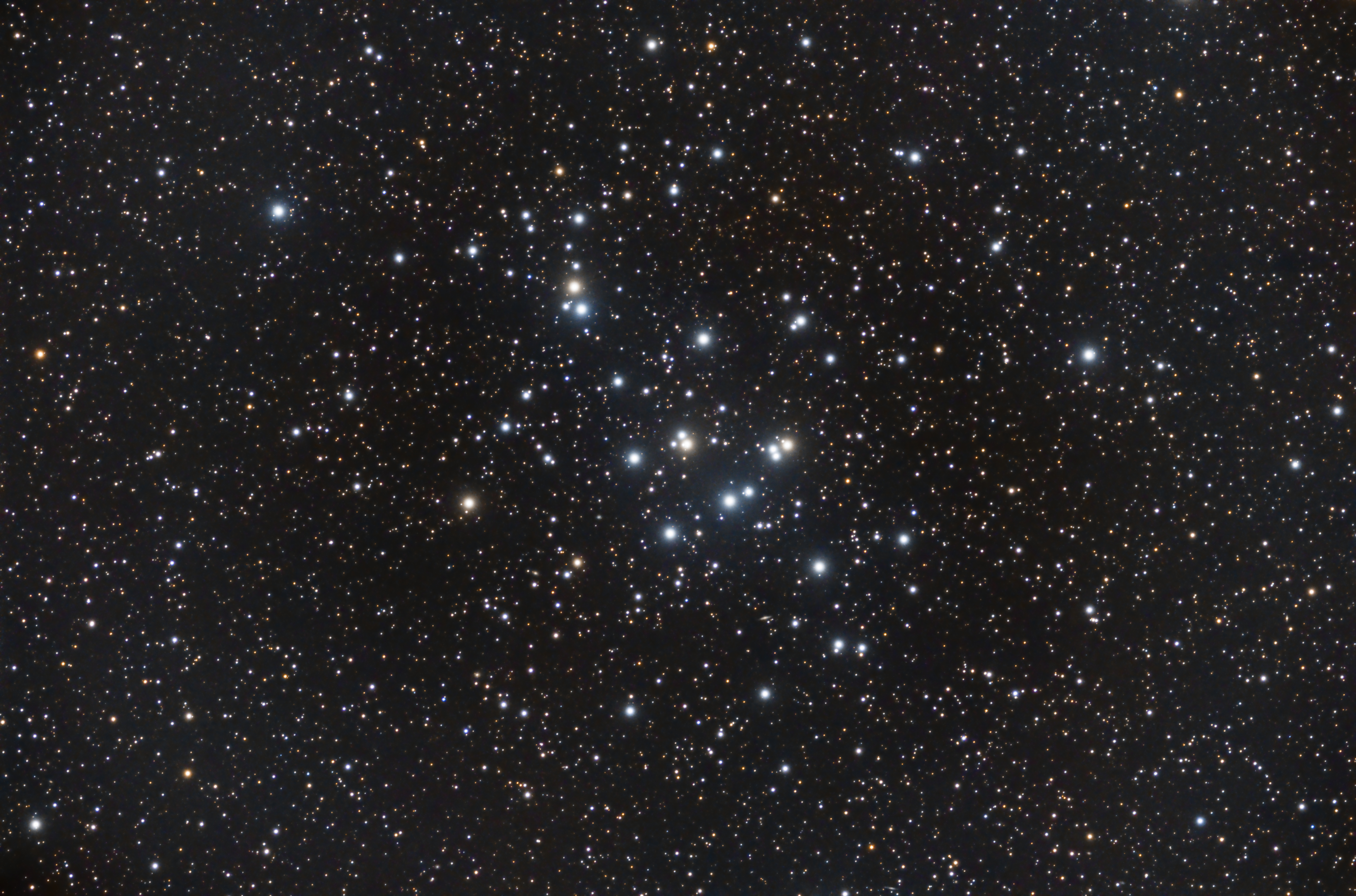
M44, also known as the Beehive Cluster or Praesepe, is one of the nearest and most prominent open star clusters in the night sky. Located in the constellation Cancer, it lies about 577 light-years from Earth and spans roughly 95 light-yearsin diameter. With an apparent magnitude of around 3.7, it is visible to the naked eye as a faint, misty patch and is easily seen with binoculars or a small telescope.
The cluster contains several hundred stars, mostly middle-aged, sun-like stars, though it also hosts some hotter, more massive stars. Its age is estimated to be around 600–700 million years, making it relatively mature for an open cluster. The stars are loosely bound by gravity, giving M44 its characteristic “swarm” appearance, which inspired its nickname, the Beehive Cluster.
M44 has fascinated astronomers for centuries; it was known to the ancient Greeks and Romans and has been a popular target for amateur and professional astronomers alike. Its combination of bright, sparkling stars and rich, dense grouping makes it an excellent showcase of stellar evolution and cluster dynamics in our galaxy.
Technical Details
Telescope: Sky-Watcher Esprit 100ED Refractor
Auto Focus: ZWO Electronic Auto Focuser
Astronomy Camera: ZWO ASI071MC Pro
Filter: Optolong UV-IR cut filter; 260 exposures @ 60 seconds each (4.3 hours)
Total Integration Time: 4.3 hours
Auto Guiding: William Optics Uniguide 50mm Guide Scope
Auto Guiding Camera: ZWO ASI120MM Mini Guide Camera
Auto Guiding Software: PHD2
Telescope Mount: Sky- Watcher EQ6-R Pro Equatorial Mount
Telescope Computer: BeeLink GK-55 Mini PC / Windows 10 Pro
Wireless Communication: GL-iNEt Beryl Travel Router
Telescope Control & Image Capture Software: Nighttime Imaging ‘N’ Astronomy (N.I.N.A.)
Image Integration Software: Astro Pixel Process, by Aries Productions
Image Post Processing Software: PixInsight, by Pleiades Astrophoto
Images captured:
Palm Springs, CA during September 2022. Dark sky classification = Bright suburban sky (Bortle 6)
CLICK ON IMAGE TO VIEW A HIGH RESOLUTION VERSION
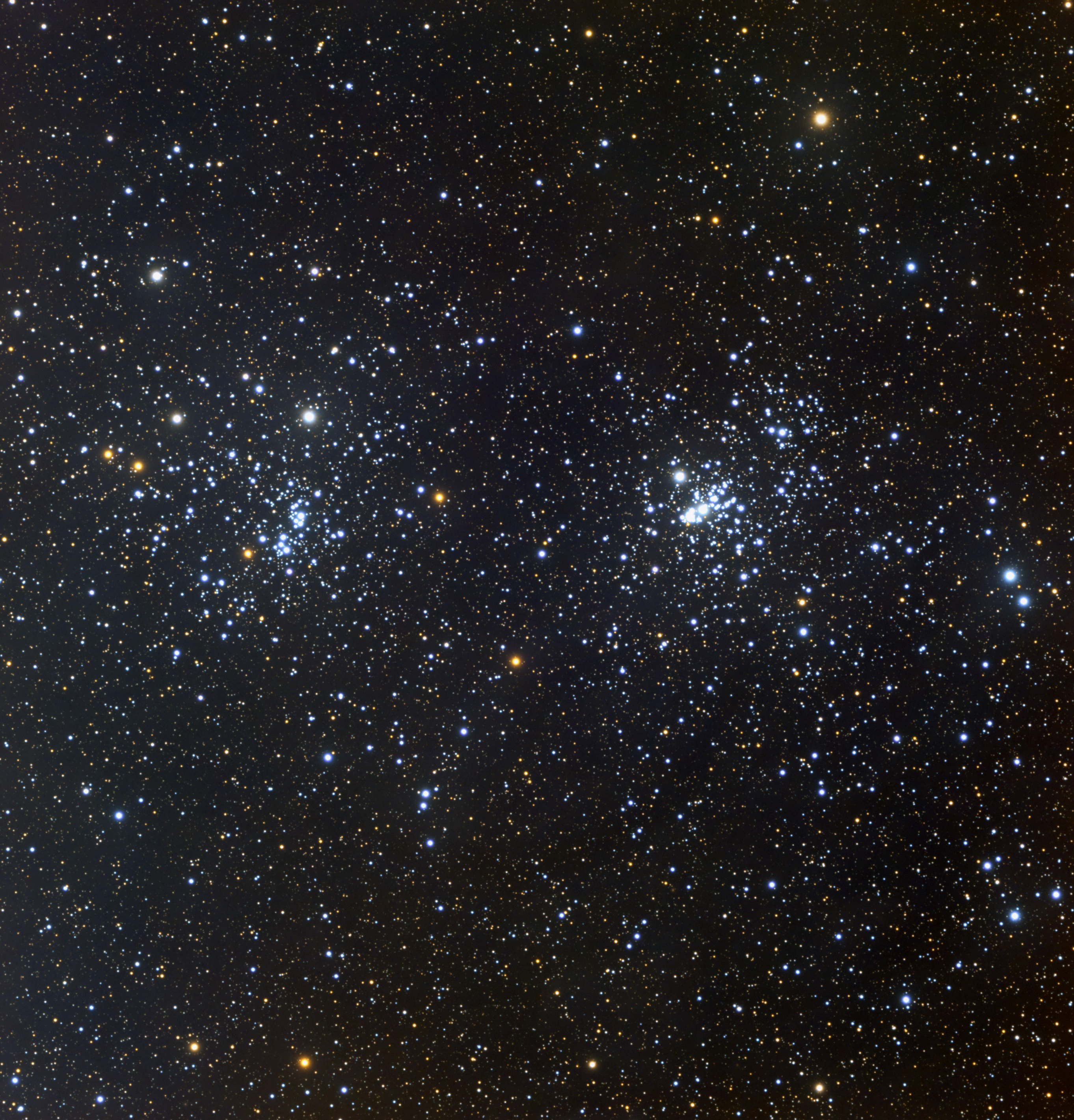
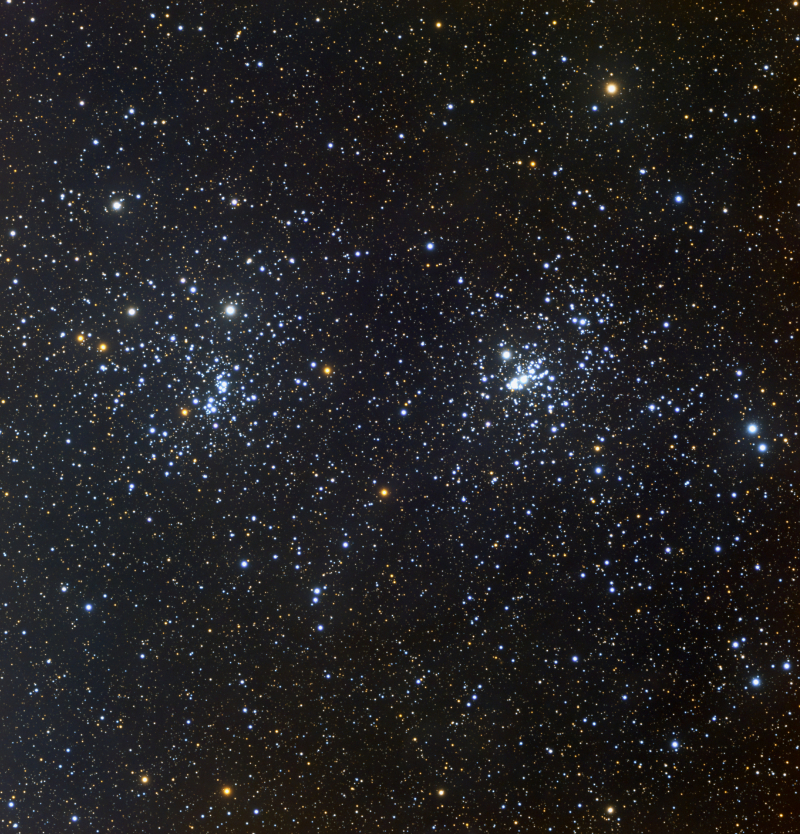
NGC 869 and NGC 884, famously known as the Double Cluster in Perseus, are a stunning pair of open star clusters that sit about 7,500 light-years away in the constellation Perseus. These clusters are relatively young, around 12.8 million years old, and shine brightly with hundreds of hot, blue-white stars, giving them a dazzling appearance through small telescopes or binoculars.
NGC 869, the slightly larger and brighter of the two, lies to the northwest, while NGC 884 sits just southeast of it. Together, they form a spectacular celestial pair easily visible to the naked eye under dark skies as a fuzzy patch. Their proximity and similar age suggest they likely formed from the same giant molecular cloud.
The Double Cluster has been admired since antiquity and has long been a favorite target for amateur astronomers due to its striking beauty, rich stellar population, and the dramatic contrast between the clusters’ young, luminous stars and the dark backdrop of space. It’s often described as one of the crown jewels of northern-sky deep-sky objects.
Technical Details
Telescope: Sky-Watcher Esprit 100ED Refractor
Auto Focus: ZWO Electronic Auto Focuser
Astronomy Camera: ZWO ASI533MC Pro
Filter: Optolong UV-IR cut filter; 1,020 exposures @ 60 seconds each (17 hours)
Total Integration Time: 17 hours
Auto Guiding: William Optics Uniguide 50mm Guide Scope
Auto Guiding Camera: ZWO ASI120MM Mini Guide Camera
Auto Guiding Software: PHD2
Telescope Mount: Sky- Watcher EQ6-R Pro Equatorial Mount
Telescope Computer: BeeLink GK-55 Mini PC / Windows 10 Pro
Wireless Communication: GL-iNEt Beryl Travel Router
Telescope Control & Image Capture Software: Nighttime Imaging ‘N’ Astronomy (N.I.N.A.)
Image Integration Software: Astro Pixel Process, by Aries Productions
Image Post Processing Software: PixInsight, by Pleiades Astrophoto
Images captured:
Palm Springs, CA during December 2022. Dark sky classification = Bright suburban sky (Bortle 6)
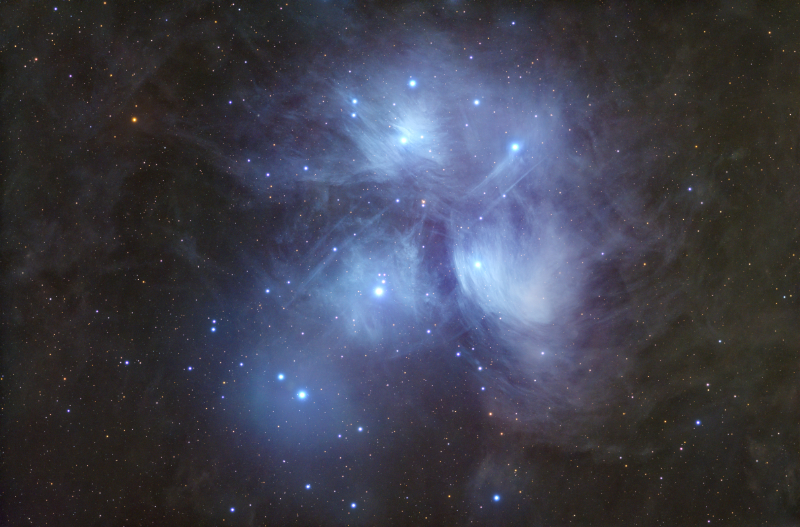
CLICK ON IMAGE TO VIEW A HIGH RESOLUTION VERSION
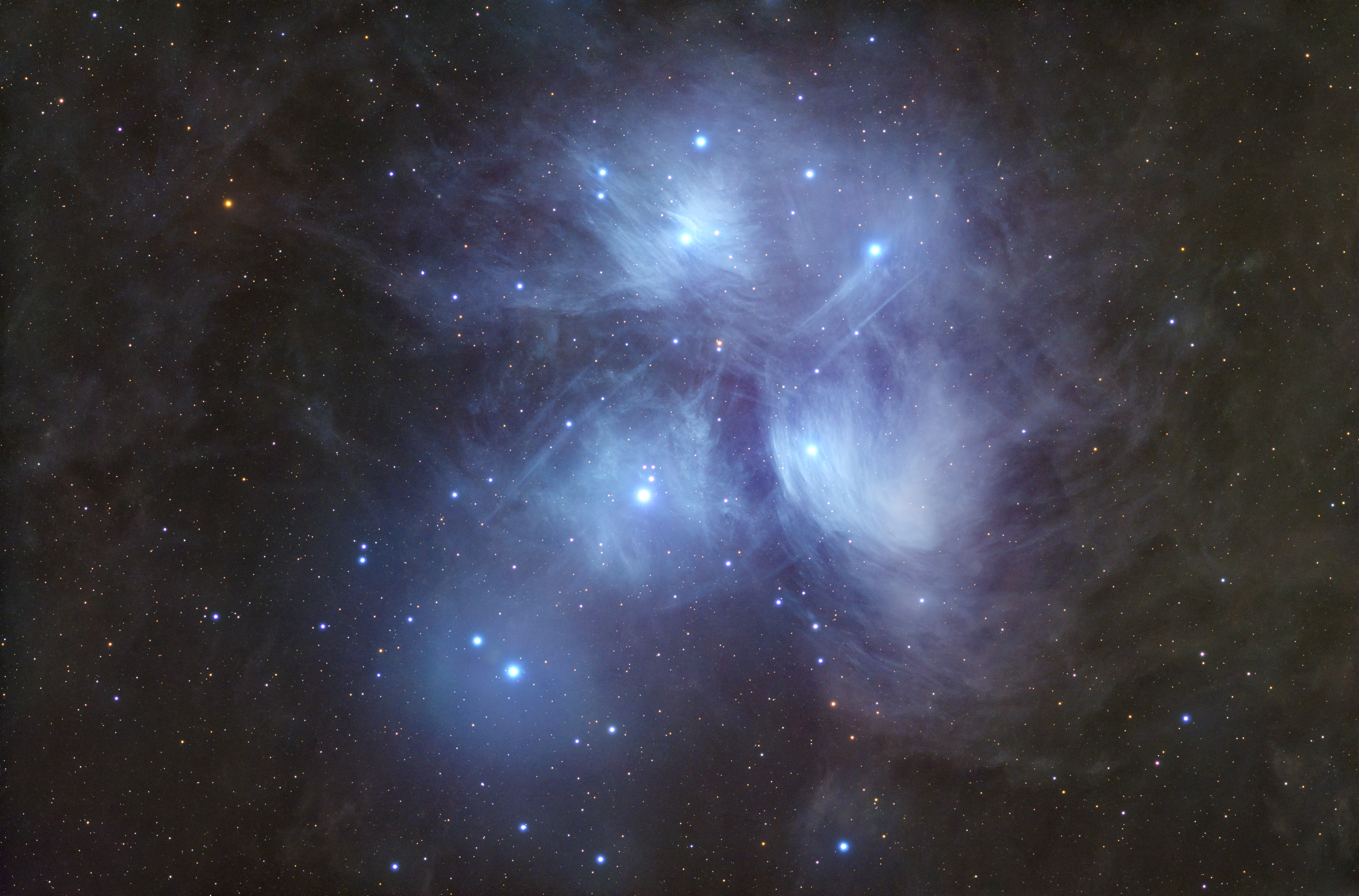
M45, famously known as the Pleiades or the Seven Sisters, is one of the most striking and easily recognizable open star clusters in the night sky. Located in the constellation Taurus, this cluster lies approximately 440 light-years from Earth. Its core contains several dozen bright, hot, blue-white stars, though modern telescopes and binoculars reveal hundreds of fainter members, all born from the same molecular cloud around 100 million years ago.
The Pleiades are often surrounded by a delicate haze of reflection nebulae, caused by interstellar dust scattering the light of these luminous stars, giving the cluster its ethereal glow in astrophotography. The brightest stars—Alcyone, Maia, Electra, Merope, Taygeta, Celaeno, and Asterope—form the iconic pattern that has inspired myths across cultures, from Greek legends to indigenous traditions worldwide.
M45 is not just a beautiful sight; it’s a laboratory for studying stellar evolution, particularly the early stages of star development, as its young stars are still shedding material and influencing the surrounding interstellar medium. Even with the naked eye, M45 is a celestial gem, shimmering like a miniature dipper of stars against the dark winter sky.
Technical Details
Telescope: Sky-Watcher Esprit 100ED Refractor
Auto Focus: ZWO Electronic Auto Focuser
Astronomy Camera: ZWO ASI071MC Pro
Filter: Optolong UV-IR cut filter; 360 X 60sec each @ 53 gain (6 hours)
Filter: Optolong UV-IR cut filter; 360 X 60sec each @ 94 gain (6 hours)
Total Integration Time: 12 hours
Auto Guiding: William Optics Uniguide 50mm Guide Scope
Auto Guiding Camera: ZWO ASI120MM Mini Guide Camera
Auto Guiding Software: PHD2
Telescope Mount: Sky- Watcher EQ6-R Pro Equatorial Mount
Telescope Computer: BeeLink GK-55 Mini PC / Windows 10 Pro
Wireless Communication: GL-iNEt Beryl Travel Router
Telescope Control & Image Capture Software: Nighttime Imaging ‘N’ Astronomy (N.I.N.A.)
Image Integration Software: Astro Pixel Process, by Aries Productions
Image Post Processing Software: PixInsight, by Pleiades Astrophoto
Images captured:
Palm Springs, CA during October 2025. Dark sky classification = Bright suburban sky (Bortle 6)