Category Archives: Astrophotography

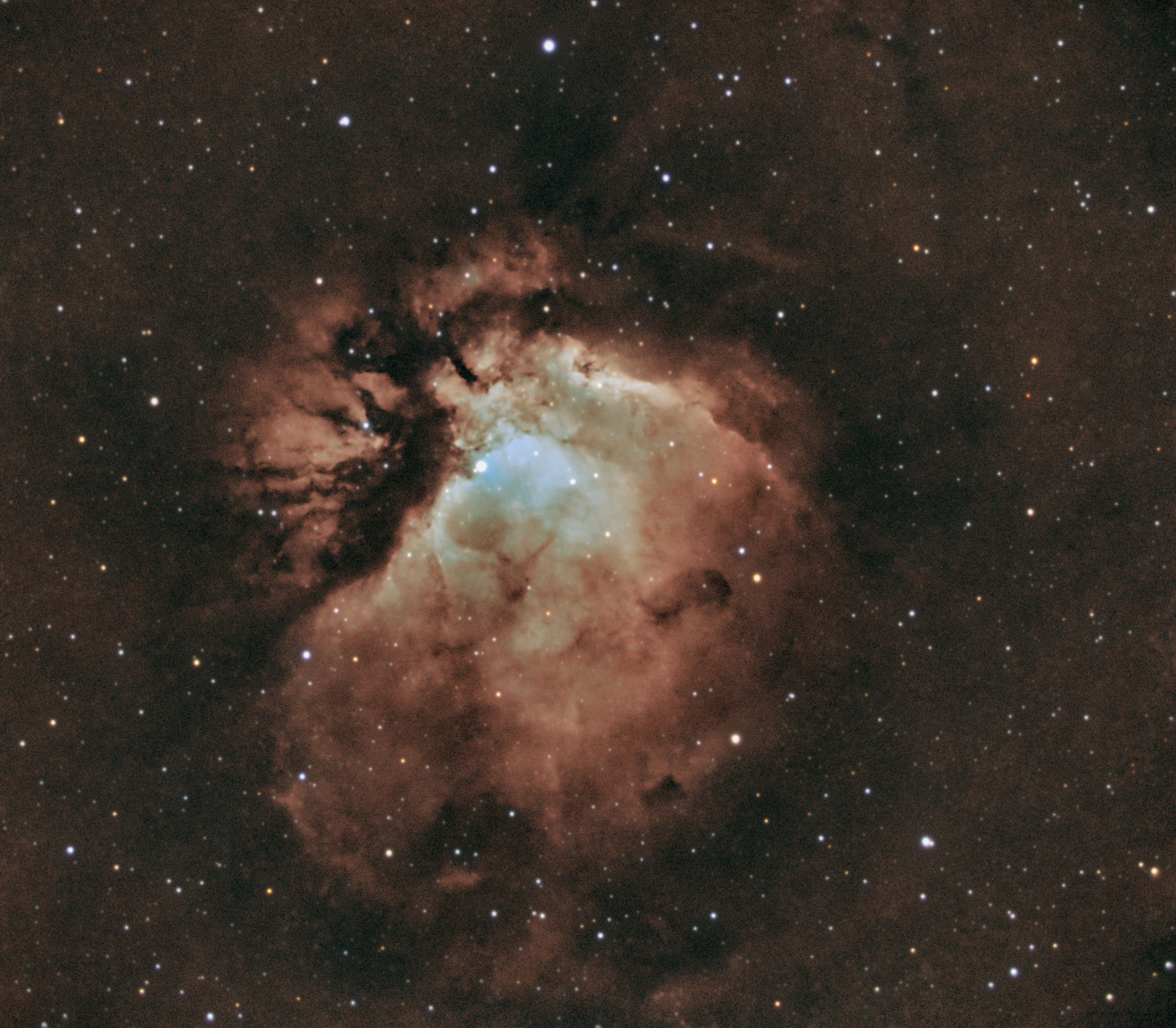
SH2-112 Nebula in Cygnus

CLICK ON IMAGE TO VIEW A HIGH RESOLUTION VERSION

SH2-112 is embedded in the rich star fields of the northern Milky Way, forming part of a larger complex of ionized gas and dark dust. The region is a classic H II nebula, where energetic ultraviolet radiation from young, massive stars excites surrounding hydrogen, causing it to glow in deep reds and subtle magenta hues.

SH2-112 appears as a soft, diffuse cloud with gentle arcs and filaments of glowing gas, partially veiled by dark interstellar dust. Its structure hints at ongoing star formation, with faint, uneven illumination revealing the turbulent interactions between stellar winds and the surrounding medium.


Technical Details

Telescope: Celestron C8 SCT (8″ Schmidt-Cassegrain) with Celestron 0.63 Focal Reducer

Auto Focus: Celestron Electronic Auto Focuser

Astronomy Camera: ZWO ASI533MC Pro

Filter: Optolong UV-IR  cut filter; 180 exposures @ 60 seconds each (3 hours)

Filter: Optolong Lenhance Dual Narrowband Ha/Oiii Filter; 156 exposures @ 5 minutes each (13 hours)

Total Integration Time: 16 hours

Off-Axis Auto Guiding: ZWO OAG-L

Auto Guiding Camera: ZWO ASI174MM Mini Guide Camera

Telescope Mount: Celestron Equatorial Mount

Telescope Computer: BeeLink GK-55 Mini PC / Windows 10 Pro

Wireless Communication: GL-iNEt Beryl Travel Router

Telescope Control & Image Capture Software: Nighttime Imaging ‘N’ Astronomy (N.I.N.A.)

Image Integration Software: Astro Pixel Process, by Aries Productions

Image Post Processing Software:  PixInsight, by Pleiades Astrophoto

Images captured in Palm Springs, CA during July 2023. Dark sky classification = Bright suburban sky (Bortle 6).
SH2-112 and SH2-115 Nebulae in Cygnus

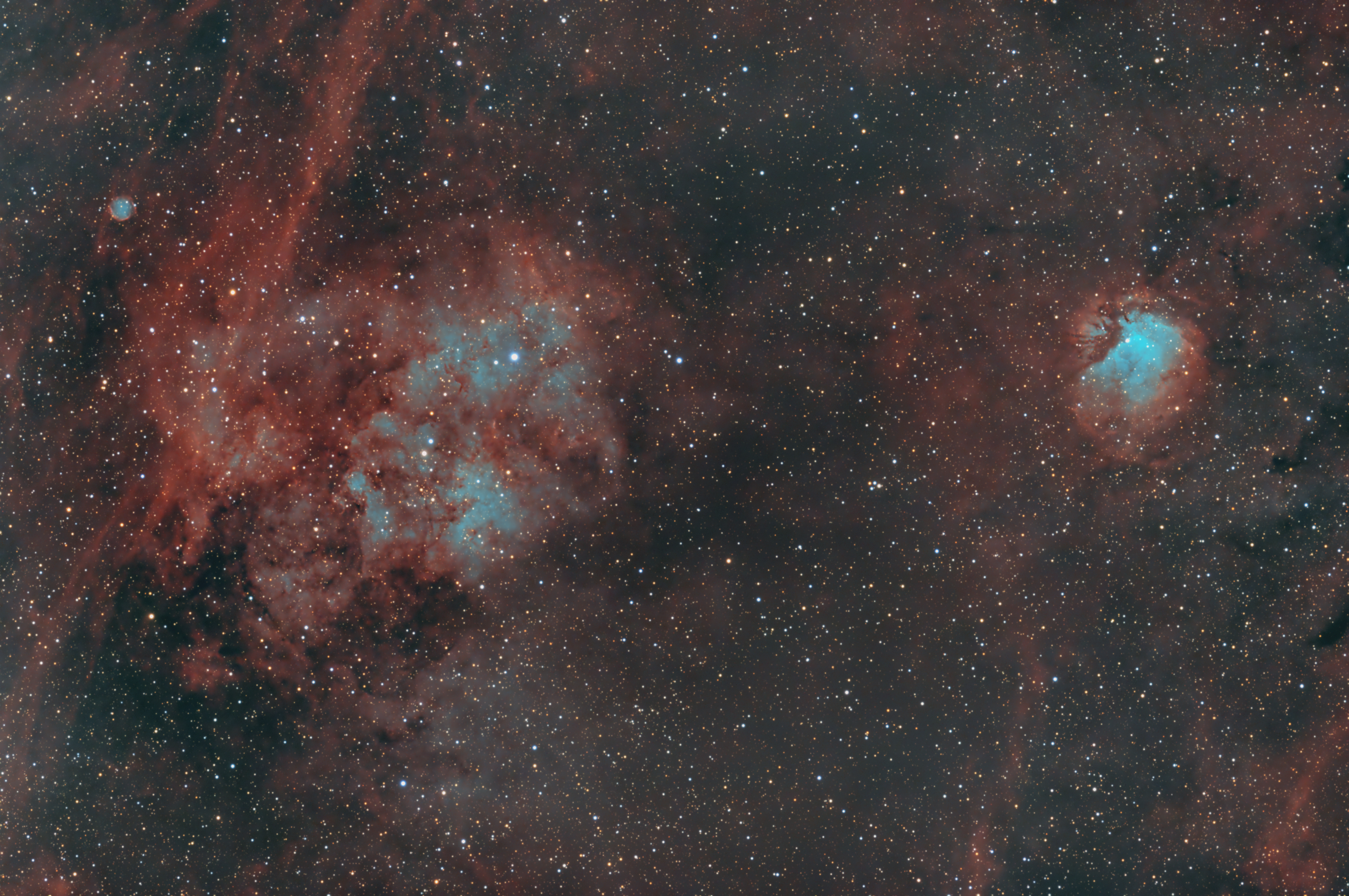
SH2-115 (left) and SH2-112 (right)

CLICK ON IMAGE TO VIEW A HIGH RESOLUTION VERSION

SH2-112 and SH2-115 are neighboring emission nebulae embedded in the rich star fields of the northern Milky Way, forming part of a larger complex of ionized gas and dark dust. These regions are classic H II nebulae, where energetic ultraviolet radiation from young, massive stars excites surrounding hydrogen, causing it to glow in deep reds and subtle magenta hues.

SH2-112 appears as a soft, diffuse cloud with gentle arcs and filaments of glowing gas, partially veiled by dark interstellar dust. Its structure hints at ongoing star formation, with faint, uneven illumination revealing the turbulent interactions between stellar winds and the surrounding medium.

SH2-115, in contrast, is brighter and more defined, often showing sharper boundaries and brighter knots where stellar radiation is most intense. Embedded stars carve cavities and edges in the nebula, giving it a textured, layered appearance that stands out against the background of the Milky Way.

Together, SH2-112 and SH2-115 create a subtle but captivating portrait of stellar birth and evolution—an intricate balance of light and shadow that showcases the dynamic processes shaping our galaxy.


Technical Details

Telescope: Sky-Watcher Esprit 100ED Refractor

Auto Focus: ZWO Electronic Auto Focuser

Astronomy Camera: ZWO ASI071MC Pro

Filter: Optolong UV-IR  cut filter; 120 exposures @ 60 seconds each (2 hours) 

Filter: Antlia ALP-T Dual Narrowband Ha/Oiii Filter; 294 exposures @ 5 minutes each (24.5 hours) 

Total Integration Time: 26.5 hours

Auto Guiding: William Optics Uniguide 50mm Guide Scope

Auto Guiding Camera: ZWO ASI120MM Mini Guide Camera

Auto Guiding Software: PHD2

Telescope Mount: Sky- Watcher EQ6-R Pro Equatorial Mount

Telescope Computer: BeeLink GK-55 Mini PC / Windows 10 Pro

Wireless Communication: GL-iNEt Beryl Travel Router

Telescope Control & Image Capture Software: Nighttime Imaging ‘N’ Astronomy (N.I.N.A.)

Image Integration Software: Astro Pixel Process, by Aries Productions

Image Post Processing Software:  PixInsight, by Pleiades Astrophoto

Images captured: Palm Springs, CA during July 2023. Dark sky classification = Bright suburban sky (Bortle 6)

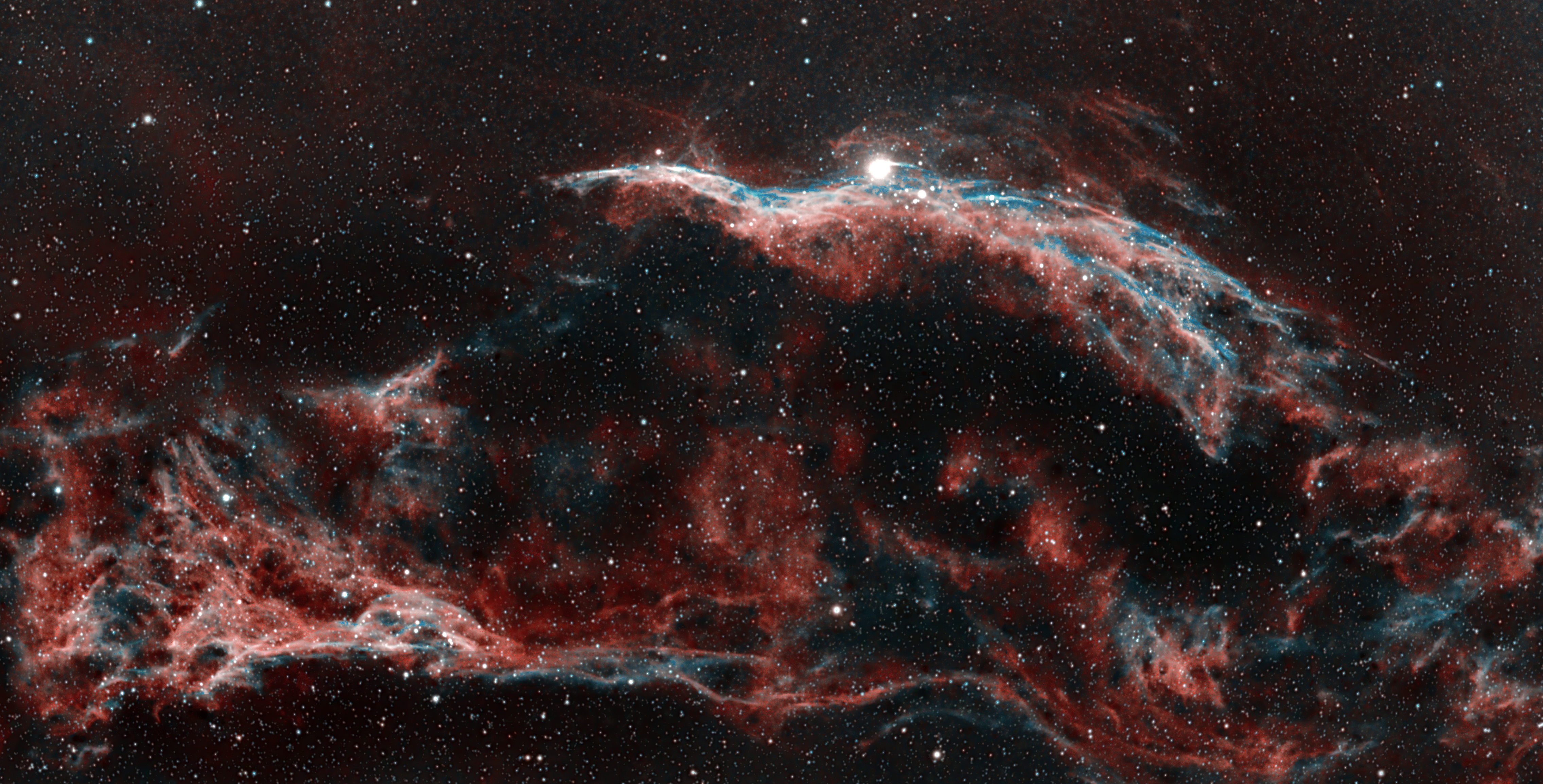
NGC6960 Western Veil Nebula

CLICK ON IMAGE TO VIEW A HIGH RESOLUTION VERSION

NGC 6992, known as the Eastern Veil Nebula, is a stunning and intricate portion of the larger Veil Nebula, a supernova remnant located in the constellation Cygnus. This nebula represents the expanding remains of a massive star that exploded thousands of years ago, scattering delicate filaments of ionized gas across space.

The Eastern Veil is especially notable for its wispy, lace-like structures, glowing in vivid reds from hydrogen emissionand blues from oxygen emission, which create a striking contrast against the dark backdrop of the Milky Way. Its intricate filaments and arcs give it an almost ethereal appearance, as if painted with cosmic brushstrokes.

At a distance of roughly 2,400 light-years from Earth, NGC 6992 spans several light-years across, making it a favorite target for astrophotographers who capture its complex, glowing tendrils. The nebula’s beauty is not only visual—it also provides astronomers with insight into the dynamics of supernova explosions and the behavior of interstellar gas.


Technical Details

Telescope: William Optics Zenithstar 61ii Refractor

Auto Focus: ZWO Electronic Auto Focuser

Astronomy Camera: ZWO ASI071MC Pro

Filter: Optolong Lenhance Dual Narrowband Ha/Oiii Filter; 120 exposures @ 5 minutes each (10 hours) 

Total Integration Time: 10 hours

Auto Guiding: William Optics Uniguide 32mm Guide Scope

Auto Guiding Camera: ZWO ASI120MM Mini Guide Camera

Auto Guiding Software: PHD2

Telescope Mount: Celestron CGX Equatorial Mount

Telescope Computer: BeeLink GK-55 Mini PC / Windows 10 Pro

Wireless Communication: GL-iNEt Beryl Travel Router

Telescope Control & Image Capture Software: Nighttime Imaging ‘N’ Astronomy (N.I.N.A.)

Image Integration Software: Astro Pixel Process, by Aries Productions

Image Post Processing Software:  PixInsight, by Pleiades Astrophoto

Images captured: Palm Springs, CA during August 2021. Dark sky classification = Bright suburban sky (Bortle 6)

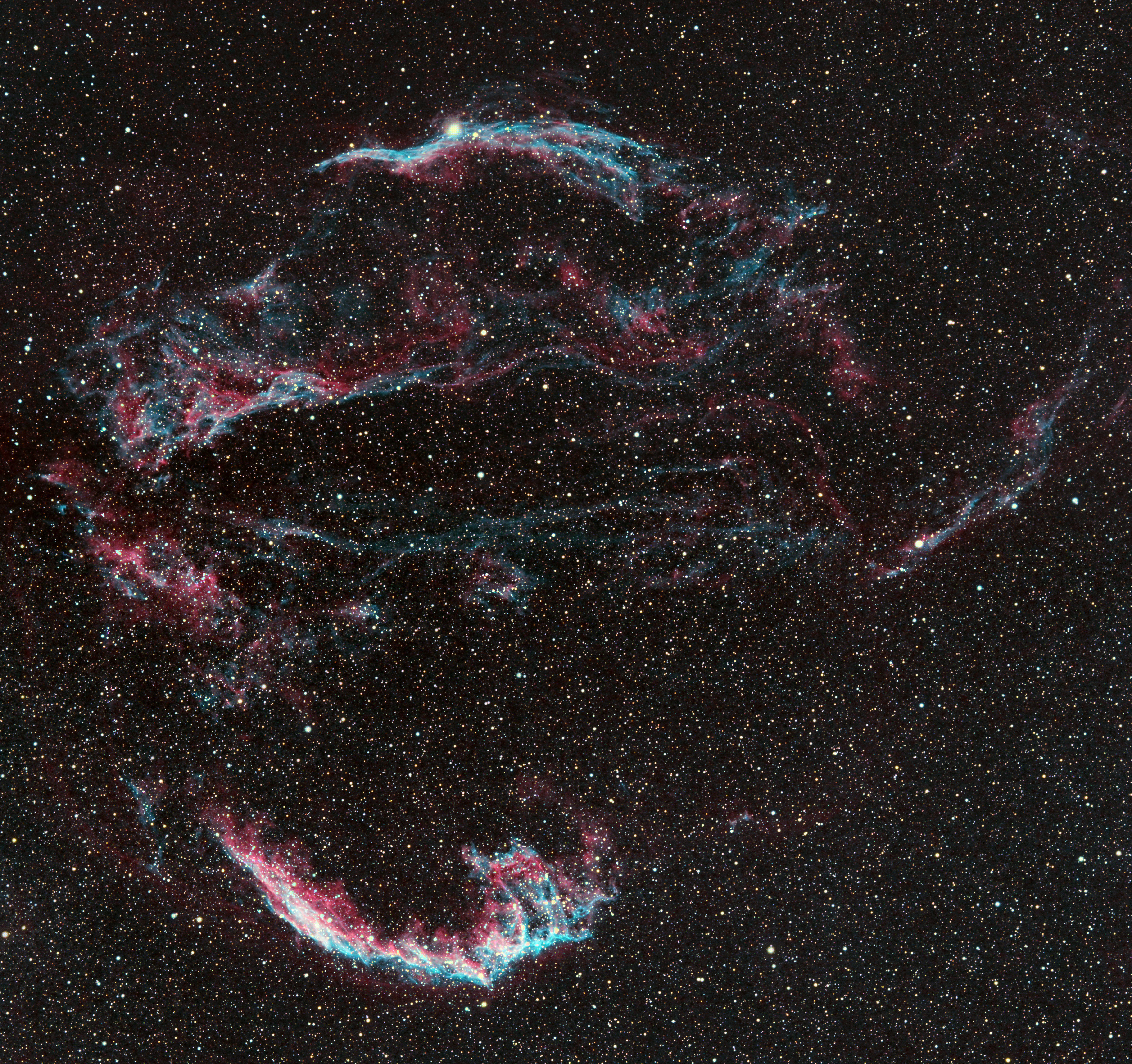
SH2-103 Cygnus Loop

CLICK ON IMAGE TO VIEW A HIGH RESOLUTION VERSION

SH2-103, also known as Sharpless 103, is an emission nebula located in the constellation Cepheus. This glowing cloud of ionized gas is energized by nearby massive young stars, causing it to radiate in vibrant hues of red from hydrogen-alpha emissions. The nebula exhibits a complex, irregular structure, with bright knots, filaments, and dark lanes that hint at turbulent processes of star formation within. Although not as famous as some of its neighboring nebulae, SH2-103 is a striking example of a stellar nursery where new stars are born, sculpting the surrounding gas with powerful stellar winds and radiation. Its rich textures make it a rewarding target for astrophotographers exploring the northern sky.

It also contains NGC6960 (TheWestern Veil Nebula) and NGC6992 (The Eastern Veil Nebula).


Technical Details

The image is a two panel mosaic.

Telescope: William Optics Zenithstar 61ii Refractor

Auto Focus: ZWO Electronic Auto Focuser

Astronomy Camera: ZWO ASI071MC Pro


Panel 1 Filter: Optolong UV-IR  cut filter; 180 exposures @ 60 seconds each (3 hours) 

Panel 1 Filter: Optolong UV-IR  cut filter; 180 exposures @ 60 seconds each (3 hours)


Panel 1 Filter: Antlia ALP-T Dual Narrowband Ha/Oiii Filter; 180 exposures @ 5 minutes each (15 hours)

Panel 2 Filter: Antlia ALP-T Dual Narrowband Ha/Oiii Filter; 180 exposures @ 5 minutes each (15 hours) 


Total Integration Time (each panel): 18 hours

Auto Guiding: William Optics Uniguide 50mm Guide Scope

Auto Guiding Camera: ZWO ASI120MM Mini Guide Camera

Auto Guiding Software: PHD2

Telescope Mount: Celestron CGX Equatorial Mount

Telescope Computer: BeeLink GK-55 Mini PC / Windows 10 Pro

Wireless Communication: GL-iNEt Beryl Travel Router

Telescope Control & Image Capture Software: Nighttime Imaging ‘N’ Astronomy (N.I.N.A.)

Image Integration Software: Astro Pixel Process, by Aries Productions

Image Post Processing Software:  PixInsight, by Pleiades Astrophoto

Images captured: Palm Springs, CA during July 2022. Dark sky classification = Bright suburban sky (Bortle 6)