Category Archives: Astrophotography

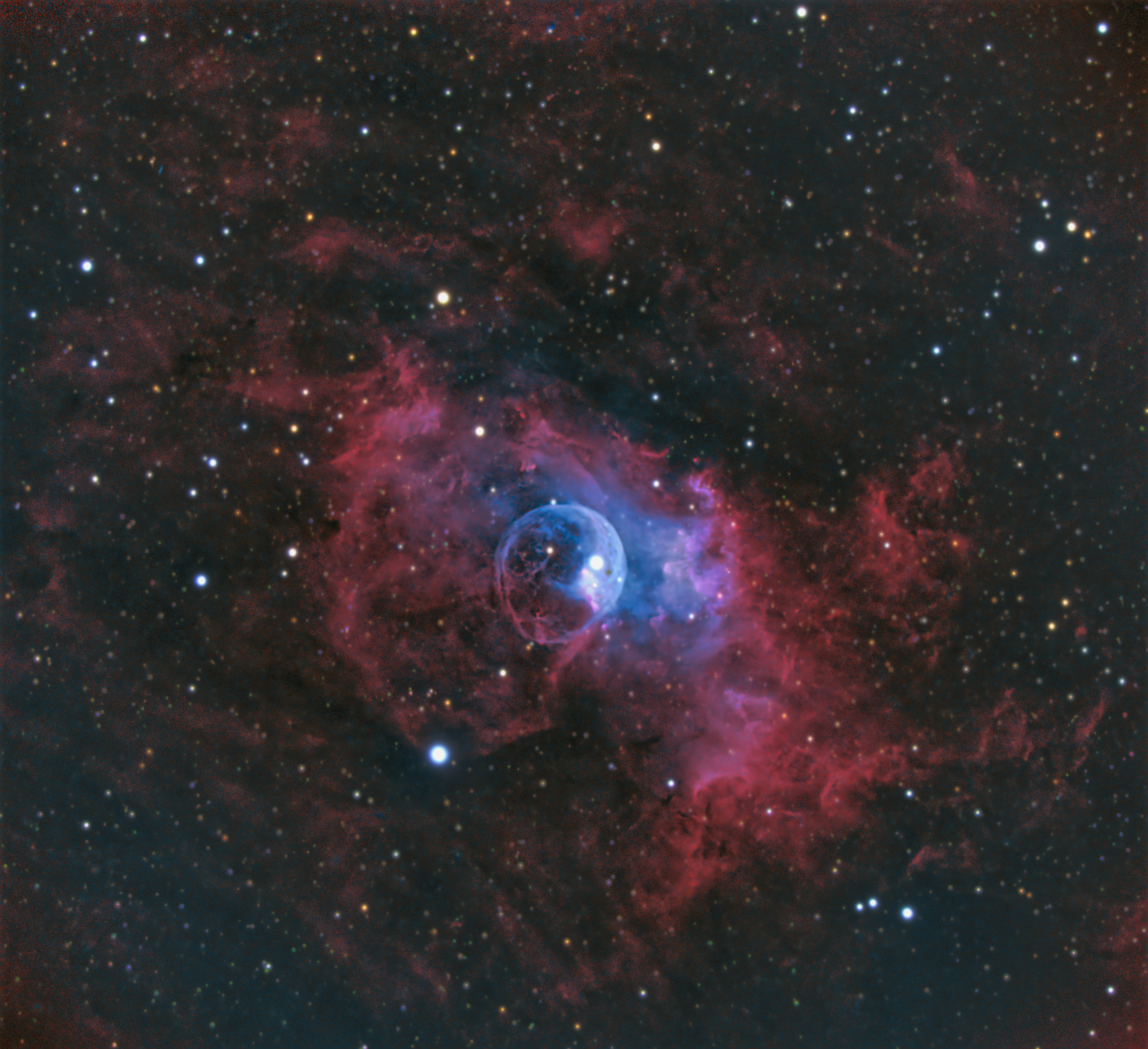
NGC7635 Bubble Nebula

CLICK ON IMAGE TO VIEW A HIGH RESOLUTION VERSION

NGC 7635 – The Bubble Nebula is a striking emission nebula located in the constellation Cassiopeia, roughly 7,100 light-years away from Earth. Its most distinctive feature is the enormous, spherical “bubble” of gas and dust, inflated by the powerful stellar wind from a massive, hot O-type star at its center, known as BD+60°2522. The bubble measures about 10 light-years across, glowing vividly as ultraviolet radiation from the central star excites the surrounding hydrogen gas.

The nebula’s surroundings are equally fascinating. Dense molecular clouds and dark dust lanes create a dramatic contrast against the luminous bubble, giving it a sculpted, almost three-dimensional appearance in astrophotography. The interaction between the stellar wind and the interstellar medium produces complex shapes, ripples, and bright edges, making the Bubble Nebula a favorite target for both amateur and professional astronomers.

Visible through medium-sized telescopes, NGC 7635 shines with a soft red hue from ionized hydrogen, while long-exposure images reveal intricate filaments and knots that hint at the turbulent forces shaping this cosmic masterpiece.


Technical Details

Telescope: Celestron C8 SCT (8″ Schmidt-Cassegrain) with Celestron 0.63 Focal Reducer

Auto Focus: Celestron Electronic Auto Focuser

Astronomy Camera: ZWO ASI533MC Pro

Filter: Optolong UV-IR  cut filter; 360 exposures @ 60 seconds each (6 hours)

Filter: Optolong Lenhance Dual Narrowband Ha/Oiii Filter; 230 exposures @ 5 minutes each (19.2 hours)

Total Integration Time: 25.2 hours

Off-Axis Auto Guiding: ZWO OAG-L

Auto Guiding Camera: ZWO ASI174MM Mini Guide Camera

Telescope Mount: Sky- Watcher EQ6-R Pro Equatorial Mount

Telescope Computer: BeeLink GK-55 Mini PC / Windows 10 Pro

Wireless Communication: GL-iNEt Beryl Travel Router

Telescope Control & Image Capture Software: Nighttime Imaging ‘N’ Astronomy (N.I.N.A.)

Image Integration Software: Astro Pixel Process, by Aries Productions

Image Post Processing Software:  PixInsight, by Pleiades Astrophoto

Images captured in Palm Springs, CA July 2024. Dark sky classification = Bright suburban sky (Bortle 6).
 

NGC7380 Wizard Nebula

CLICK ON IMAGE TO VIEW A HIGH RESOLUTION VERSION

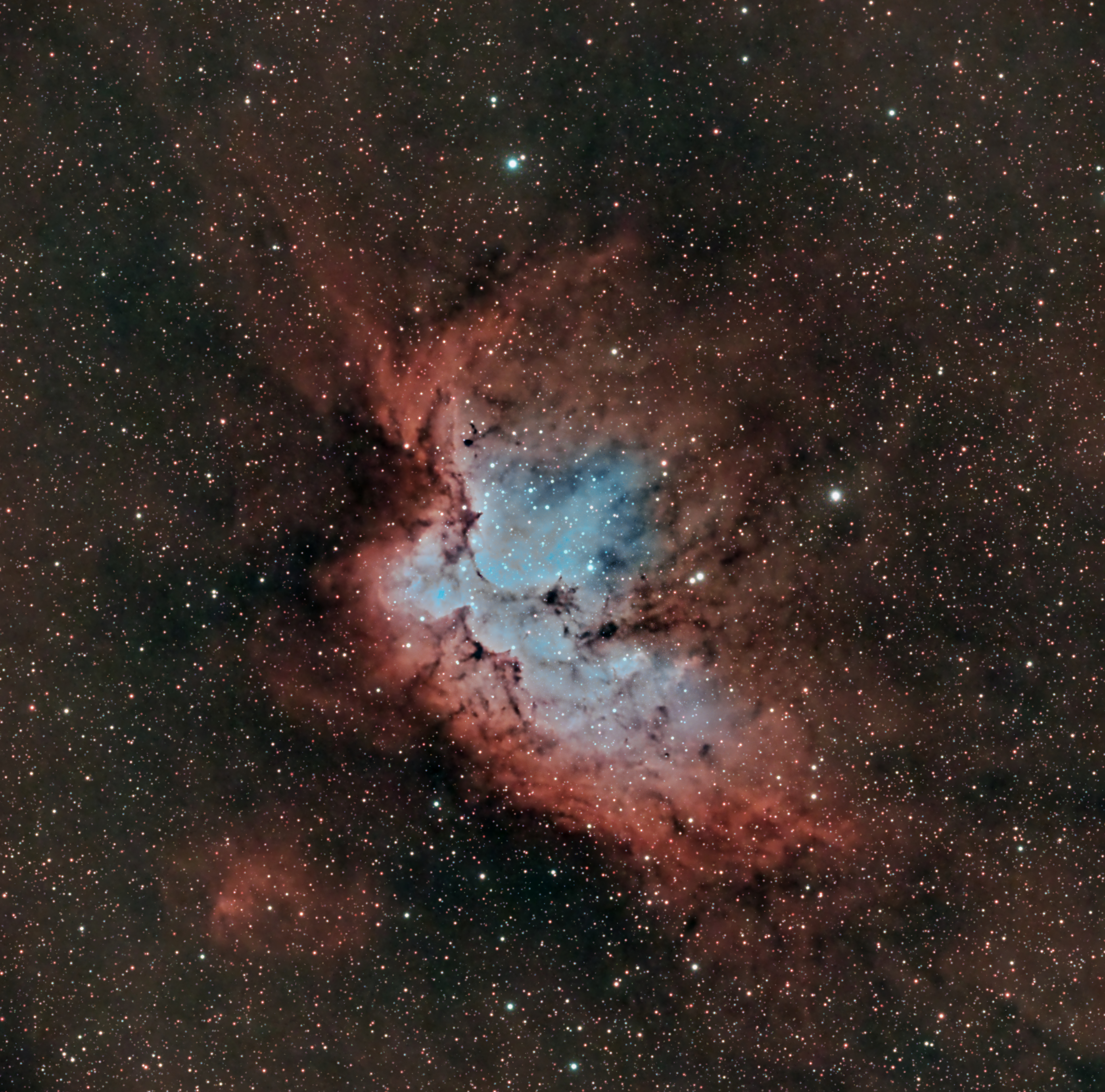
Nestled in the constellation Cepheus, the Wizard Nebula is a striking emission nebula and young open star clusterlocated roughly 7,200 light-years from Earth. Its nickname comes from the ghostly shape of the nebula’s swirling gas and dust, which resembles a robed figure—a celestial wizard casting its spell across the cosmos.

The nebula is energized by the intense radiation of its hot, massive stars, which illuminate and sculpt the surrounding clouds of hydrogen gas, creating intricate filaments, pillars, and dark lanes. These stellar nurseries are regions of ongoing star formation, where new stars are being born from dense pockets of gas.

NGC 7380 spans about 100 light-years and is particularly vibrant in H-alpha light, giving it a reddish-pink hue in astrophotography. The combination of young stars, glowing gas, and dramatic dark dust lanes makes it a favorite target for amateur astronomers and astrophotographers alike. Its magical, almost otherworldly appearance has made it a true “wizard” of the night sky.


Technical Details

Telescope: Sky-Watcher Esprit 100ED Refractor

Auto Focus: ZWO Electronic Auto Focuser

Astronomy Camera: ZWO ASI533MC Pro

Filter: Antlia ALP-T Dual Narrowband Ha/Oiii Filter; 432 exposures @ 5 minutes each (36 hours) 

Total Integration Time: 36 hours

Auto Guiding: William Optics Uniguide 50mm Guide Scope

Auto Guiding Camera: ZWO ASI120MM Mini Guide Camera

Auto Guiding Software: PHD2

Telescope Mount: Sky- Watcher EQ6-R Pro Equatorial Mount

Telescope Computer: BeeLink GK-55 Mini PC / Windows 10 Pro

Wireless Communication: GL-iNEt Beryl Travel Router

Telescope Control & Image Capture Software: Nighttime Imaging ‘N’ Astronomy (N.I.N.A.)

Image Integration Software: Astro Pixel Process, by Aries Productions

Image Post Processing Software:  PixInsight, by Pleiades Astrophoto

Images captured: Palm Springs, CA during August 2022. Dark sky classification = Bright suburban sky (Bortle 6)

NGC7293 Helix Nebula

CLICK ON IMAGE TO VIEW A HIGH RESOLUTION VERSION

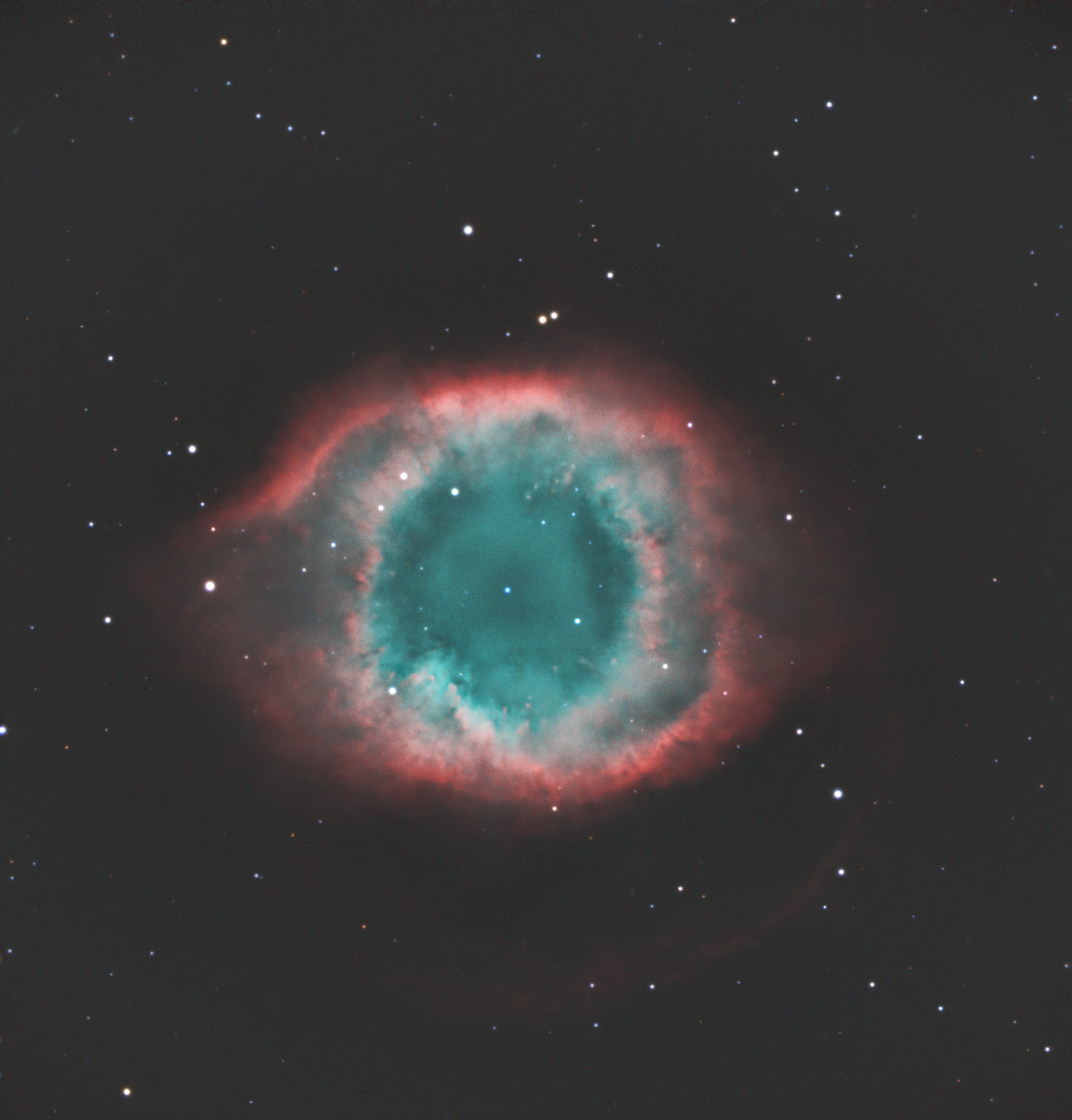
NGC 7293, famously known as the Helix Nebula, is one of the closest and most spectacular examples of a planetary nebula, located roughly 700 light-years away in the constellation Aquarius. Often nicknamed the “Eye of God” because of its striking appearance, the Helix Nebula is the glowing shell of gas expelled by a dying sun-like star.

Spanning about 2.5 light-years across, it displays a complex structure of concentric rings, wispy filaments, and comet-like knots of gas and dust, which are being sculpted by the intense radiation from the nebula’s hot central white dwarf. Its colors, often captured in astrophotography, range from vivid reds and pinks (from hydrogen emission) to greens and blues (from oxygen emission), creating an ethereal, almost three-dimensional appearance.

The Helix Nebula offers astronomers a detailed glimpse into the final stages of stellar evolution for medium-sized stars, illustrating how stars like our Sun will one day shed their outer layers, leaving behind a dense, glowing core. Its proximity and size make it a favorite target for both professional telescopes and amateur astrophotographers seeking to capture its mesmerizing beauty.

Technical Details

Telescope: Celestron C8 SCT (8″ Schmidt-Cassegrain) with Celestron 0.63 Focal Reducer

Auto Focus: Celestron Electronic Auto Focuser

Astronomy Camera: ZWO ASI533MC Pro

Filter: Optolong UV-IR  cut filter; 360 exposures @ 60 seconds each (6 hours)

Filter: Optolong Lenhance Dual Narrowband Ha/Oiii Filter; 210 exposures @ 5 minutes each (17.5 hours)

Total Integration Time: 23.5 hours

Off-Axis Auto Guiding: ZWO OAG-L

Auto Guiding Camera: ZWO ASI174MM Mini Guide Camera

Telescope Mount: Sky- Watcher EQ6-R Pro Equatorial Mount

Telescope Computer: BeeLink GK-55 Mini PC / Windows 10 Pro

Wireless Communication: GL-iNEt Beryl Travel Router

Telescope Control & Image Capture Software: Nighttime Imaging ‘N’ Astronomy (N.I.N.A.)

Image Integration Software: Astro Pixel Process, by Aries Productions

Image Post Processing Software:  PixInsight, by Pleiades Astrophoto

Images captured in Palm Springs, CA during September, 2024. Dark sky classification = Bright suburban sky (Bortle 6).
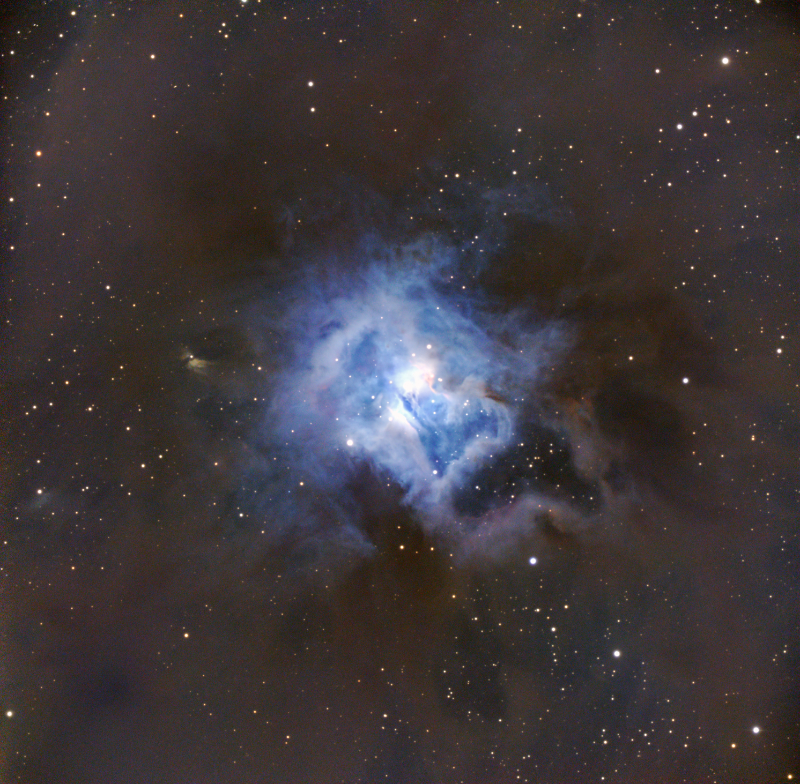
NGC7023 Iris Nebula

CLICK ON IMAGE TO VIEW A HIGH RESOLUTION VERSION

NGC 7023, famously known as the Iris Nebula, is a stunning reflection nebula located in the constellation Cepheus, about 1,300 light-years from Earth. This nebula is illuminated by a young, massive star at its center, HD 200775, whose bright light scatters off surrounding dust clouds, giving the nebula its characteristic bluish glow. The dense dust lanes and filamentary structures around the star create a floral, almost petal-like appearance, which inspired the name “Iris.”

Surrounding the central star, the nebula transitions from a vibrant blue core to faint reddish and brownish outer regions caused by interstellar dust and emission from hydrogen gas. NGC 7023 is often studied to understand the interaction between young stars and their dusty environments, including how starlight shapes and illuminates surrounding nebulae. Its delicate beauty makes it a favorite target for both amateur and professional astrophotographers.


Technical Details

Telescope: Celestron C8 SCT (8″ Schmidt-Cassegrain) with Celestron 0.63 Focal Reducer

Auto Focus: Celestron Electronic Auto Focuser

Astronomy Camera: ZWO ASI533MC Pro

Filter: Optolong UV-IR  cut filter; 1,425 exposures @ 60 seconds each (23.75 hours)

Total Integration Time: 23.75 hours

Off-Axis Auto Guiding: ZWO OAG-L

Auto Guiding Camera: ZWO ASI174MM Mini Guide Camera

Telescope Mount: Sky- Watcher EQ6-R Pro Equatorial Mount

Telescope Computer: BeeLink GK-55 Mini PC / Windows 10 Pro

Wireless Communication: GL-iNEt Beryl Travel Router

Telescope Control & Image Capture Software: Nighttime Imaging ‘N’ Astronomy (N.I.N.A.)

Image Integration Software: Astro Pixel Process, by Aries Productions

Image Post Processing Software:  PixInsight, by Pleiades Astrophoto

Images captured in Eastern Mojave Desert, CA during September 2024. Dark sky classification = Rural sky (Bortle 3).

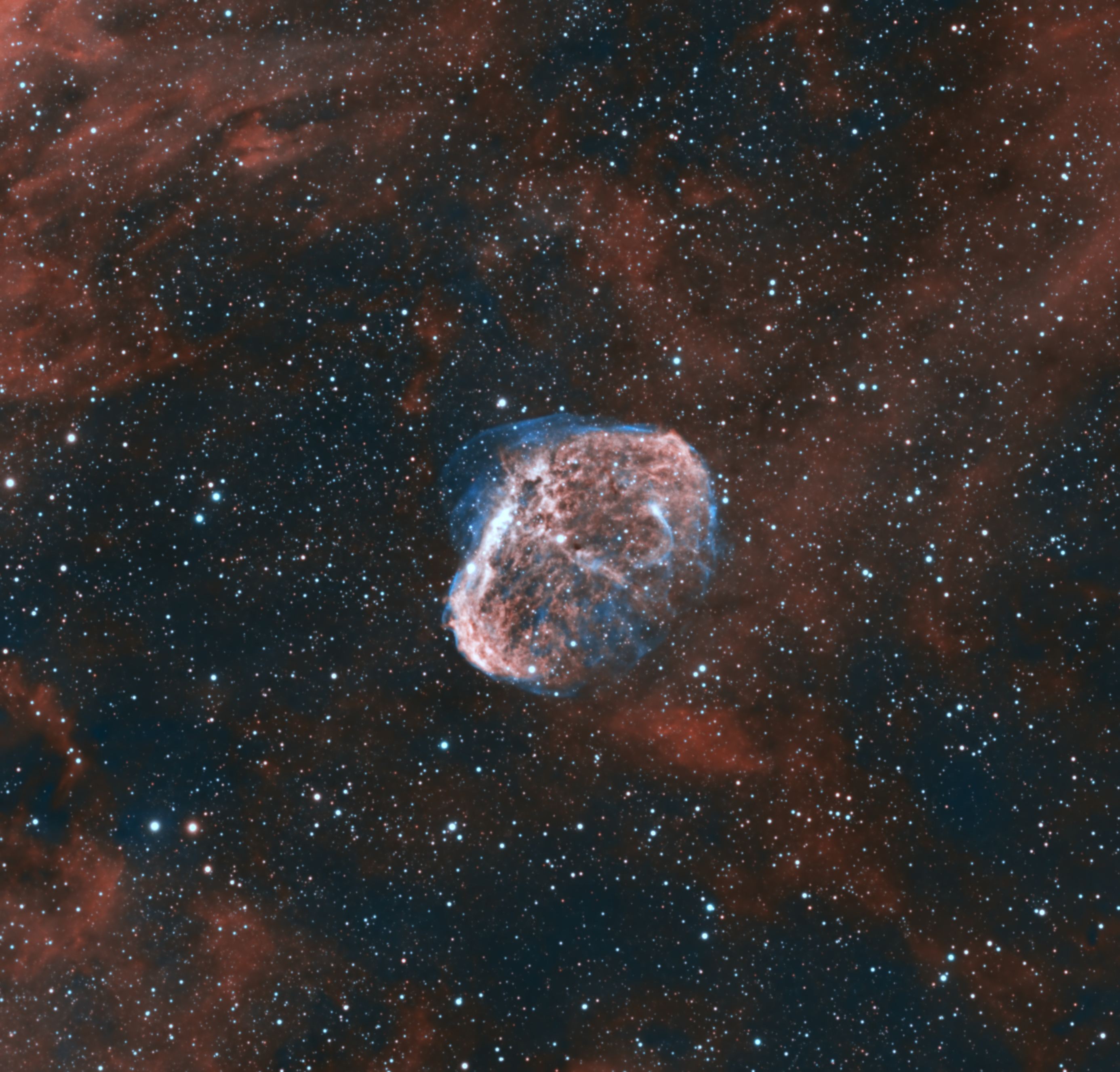
NGC6888 Cresent Nebula

CLICK ON IMAGE TO VIEW A HIGH RESOLUTION VERSION

NGC 6888, commonly known as the Crescent Nebula, is a dramatic emission nebula located about 5,000 light-years away in the constellation Cygnus. Shaped like a glowing, wind-swept arc, this nebula is the result of powerful stellar forces at work around a massive Wolf–Rayet star, WR 136, at its center.

The Crescent Nebula formed when intense stellar winds from WR 136 collided with slower material the star had previously shed during an earlier phase of its life. This violent interaction sculpted the surrounding gas into a thin, shell-like structure filled with intricate filaments, knots, and shock fronts. Hydrogen, oxygen, and sulfur gases glow brightly, revealing layers of ionized material and turbulent motion within the nebula.

Spanning roughly 25 light-years, NGC 6888 is a striking example of how massive stars shape and enrich their surroundings before ending their lives in supernova explosions. In astrophotography, the Crescent Nebula stands out for its complex textures and strong contrast between bright arcs and faint, wispy extensions, offering a compelling glimpse into the life cycle of stars and the dynamic nature of the interstellar medium.


Technical Details

Telescope: Sky-Watcher Esprit 100ED Refractor

Auto Focus: ZWO Electronic Auto Focuser

Astronomy Camera: ZWO ASI533MC Pro

Filter: Optolong UV-IR  cut filter; 180 exposures @ 60 seconds each (3 hours) 

Filter: Antlia ALP-T Dual Narrowband Ha/Oiii Filter; 250 exposures @ 5 minutes each (20,8 hours) 

Total Integration Time: 28.8 hours

Auto Guiding: William Optics Uniguide 50mm Guide Scope

Auto Guiding Camera: ZWO ASI120MM Mini Guide Camera

Auto Guiding Software: PHD2

Telescope Mount: Celestron CGX Equatorial Mount

Telescope Computer: BeeLink GK-55 Mini PC / Windows 10 Pro

Wireless Communication: GL-iNEt Beryl Travel Router

Telescope Control & Image Capture Software: Nighttime Imaging ‘N’ Astronomy (N.I.N.A.)

Image Integration Software: Astro Pixel Process, by Aries Productions

Image Post Processing Software:  PixInsight, by Pleiades Astrophoto

Images captured: Palm Springs, CA during July 2022. Dark sky classification = Bright suburban sky (Bortle 6)