Category Archives: Astrophotography

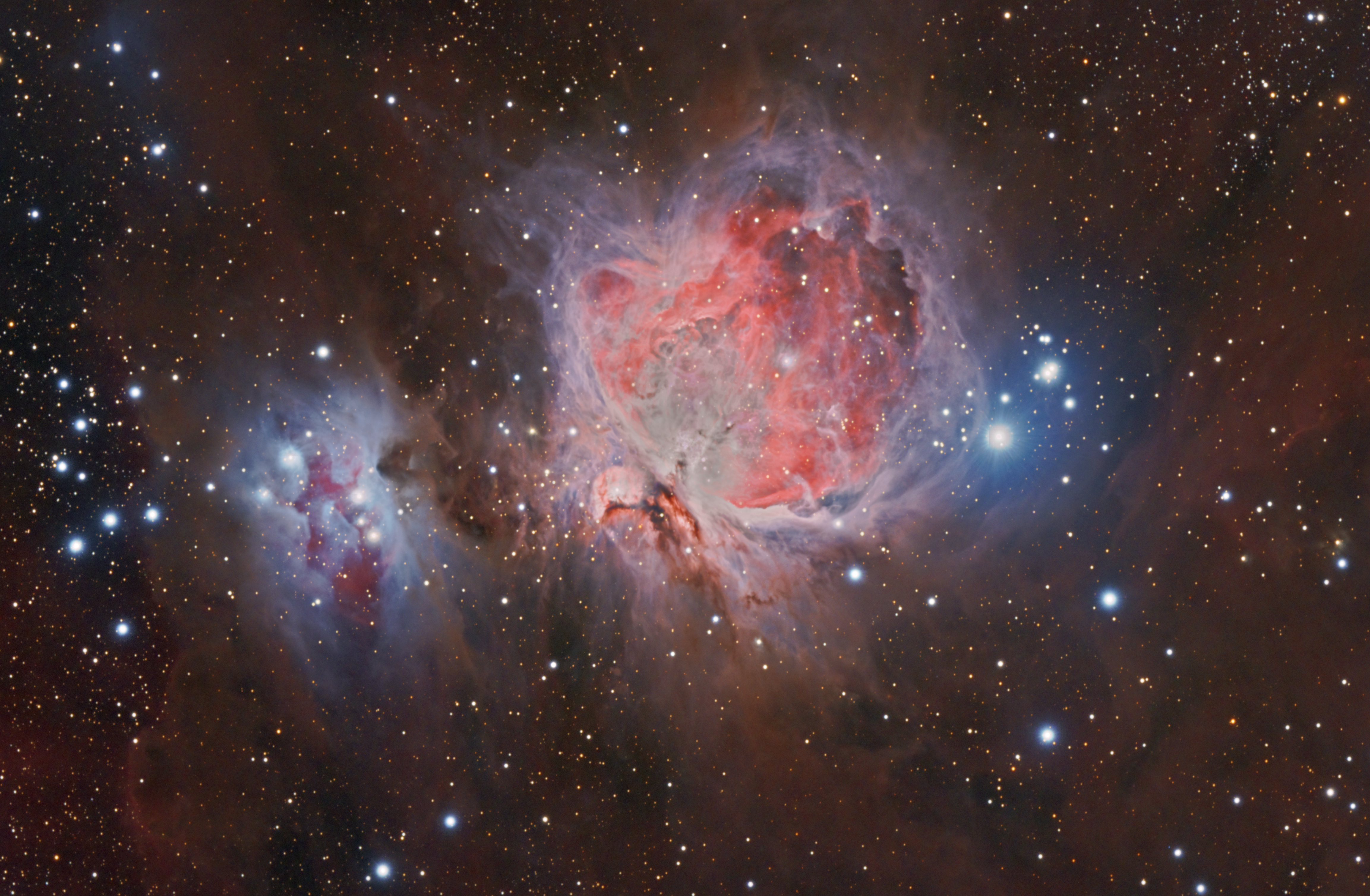
M42 Orion Nebula

CLICK ON IMAGE TO VIEW A HIGH RESOLUTION VERSION

The Orion Nebula (M42) is one of the most spectacular and well-studied star-forming regions in the night sky. Located about 1,350 light-years away in the constellation Orion, it appears as a glowing cloud of gas and dust nestled within Orion’s Sword and is visible to the naked eye under dark skies.

M42 is a vast stellar nursery, where intense ultraviolet radiation from the young, massive stars of the Trapezium Cluster energizes surrounding hydrogen gas, causing it to shine in rich hues of red, pink, and violet. Dark lanes of dust weave through the nebula, sculpted by stellar winds and gravity, creating dramatic contrasts and intricate structures. Within these shadows lie collapsing clouds where new stars and planetary systems are actively forming.

Spanning roughly 24 light-years across, the Orion Nebula offers a rare, close-up view of the processes that shape stars and planets. For astronomers and astrophotographers alike, M42 is a cornerstone object—both scientifically invaluable and visually breathtaking—providing a glimpse into the same kind of cosmic environment that once gave birth to our own Sun.


Technical Details

Telescope: Sky-Watcher Esprit 100ED Refractor

Auto Focus: ZWO Electronic Auto Focuser

Astronomy Camera: ZWO ASI071MC Pro

Filter: Optolong UV-IR  cut filter; 840 exposures @ 60 seconds each (14 hours) 

Filter: Optolong UV-IR  cut filter; 360 exposures @ 30 seconds each (3 hours)

Filter: Optolong Lenhance Dual Narrowband Ha/Oiii Filter; 40 exposures @ 60 seconds each (0.67 hours) 

Filter: Optolong Lenhance Dual Narrowband Ha/Oiii Filter; 40 exposures @ 5 minutes each (3.33 hours)

Total Integration Time: 21 hours

Auto Guiding: William Optics Uniguide 50mm Guide Scope

Auto Guiding Camera: ZWO ASI120MM Mini Guide Camera

Auto Guiding Software: PHD2

Telescope Mount: Celestron CGX Equatorial Mount

Telescope Computer: BeeLink GK-55 Mini PC / Windows 10 Pro

Wireless Communication: GL-iNEt Beryl Travel Router

Telescope Control & Image Capture Software: Nighttime Imaging ‘N’ Astronomy (N.I.N.A.)

Image Integration Software: Astro Pixel Process, by Aries Productions

Image Post Processing Software:  PixInsight, by Pleiades Astrophoto

Images captured: Palm Springs, CA during January 2022. Dark sky classification = Bright suburban sky (Bortle 6)
M27 Dumbbell Nebula

CLICK ON IMAGE TO VIEW A HIGH RESOLUTION VERSION

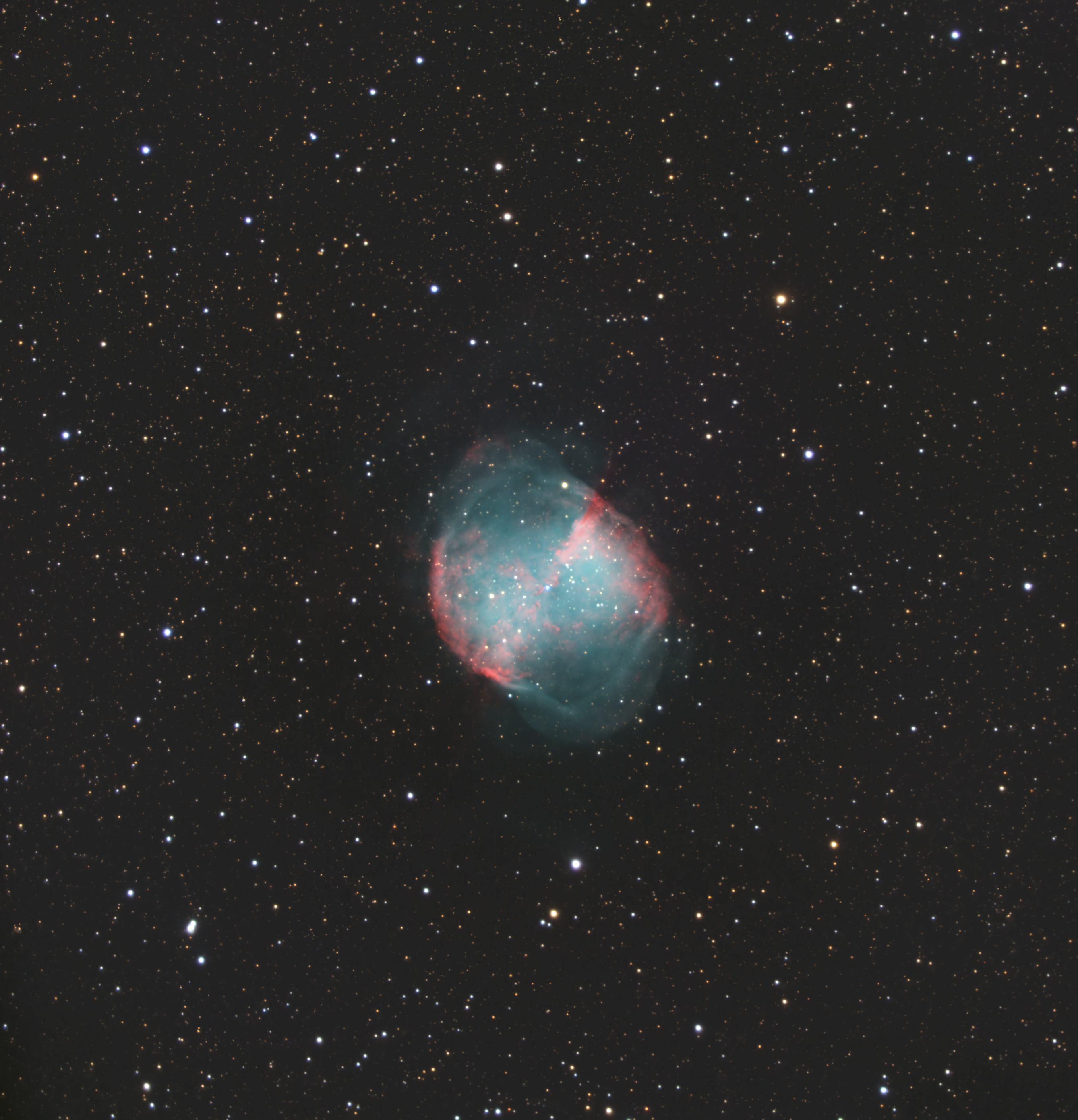
The M27 Dumbbell Nebula, also known as the Apple Core Nebula, is one of the brightest and best-known planetary nebulae in the night sky. Located about 1,300 light-years away in the constellation Vulpecula, it was the first planetary nebula ever discovered, identified by Charles Messier in 1764.

M27 marks the final evolutionary stage of a Sun-like star. As the star exhausted its nuclear fuel, it shed its outer layers into space, forming the nebula’s distinctive dumbbell or hourglass shape. At its center lies a hot white dwarf whose intense ultraviolet radiation causes the surrounding gas to glow in vivid hues of red hydrogen emission and blue-green oxygen.

Delicate filaments, knots, and faint outer halos reveal the complex interactions between stellar winds and expanding gas over tens of thousands of years. Through telescopes and astrophotography, M27 displays remarkable structure and depth, offering a striking glimpse into the future fate of our own Sun and a beautiful example of stellar death giving rise to cosmic art.


Technical Details

Telescope: Celestron C8 SCT (8″ Schmidt-Cassegrain) with Celestron 0.63 Focal Reducer

Auto Focus: Celestron Electronic Auto Focuser

Astronomy Camera: ZWO ASI533MC Pro

Filter: Optolong UV-IR  cut filter; 324 exposures @ 60 seconds each (5.4 hours)

Filter: Antlia ALP-T Dual Narrowband Ha/Oiii Filter; 100 exposures @ 5 minutes each (8.3 hours)

Total Integration Time: 13.7 hours

Off-Axis Auto Guiding: ZWO OAG-L

Auto Guiding Camera: ZWO ASI174MM Mini Guide Camera

Telescope Mount: Sky- Watcher EQ6-R Pro Equatorial Mount

Telescope Computer: BeeLink GK-55 Mini PC / Windows 10 Pro

Wireless Communication: GL-iNEt Beryl Travel Router

Telescope Control & Image Capture Software: Nighttime Imaging ‘N’ Astronomy (N.I.N.A.)

Image Integration Software: Astro Pixel Process, by Aries Productions

Image Post Processing Software:  PixInsight, by Pleiades Astrophoto

Images captured in Palm Springs, CA during October 2023. Dark sky classification = Bright suburban sky (Bortle 6).


M20 Trifid Nebula

CLICK ON IMAGE TO VIEW A HIGH RESOLUTION VERSION

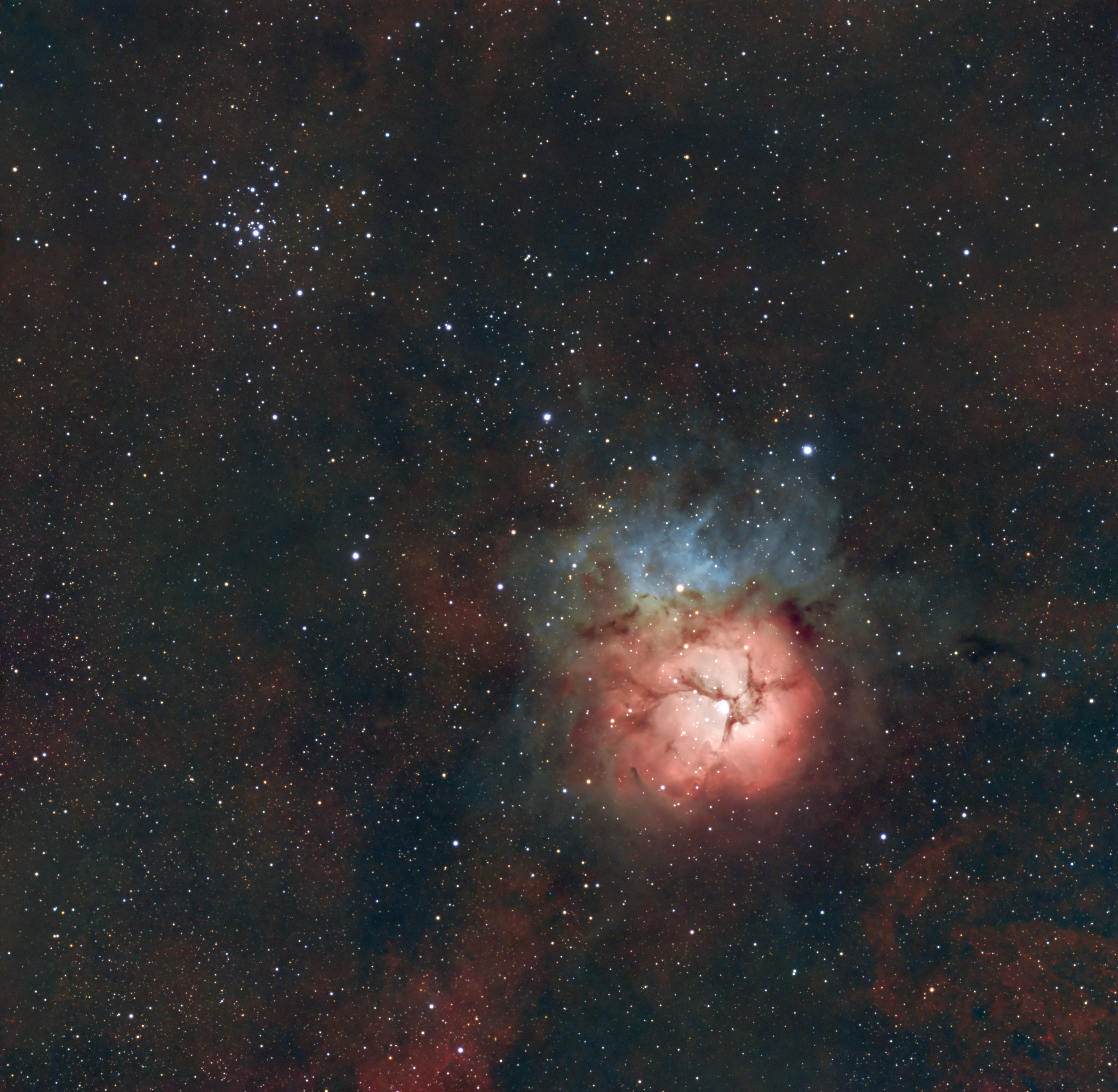
The Trifid Nebula (M20) is a striking and complex nebula located in the constellation Sagittarius, about 5,000 light-years from Earth. Its name, “Trifid,” comes from the three prominent dark dust lanes that divide the nebula into distinct lobes, giving it a dramatic, three-part appearance.

M20 is a rare combination of three different nebula types in one region. The glowing red emission nebula is energized by intense ultraviolet radiation from a young, massive central star, while nearby blue reflection nebula regions scatter starlight off fine dust particles. Cutting through both are intricate dark nebulae, where cold dust obscures the light behind it, carving the nebula’s iconic shape.

This stellar nursery is actively forming new stars, with dense clouds of gas and dust collapsing under gravity. Young stars and protostars are embedded throughout the nebula, making it an important target for studying early stellar evolution.

In wide-field astrophotography, the Trifid Nebula stands out for its vivid contrast—deep reds, electric blues, and inky black dust lanes—often sharing the frame with the nearby Lagoon Nebula (M8). Its beauty and scientific richness make M20 one of the most iconic and rewarding nebulae in the summer Milky Way.


Technical Details

Telescope: Sky-Watcher Esprit 100ED Refractor

Auto Focus: ZWO Electronic Auto Focuser

Astronomy Camera: ZWO ASI533MC Pro

Filter: Optolong UV-IR  cut filter; 320 exposures @ 60 seconds each (5.3 hours) 

Filter: Antlia ALP-T Dual Narrowband Ha/Oiii Filter; 120 exposures @ 5 minutes each (12 hours) 

Total Integration Time: 17.3 hours

Auto Guiding: William Optics Uniguide 50mm Guide Scope

Auto Guiding Camera: ZWO ASI120MM Mini Guide Camera

Auto Guiding Software: PHD2

Telescope Mount: Sky- Watcher EQ6-R Pro Equatorial Mount

Telescope Computer: BeeLink GK-55 Mini PC / Windows 10 Pro

Wireless Communication: GL-iNEt Beryl Travel Router

Telescope Control & Image Capture Software: Nighttime Imaging ‘N’ Astronomy (N.I.N.A.)

Image Integration Software: Astro Pixel Process, by Aries Productions

Image Post Processing Software:  PixInsight, by Pleiades Astrophoto

Images captured: Palm Springs, CA during September 2022. Dark sky classification = Bright suburban sky (Bortle 6)
 

M17 Omega Nebula

CLICK ON IMAGE TO VIEW A HIGH RESOLUTION VERSION

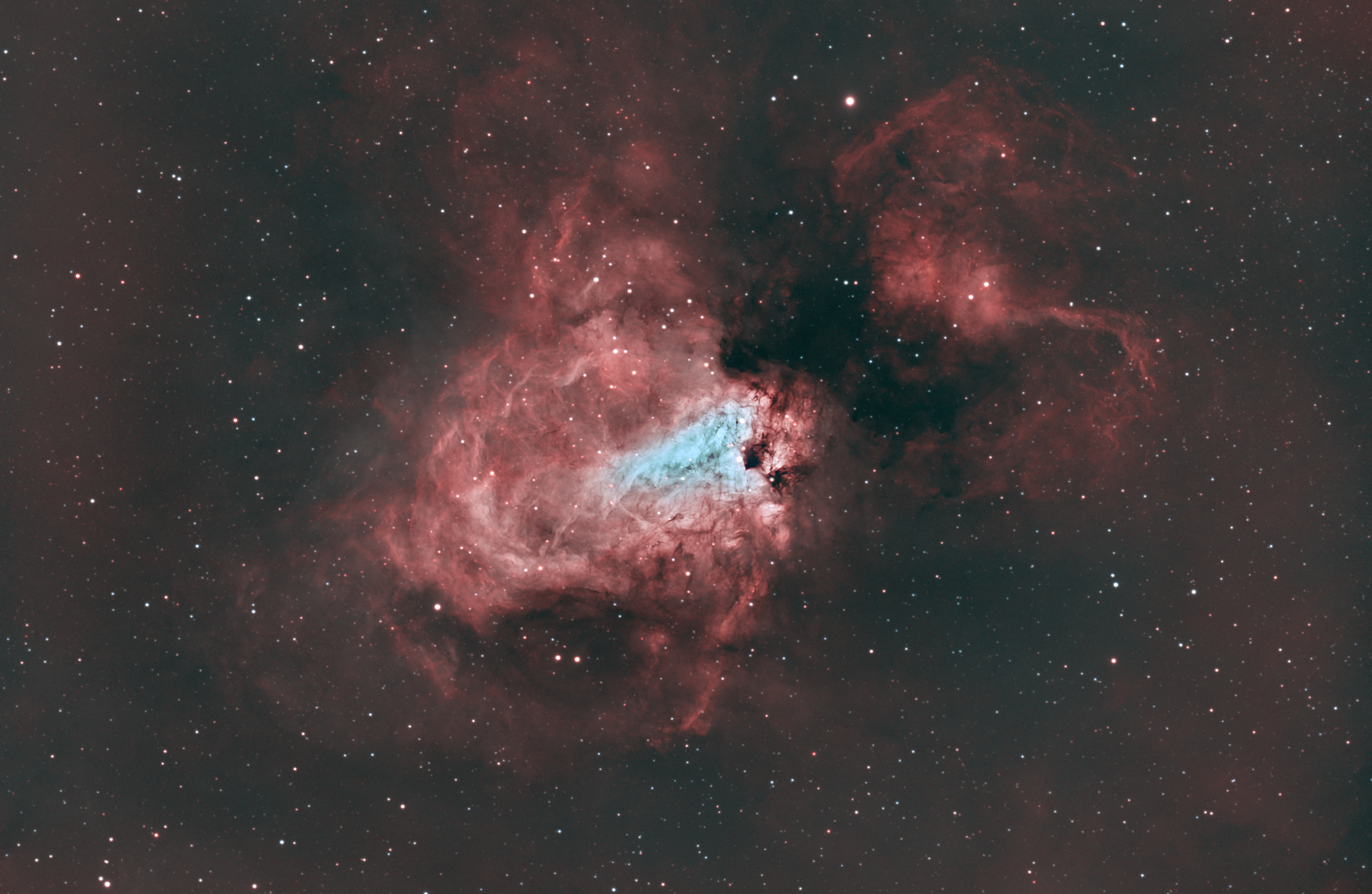
M17 – The Omega (or Swan) Nebula
Nearby in the sky, the Omega Nebula glows as a bright, sweeping arc of ionized gas, its curved shape earning it names such as the Swan, Horseshoe, or Checkmark Nebula. Powered by a cluster of hot, young stars embedded within its core, M17 is one of the brightest and most massive star-forming regions in our galaxy. Dense clouds of gas and dust frame the nebula, while brilliant emission regions reveal where stellar radiation is actively shaping the surrounding material. Located roughly 5,500 light-years from Earth, M17 showcases star formation on a grand and energetic scale.


Technical Details

Telescope: Sky-Watcher Esprit 100ED Refractor

Auto Focus: ZWO Electronic Auto Focuser

Astronomy Camera: ZWO ASI183MC Pro

Filter: Optolong UV-IR  cut filter; 240 exposures @ 60 seconds each (4 hours) 

Filter: Antlia ALP-T Dual Narrowband Ha/Oiii Filter; 228 exposures @ 5 minutes each (18 hours) 

Total Integration Time: 22 hours

Auto Guiding: William Optics Uniguide 50mm Guide Scope

Auto Guiding Camera: ZWO ASI120MM Mini Guide Camera

Auto Guiding Software: PHD2

Telescope Mount: Celestron CGX Equatorial Mount

Telescope Computer: BeeLink GK-55 Mini PC / Windows 10 Pro

Wireless Communication: GL-iNEt Beryl Travel Router

Telescope Control & Image Capture Software: Nighttime Imaging ‘N’ Astronomy (N.I.N.A.)

Image Integration Software: Astro Pixel Process, by Aries Productions

Image Post Processing Software:  PixInsight, by Pleiades Astrophoto

Images captured: Palm Springs, CA during September 2022. Dark sky classification = Bright suburban sky (Bortle 6)
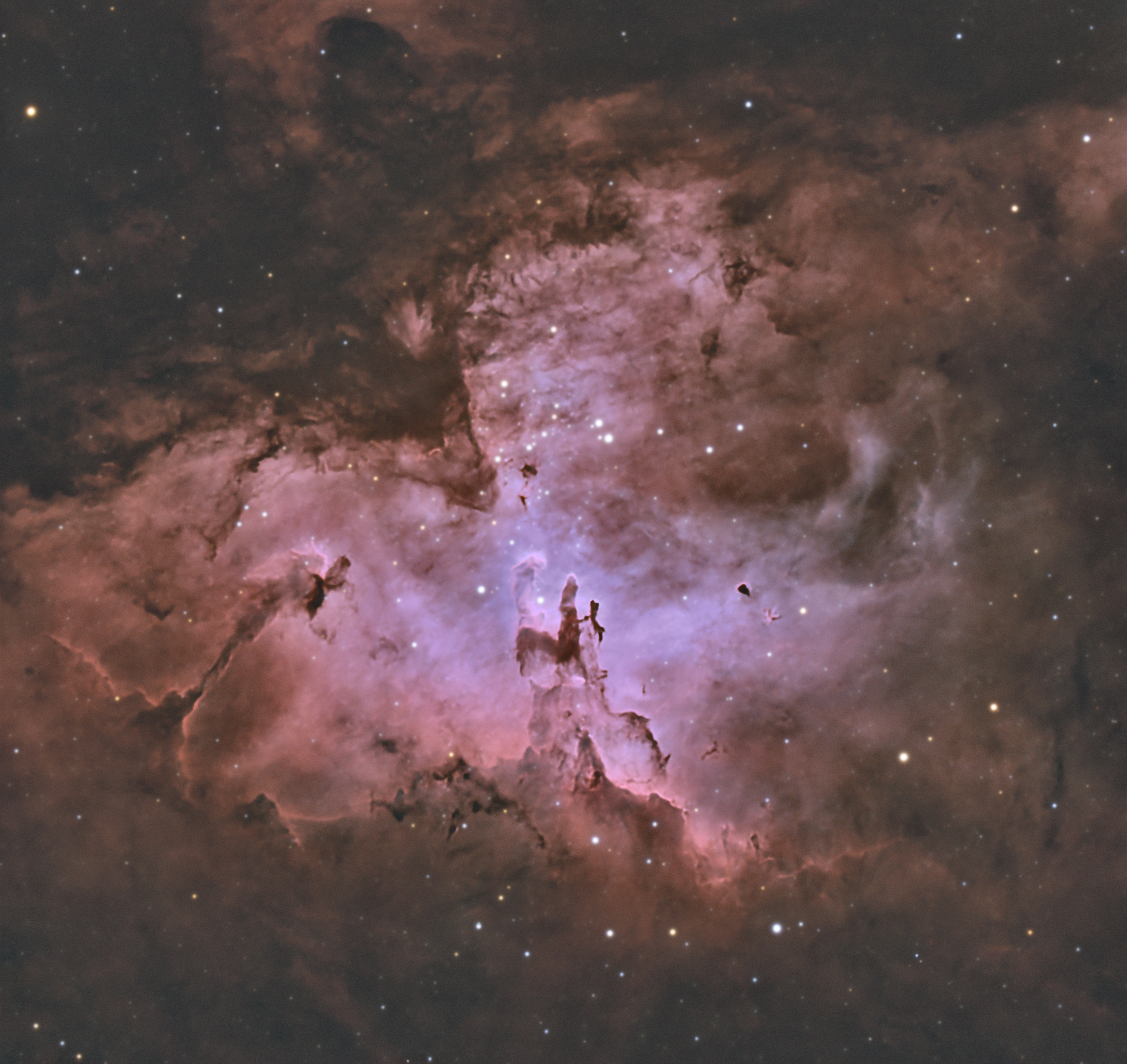
M16 Eagle Nebula (and The Pillars of Creation)

CLICK ON IMAGE TO VIEW A HIGH RESOLUTION VERSION

M16 – The Eagle Nebula
The Eagle Nebula is a vast cloud of glowing hydrogen gas and dark dust, illuminated by intense ultraviolet radiation from a cluster of young, massive stars at its center. It is best known for the iconic “Pillars of Creation,” towering columns of cold gas and dust where new stars are forming, hidden from view within their dense cores. These sculpted structures are shaped by stellar winds and radiation, giving the nebula a dramatic contrast between luminous reds and inky black dust lanes. M16 lies about 7,000 light-years away and spans tens of light-years across, offering a vivid glimpse into the processes that give birth to stars.


Technical Details

Telescope: Celestron C8 SCT (8″ Schmidt-Cassegrain) with Celestron 0.63 Focal Reducer

Auto Focus: Celestron Electronic Auto Focuser

Astronomy Camera: ZWO ASI533MC Pro

Filter: Optolong UV-IR  cut filter; 120 exposures @ 60 seconds each (2 hours)

Filter: Antlia ALP-T Dual Narrowband Ha/Oiii Filter; 150 exposures @ 5 minutes each (13 hours)

Total Integration Time: 15 hours

Off-Axis Auto Guiding: ZWO OAG-L

Auto Guiding Camera: ZWO ASI174MM Mini Guide Camera

Telescope Mount: Sky- Watcher EQ6-R Pro Equatorial Mount

Telescope Computer: BeeLink GK-55 Mini PC / Windows 10 Pro

Wireless Communication: GL-iNEt Beryl Travel Router

Telescope Control & Image Capture Software: Nighttime Imaging ‘N’ Astronomy (N.I.N.A.)

Image Integration Software: Astro Pixel Process, by Aries Productions

Image Post Processing Software:  PixInsight, by Pleiades Astrophoto

Images captured in Palm Springs, CA during July 2025. Dark sky classification = Bright suburban sky (Bortle 6).