Category Archives: Astrophotography

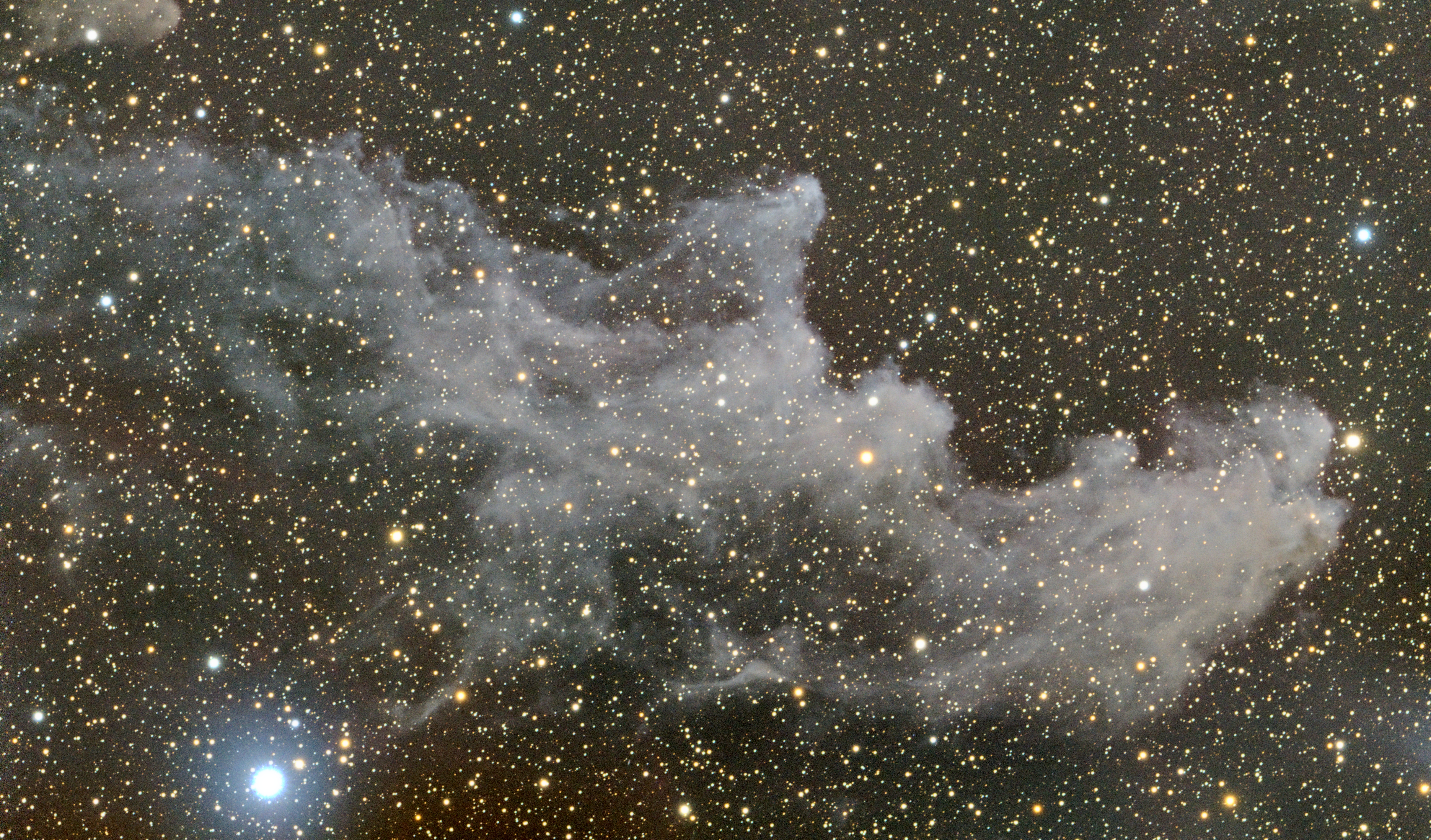
IC2118 Witch Head Nebula

CLICK ON IMAGE TO VIEW A HIGH RESOLUTION VERSION

IC 2118, commonly known as the Witch Head Nebula, is a faint and haunting reflection nebula drifting along the western edge of the constellation Eridanus. Its elongated, curved shape resembles the profile of a spectral face gazing across the stars, giving rise to its evocative nickname.

Unlike glowing emission nebulae, IC 2118 shines by reflecting the light of nearby stars, most notably the brilliant blue supergiant Rigel in Orion. Rigel’s intense starlight illuminates the nebula’s fine dust grains, bathing the Witch Head in soft blue hues and revealing delicate wisps and filaments that stretch across light-years of space.

The nebula lies relatively close in cosmic terms, at a distance of roughly 900–1,000 light-years, and is composed primarily of cold interstellar dust rather than active star-forming gas. Its subtle brightness and low surface contrast make IC 2118 a challenging but rewarding target for deep-sky observation and astrophotography, especially under dark skies.

Ethereal and understated, the Witch Head Nebula is a striking example of how interstellar dust can sculpt light into ghostly forms, offering a quiet, atmospheric counterpoint to Orion’s more dramatic and luminous neighbors.


Technical Details

Telescope: Sky-Watcher Esprit 100ED Refractor

Auto Focus: ZWO Electronic Auto Focuser

Astronomy Camera: ZWO ASI071MC Pro

Filter: Optolong UV-IR  cut filter; 300 exposures @ 120 seconds each (10 hours) 

Filter: Optolong UV-IR  cut filter; 72 exposures @ 5 minutes each (6 hours)

Total Integration Time: 16 hours

Auto Guiding: William Optics Uniguide 50mm Guide Scope

Auto Guiding Camera: ZWO ASI120MM Mini Guide Camera

Auto Guiding Software: PHD2

Telescope Mount: Celestron CGX Equatorial Mount

Telescope Computer: BeeLink GK-55 Mini PC / Windows 10 Pro

Wireless Communication: GL-iNEt Beryl Travel Router

Telescope Control & Image Capture Software: Nighttime Imaging ‘N’ Astronomy (N.I.N.A.)

Image Integration Software: Astro Pixel Process, by Aries Productions

Image Post Processing Software:  PixInsight, by Pleiades Astrophoto

Images captured:

Eastern Mojave Desert, CA during November 2021. Dark sky classification = Rural sky (Bortle 3)
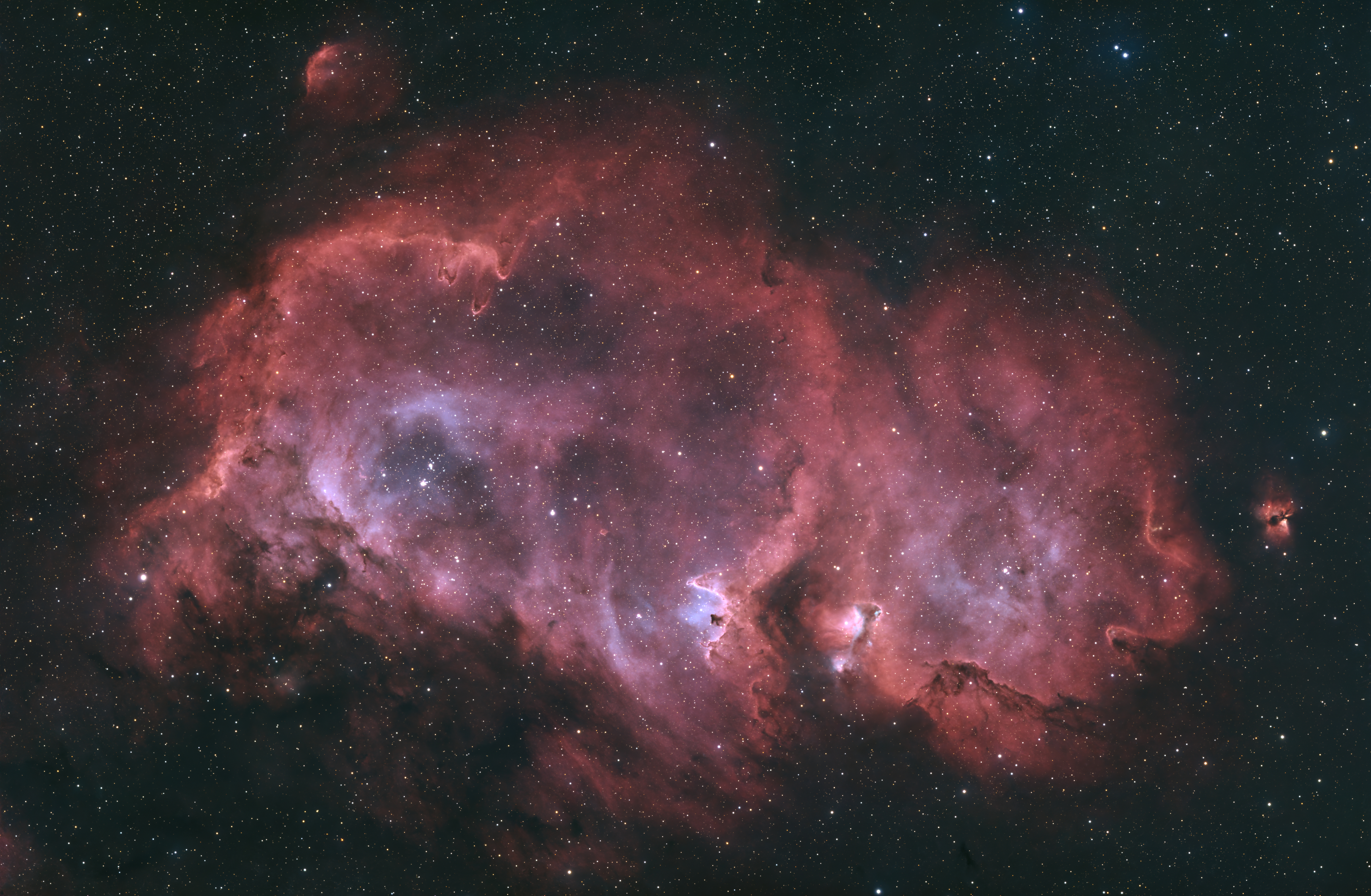
IC1848 Soul Nebula

CLICK ON IMAGE TO VIEW A HIGH RESOLUTION VERSION

The Soul Nebula (IC 1848) is a vast and evocative emission nebula located about 6,500 light-years away in the constellation Cassiopeia. Spanning roughly 100 light-years, it forms a striking celestial pairing with its nearby neighbor, the Heart Nebula, together shaping one of the most iconic regions of the Perseus Arm of the Milky Way.

Glowing primarily in deep reds from ionized hydrogen gas, the Soul Nebula is a rich stellar nursery where new stars are actively forming. Dark, winding dust lanes carve dramatic shapes through the luminous gas, while bright knots and pillars mark regions sculpted by intense radiation and stellar winds from young, massive stars embedded within. Among these are open star clusters whose energetic light excites the surrounding clouds, causing them to shine.

Often described as more intricate and textured than its companion, the Soul Nebula reveals delicate filaments, shock fronts, and pockets of darkness that give it a haunting, almost ethereal appearance. In long-exposure and narrowband astrophotography, subtle blues and golds emerge alongside the dominant crimson, highlighting the complex interplay between gas, dust, and starlight.

The Soul Nebula stands as a powerful reminder of the dynamic processes that shape our galaxy—where stellar birth, radiation, and gravity work together to transform cold clouds of gas into blazing new suns.


Technical Details

Telescope: Sky-Watcher Esprit 100ED Refractor

Auto Focus: ZWO Electronic Auto Focuser

Astronomy Camera: ZWO ASI071MC Pro

Filter: Optolong UV-IR  cut filter; 90 exposures @ 120 seconds each (3 hours) 

Filter: Optolong Lenhance Dual Narrowband Ha/Oiii Filter; 360 exposures @ 5 minutes each (30) 

Total Integration Time: 33 hours

Auto Guiding: William Optics Uniguide 50mm Guide Scope

Auto Guiding Camera: ZWO ASI120MM Mini Guide Camera

Auto Guiding Software: PHD2

Telescope Mount: Sky- Watcher EQ6-R Pro Equatorial Mount

Telescope Computer: BeeLink GK-55 Mini PC / Windows 10 Pro

Wireless Communication: GL-iNEt Beryl Travel Router

Telescope Control & Image Capture Software: Nighttime Imaging ‘N’ Astronomy (N.I.N.A.)

Image Integration Software: Astro Pixel Process, by Aries Productions

Image Post Processing Software:  PixInsight, by Pleiades Astrophoto

Images captured:

Palm Springs, CA during September 2025. Dark sky classification = Bright suburban sky (Bortle 6)


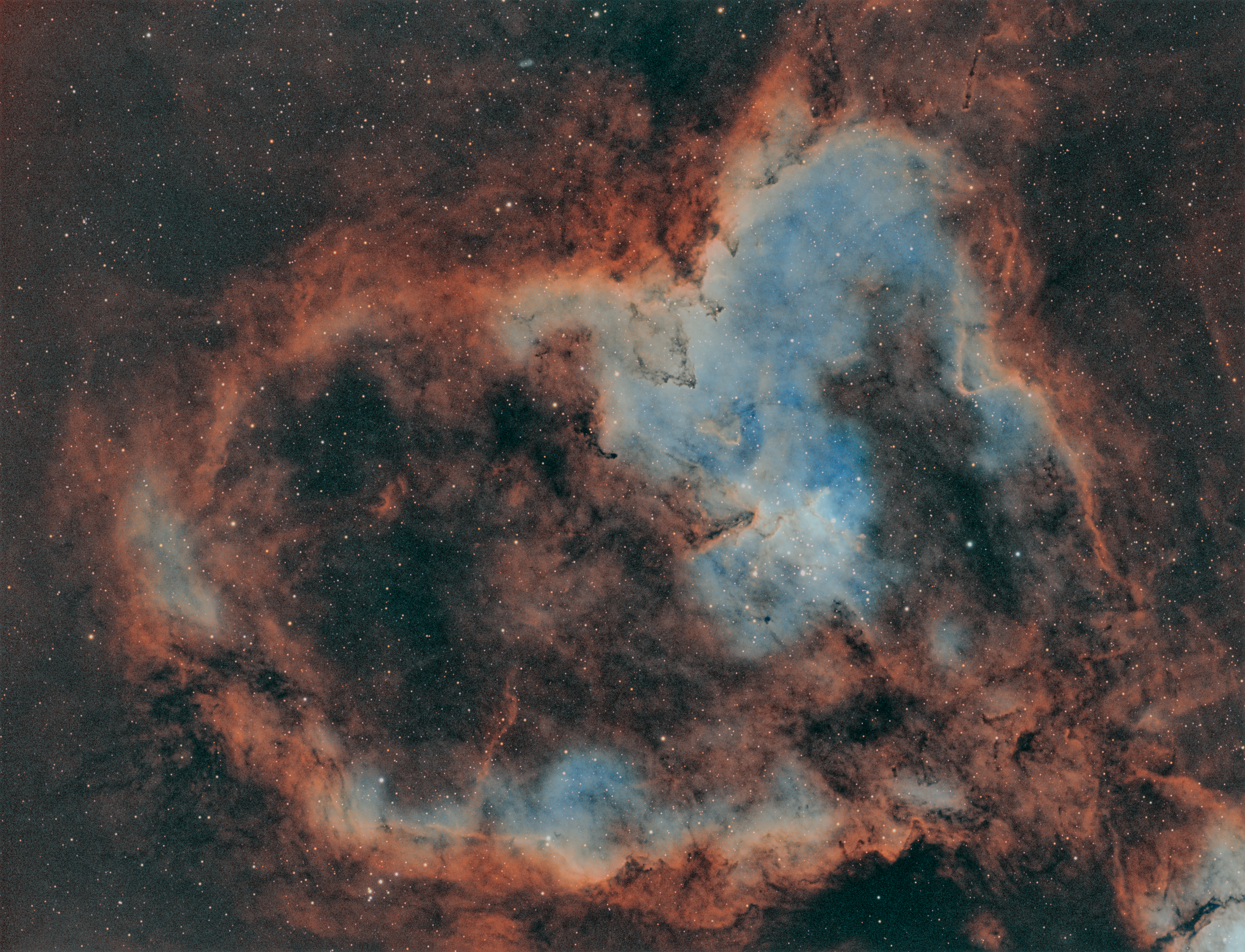
IC1805 Heart Nebula

CLICK ON IMAGE TO VIEW A HIGH RESOLUTION VERSION

The IC 1805 Heart Nebula is a vast region of glowing gas and dust in the constellation Cassiopeia, its unmistakable heart-like shape etched across the Milky Way. Spanning roughly 150 light-years, this emission nebula lies about 7,500 light-years from Earth and shines primarily in deep reds from ionized hydrogen, energized by intense ultraviolet radiation from young, massive stars.

At the core of the nebula is the open star cluster Melotte 15, whose hot, newly formed stars sculpt the surrounding clouds into intricate ridges, pillars, and dark cavities. Stellar winds and radiation carve out sinuous filaments and towering walls of gas, revealing an ongoing story of star birth and cosmic erosion. Pockets of darker dust trace the boundaries where gravity and radiation compete, hinting at future generations of stars still hidden within the clouds.

Often imaged together with its neighboring Soul Nebula (IC 1848), the Heart Nebula is a favorite target for wide-field astrophotography. Its rich structure, dramatic contrast, and symbolic form make it both scientifically compelling and visually evocative—a luminous reminder of the dynamic processes that shape our galaxy.


Technical Details

Telescope: Sky-Watcher Esprit 100ED Refractor

Auto Focus: ZWO Electronic Auto Focuser

Astronomy Camera: ZWO ASI071MC Pro

Filter: Antlia ALP-T Dual Narrowband Ha/Oiii Filter; 300 exposures @ 5 minutes each (25 hours) 

Total Integration Time: 25 hours

Auto Guiding: William Optics Uniguide 50mm Guide Scope

Auto Guiding Camera: ZWO ASI120MM Mini Guide Camera

Auto Guiding Software: PHD2

Telescope Mount: Sky- Watcher EQ6-R Pro Equatorial Mount

Telescope Computer: BeeLink GK-55 Mini PC / Windows 10 Pro

Wireless Communication: GL-iNEt Beryl Travel Router

Telescope Control & Image Capture Software: Nighttime Imaging ‘N’ Astronomy (N.I.N.A.)

Image Integration Software: Astro Pixel Process, by Aries Productions

Image Post Processing Software:  PixInsight, by Pleiades Astrophoto

Images captured:

Palm Springs, CA during October 2022. Dark sky classification = Bright suburban sky (Bortle 6)

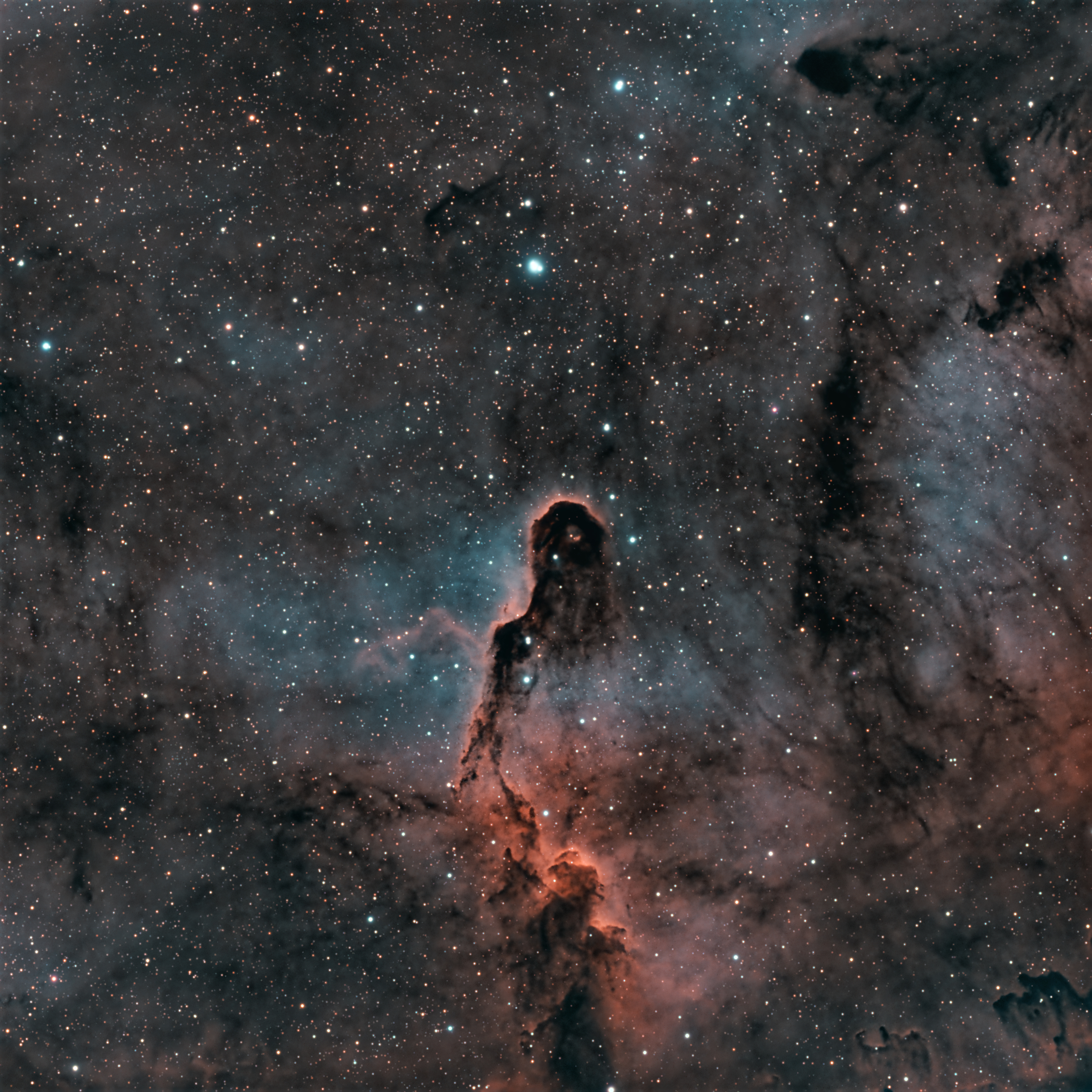
IC1396 Elephant’s Trunk Nebula

CLICK ON IMAGE TO VIEW A HIGH RESOLUTION VERSION

IC 1396’s Elephant’s Trunk Nebula is a striking region of interstellar sculpture located in the constellation Cepheus, about 2,400 light-years from Earth. This elongated, sinuous column of dark gas and dust appears to reach into the glowing heart of the larger IC 1396 emission nebula, earning its evocative name from its trunk-like shape.

The nebula is a classic example of a dense molecular cloud being carved by radiation. Intense ultraviolet light from the massive star HD 206267 ionizes the surrounding hydrogen, causing the nebula to glow in deep reds while simultaneously eroding the darker, cooler material of the trunk. The contrast between the luminous background and the opaque dust gives the Elephant’s Trunk its dramatic, three-dimensional appearance.

Within the trunk itself, new stars are forming. Pockets of gas collapse under gravity, shielded from harsh radiation by the surrounding dust. These hidden stellar nurseries reveal themselves in astrophotography through subtle knots, tendrils, and embedded dark globules, showing a dynamic balance between destruction and creation.

To observers and imagers alike, the Elephant’s Trunk Nebula stands as a vivid reminder of the power of stellar feedback, where massive stars reshape their environment while simultaneously triggering the birth of the next generation of suns.


Technical Details

Telescope: Sky-Watcher Esprit 100ED Refractor

Auto Focus: ZWO Electronic Auto Focuser

Astronomy Camera: ZWO ASI071MC Pro

Filter: Antlia ALP-T Dual Narrowband Ha/Oiii Filter; 258 exposures @ 5 minutes each (21.5 hours) 

Total Integration Time: 21.5 hours

Auto Guiding: William Optics Uniguide 50mm Guide Scope

Auto Guiding Camera: ZWO ASI120MM Mini Guide Camera

Auto Guiding Software: PHD2

Telescope Mount: Sky- Watcher EQ6-R Pro Equatorial Mount

Telescope Computer: BeeLink GK-55 Mini PC / Windows 10 Pro

Wireless Communication: GL-iNEt Beryl Travel Router

Telescope Control & Image Capture Software: Nighttime Imaging ‘N’ Astronomy (N.I.N.A.)

Image Integration Software: Astro Pixel Process, by Aries Productions

Image Post Processing Software:  PixInsight, by Pleiades Astrophoto

Images captured:

Palm Springs, CA during July 2022. Dark sky classification = Bright suburban sky (Bortle 6)

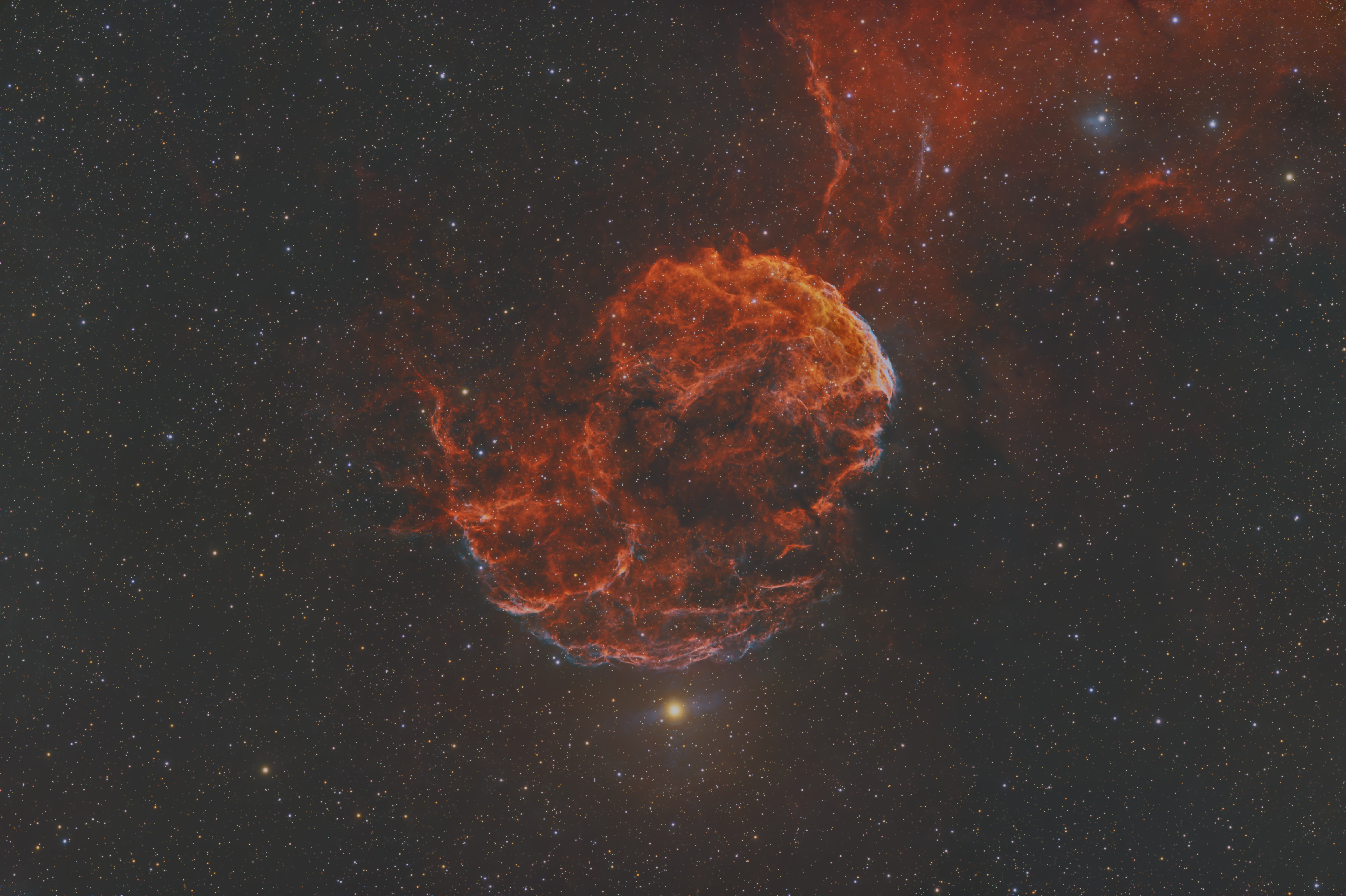
IC443 Jellyfish Nebula

CLICK ON IMAGE TO VIEW A HIGH RESOLUTION VERSION

C 443, commonly known as the Jellyfish Nebula, is a dramatic supernova remnant located in the constellation Gemini, roughly 5,000 light-years from Earth. The nebula is the expanding aftermath of a massive star that exploded tens of thousands of years ago, sending shockwaves rippling through the surrounding interstellar medium.

Visually, IC 443 resembles a translucent, drifting jellyfish, with tangled filaments and sweeping arcs of gas forming its “tentacles.” These glowing structures are created as the supernova’s shock front collides with nearby molecular clouds, compressing and heating the gas until it radiates in vivid reds, oranges, and faint blues. Hydrogen, sulfur, and oxygen emissions reveal a complex web of turbulence and motion frozen in light.

Scientifically, the Jellyfish Nebula is especially intriguing because it interacts strongly with its environment. It is associated with high-energy X-ray and gamma-ray sources, and it contains a neutron star—likely the collapsed core of the original star—speeding away from the explosion site. This makes IC 443 a valuable laboratory for studying how supernova remnants seed space with heavy elements and trigger future star formation.

For observers and astrophotographers, IC 443 is a challenging but rewarding target. Its delicate filaments are faint and require long exposures and narrowband imaging to fully reveal, but the result is a haunting portrait of stellar death and renewal, suspended against the rich star fields of Gemini.


Technical Details

Telescope: Sky-Watcher Esprit 100ED Refractor

Auto Focus: ZWO Electronic Auto Focuser

Astronomy Camera: ZWO ASI071MC Pro

Filter: Optolong UV-IR  cut filter; 120 exposures @ 60 seconds each (2 hours) 

Filter: Antlia ALP-T Dual Narrowband Ha/Oiii Filter; 162 exposures @ 5 minutes each (13.2 hours) 

Total Integration Time: 15.2 hours

Auto Guiding: William Optics Uniguide 50mm Guide Scope

Auto Guiding Camera: ZWO ASI120MM Mini Guide Camera

Auto Guiding Software: PHD2

Telescope Mount: Celestron CGX Equatorial Mount

Telescope Computer: BeeLink GK-55 Mini PC / Windows 10 Pro

Wireless Communication: GL-iNEt Beryl Travel Router

Telescope Control & Image Capture Software: Nighttime Imaging ‘N’ Astronomy (N.I.N.A.)

Image Integration Software: Astro Pixel Process, by Aries Productions

Image Post Processing Software:  PixInsight, by Pleiades Astrophoto

Images captured:

Palm Springs, CA during March 2025. Dark sky classification = Bright suburban sky (Bortle 6)