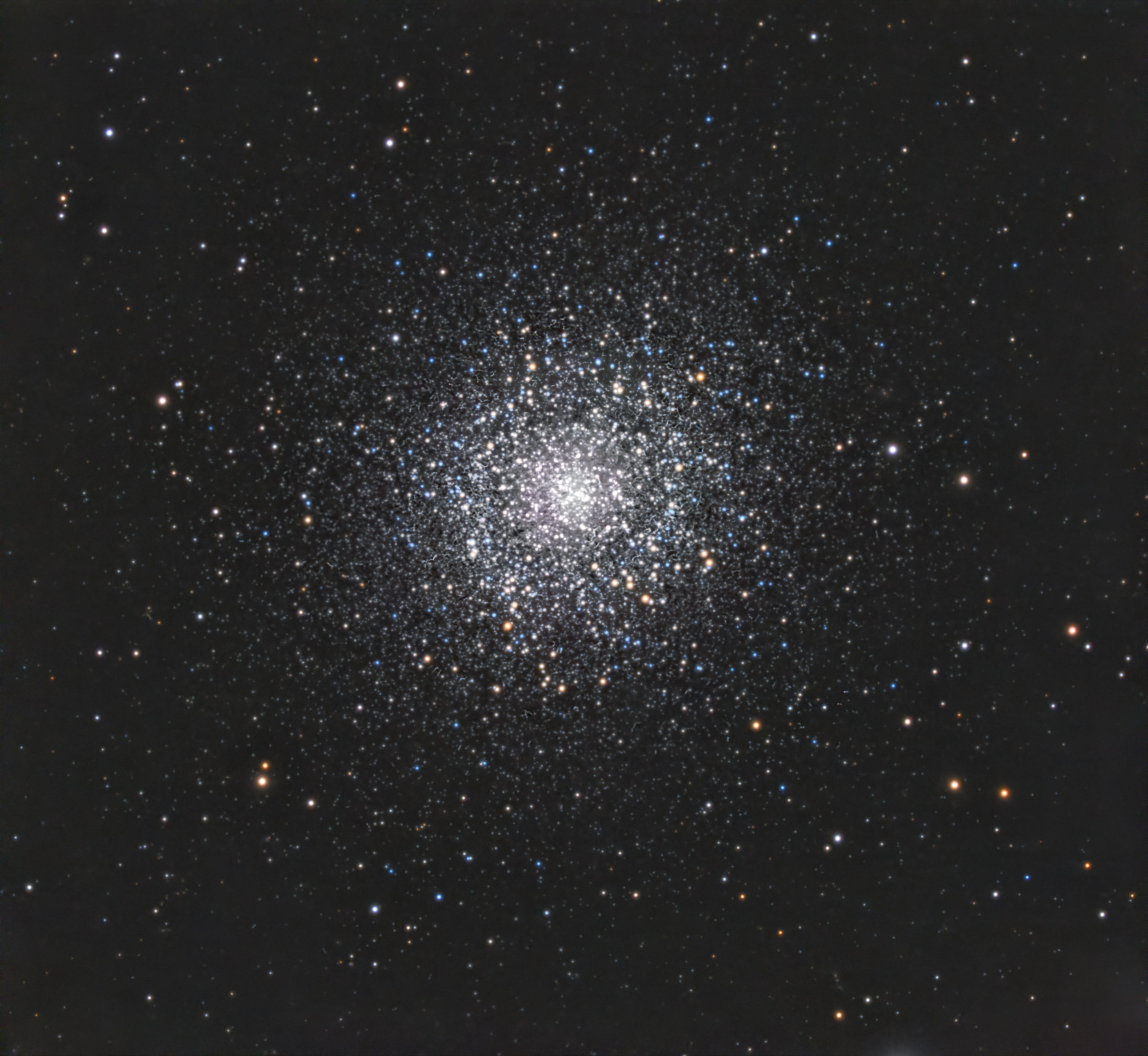
CLICK ON IMAGE TO VIEW A HIGH RESOLUTION VERSION
The M13 Hercules Cluster, also known as the Great Hercules Cluster, is one of the brightest and most spectacular globular clusters visible in the northern hemisphere. Located about 22,200 light-years away in the constellation Hercules, it spans roughly 145 light-years in diameter and contains several hundred thousand stars densely packed together.
M13 is a globular cluster, meaning it is a roughly spherical collection of ancient stars, many over 11 billion years old, orbiting the Milky Way’s center. Its core is extremely dense, giving it a shimmering, almost jewel-like appearance when viewed through a telescope. Under dark skies, it is visible to the naked eye as a faint, fuzzy patch, but even a small telescope reveals hundreds of individual stars arranged in a bright, concentrated core.
Astronomers have studied M13 extensively, not only for its stellar population but also because of its historical significance—in 1974, the Arecibo Observatory sent a radio message toward it as part of an interstellar communication experiment.
M13 remains a favorite target for amateur astronomers, offering a striking glimpse of a dense, ancient stellar system that has existed since the early days of our galaxy.
Technical Details
Telescope: Celestron C8 SCT (8″ Schmidt-Cassegrain) with Celestron 0.63 focal reducer
Auto Focus: Celestron Electronic Auto Focuser
Astronomy Camera: ZWO ASI533MC Pro
Filter: Optolong UV-IR cut filter; 360 exposures @ 60 seconds each (6 hours)
Total Integration Time: 6 hours
Off-Axis Auto Guiding: ZWO OAG-L
Auto Guiding Camera: ZWO ASI174MM Mini Guide Camera
Auto Guiding Software: PHD2
Telescope Mount: Sky- Watcher EQ6-R Pro
Telescope Computer: BeeLink GK-55 Mini PC / Windows 10 Pro
Wireless Communication: GL-iNEt Beryl Travel Router
Telescope Control & Image Capture Software: Nighttime Imaging ‘N’ Astronomy (N.I.N.A.)
Image Integration Software: Astro Pixel Process, by Aries Productions
Image Post Processing Software: PixInsight, by Pleiades Astrophoto
Images captured in Palm Springs, CA during June 2022. Dark sky classification = Bright suburban sky (Bortle 6)
Visited 21 times, 1 visit(s) today