CLICK ON IMAGE TO VIEW A HIGH RESOLUTION VERSION
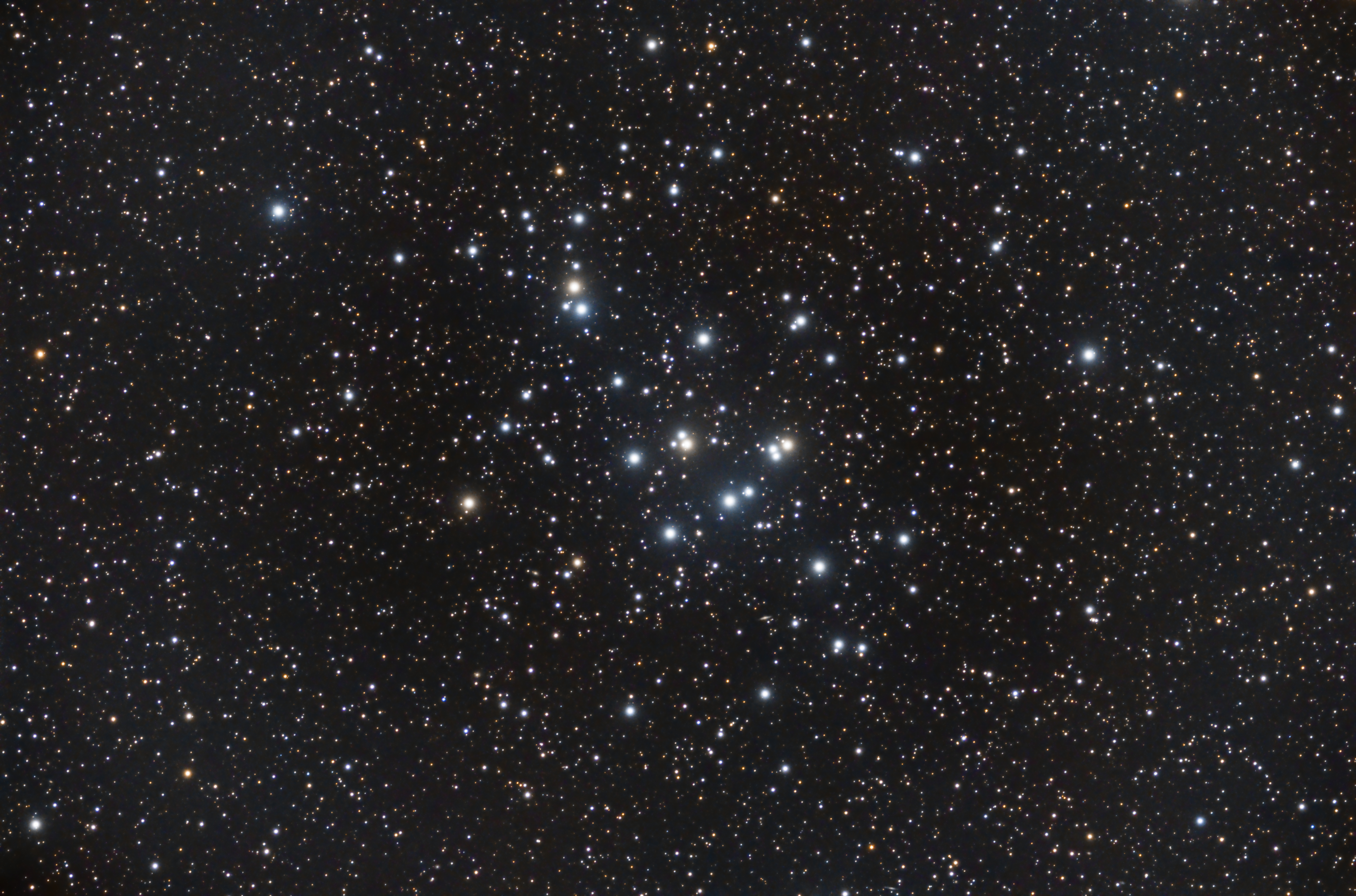
M44, also known as the Beehive Cluster or Praesepe, is one of the nearest and most prominent open star clusters in the night sky. Located in the constellation Cancer, it lies about 577 light-years from Earth and spans roughly 95 light-yearsin diameter. With an apparent magnitude of around 3.7, it is visible to the naked eye as a faint, misty patch and is easily seen with binoculars or a small telescope.
The cluster contains several hundred stars, mostly middle-aged, sun-like stars, though it also hosts some hotter, more massive stars. Its age is estimated to be around 600–700 million years, making it relatively mature for an open cluster. The stars are loosely bound by gravity, giving M44 its characteristic “swarm” appearance, which inspired its nickname, the Beehive Cluster.
M44 has fascinated astronomers for centuries; it was known to the ancient Greeks and Romans and has been a popular target for amateur and professional astronomers alike. Its combination of bright, sparkling stars and rich, dense grouping makes it an excellent showcase of stellar evolution and cluster dynamics in our galaxy.
Technical Details
Telescope: Sky-Watcher Esprit 100ED Refractor
Auto Focus: ZWO Electronic Auto Focuser
Astronomy Camera: ZWO ASI071MC Pro
Filter: Optolong UV-IR cut filter; 260 exposures @ 60 seconds each (4.3 hours)
Total Integration Time: 4.3 hours
Auto Guiding: William Optics Uniguide 50mm Guide Scope
Auto Guiding Camera: ZWO ASI120MM Mini Guide Camera
Auto Guiding Software: PHD2
Telescope Mount: Sky- Watcher EQ6-R Pro Equatorial Mount
Telescope Computer: BeeLink GK-55 Mini PC / Windows 10 Pro
Wireless Communication: GL-iNEt Beryl Travel Router
Telescope Control & Image Capture Software: Nighttime Imaging ‘N’ Astronomy (N.I.N.A.)
Image Integration Software: Astro Pixel Process, by Aries Productions
Image Post Processing Software: PixInsight, by Pleiades Astrophoto
Images captured:
Palm Springs, CA during September 2022. Dark sky classification = Bright suburban sky (Bortle 6)
Visited 17 times, 1 visit(s) today