What’s Up With That?
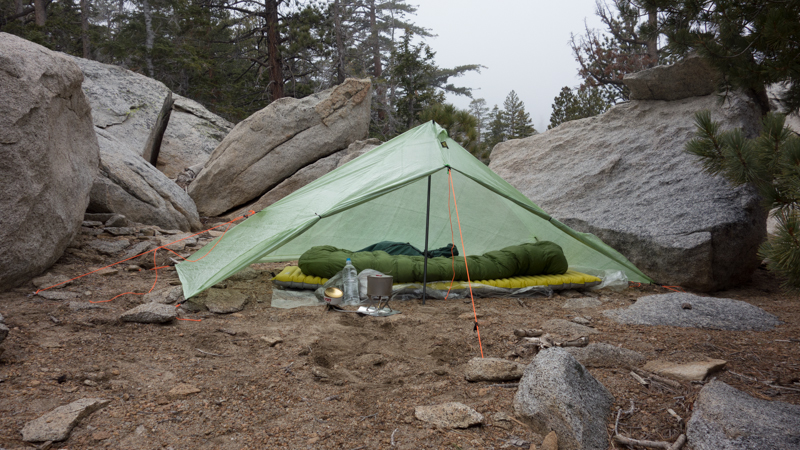
Let me confuse you.
In 2018 I wrote this article, If I Could Have Only One Shelter it Would be a MLD TrailStar.
Yesterday I wrote a post stating TarpTent Scarp 1: My Favorite Shelter of All Time.
Today I am stating that my go to shelter is neither the TrailStar, nor the Scarp 1. My “go to’ shelter is my Six Moon Designs Deschutes CF, which I wrote about 10 years ago as a first impression essay.
So what gives?
The thing is, there is no best shelter. If you see an article that states something like, “The Best Shelters of 2025” or “The Best of Anything List” don’t read it. There is no best. Nothing fulfills all criteria that a product attempts to do. These “Best” lists are just click-bait trying to induce you to buy something.
MLD TrailStar
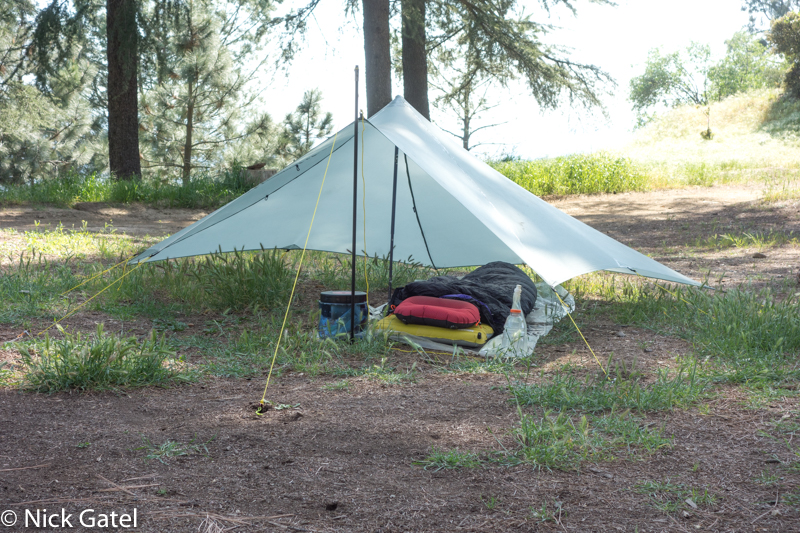
This shelter is very lightweight given the large area it covers. Its construction is simple. It doesn’t break. It has no zippers or doors. It can be set up with a couple trekking poles, a hiking staff and a small pole, or even a couple of downed tree branches.
Its footprint takes up a lot of real estate. It needs 11 stakes and they need to be sturdy.
It isn’t easy to get in and out of. But once inside it is so spacious. It sheds wind like very few shelters. And it is fairly light at 26 ounces with seam sealing and guy lines. Other than a heavy snowstorm, it can handle most weather.
But it doesn’t do anything exceptionally well other than protecting against wind. So it’s a pretty good shelter for almost any situation, given its light weight. This last sentence is what makes it the shelter I would want if I could only have one shelter.
TarpTent Scarp 1
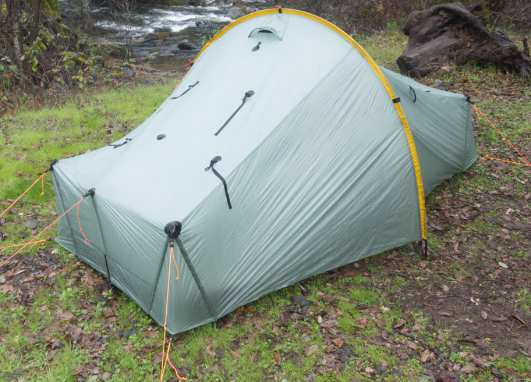
This thing is ingenious. It has held up extremely well for the past 15 years. However it is heavy compared to the competition, unless it is only compared to other 4 season tents.
I love this tent.
But I don’t only backpack in winter. I backpack all four seasons in all kinds of terrain — from the desert to the sea to the mountains. Given its weight, it is overkill for me on most trips in spring, summer and fall when a less robust shelter makes sense.
The Quiver (or the Toolbox)
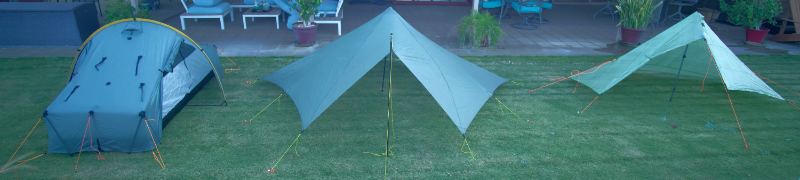
A quiver is a case for holding a bunch of arrows. A toolbox holds a bunch of tools for various operations. You need more than one arrow to hunt. You need different tools for different jobs.
And I need more than one shelter to cover all the seasons, all the terrain, all my needs.
I live in Southern California. I mostly hike in our deserts and various mountain ranges throughout the state. I also backpack fairly often in Nevada and Arizona. On most trips it doesn’t rain. The wind often isn’t a problem. All of which means I often don’t really need a shelter, even when others do. And for the past 10 years I have 3 shelters in my quiver for 99% of my backpacking trips.
Weight and Living Space
There are two specs that interest me when choosing a shelter for a trip, other than the weather:
- weight
- coverage area
Weight is obvious. The lighter, the better.
Coverage area is a difficult thing to visualize on paper or a screen. When my TrailStar or Deschutes are pitched low to the ground, the sloping walls provide very little usable space near the edges. The Scarp 1, using struts at each end has a minimum 18 inch tall walls of usable space.
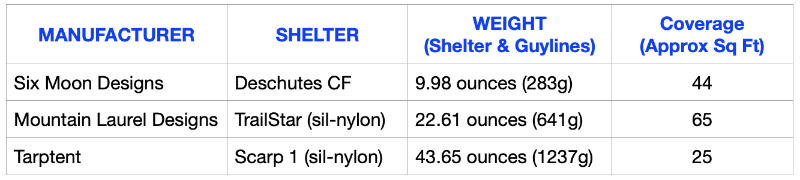
The Scarp 1 has about 43% less coverage area than the Deschutes, but it actually has more usable living space.
Weights in the table above are for the shelter and guy lines only. The Scarp 1 weight includes the arch pole.
Bugs, Insects & Condensation
Flying Monsters
The Deschutes and TrailStar have no protection from bugs and insects. I tolerate mosquitoes better than anyone I know. When they are plentiful a headnet and a little DEET serve me well. For those who need more protection from those flying pests, both companies sell mesh inner nets, what will add around 12 ounces to the total weight.
Condensation
The Scarp 1 handles (or mostly eliminates) condensation better than any tent I have ever owned. For the other two, the thing one can do is try to minimize it by shelter location, and pitch height.
Non-Shelters
For me the best roof is the night sky. This is my preference. I suspect the majority of backpackers sleep in a shelter. What works for me may not work for others. We are both right.
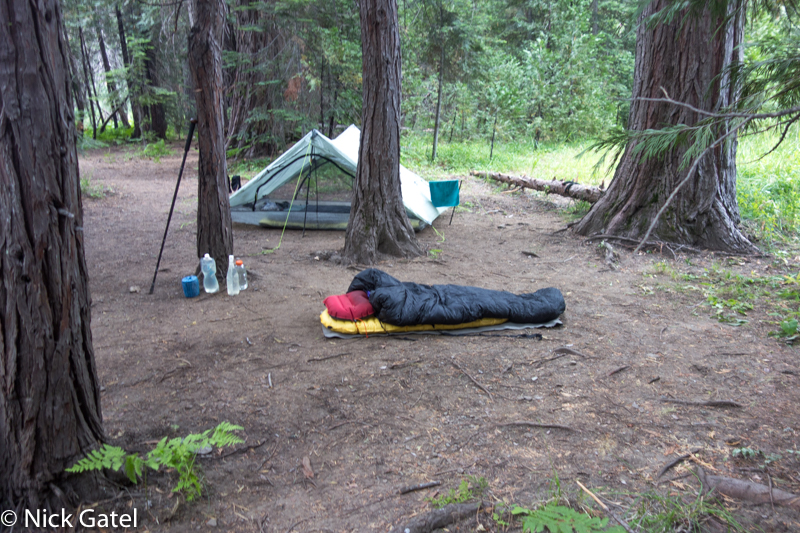


Six Moon Designs Deschutes CF
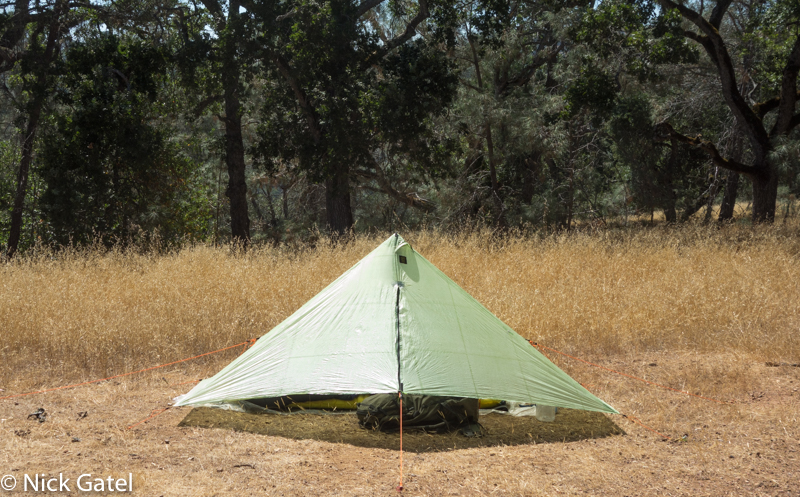
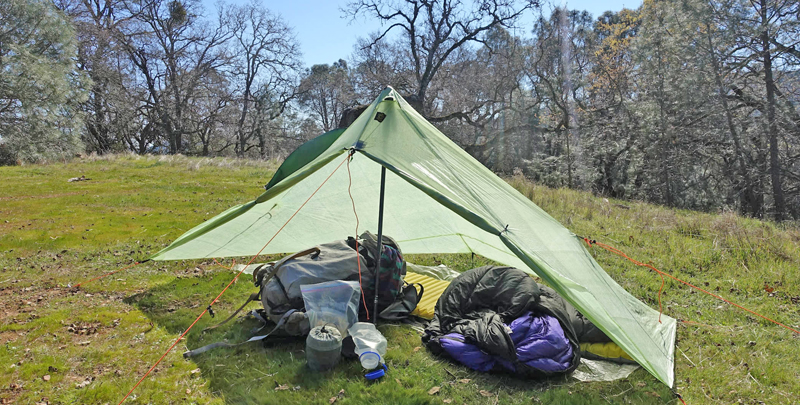
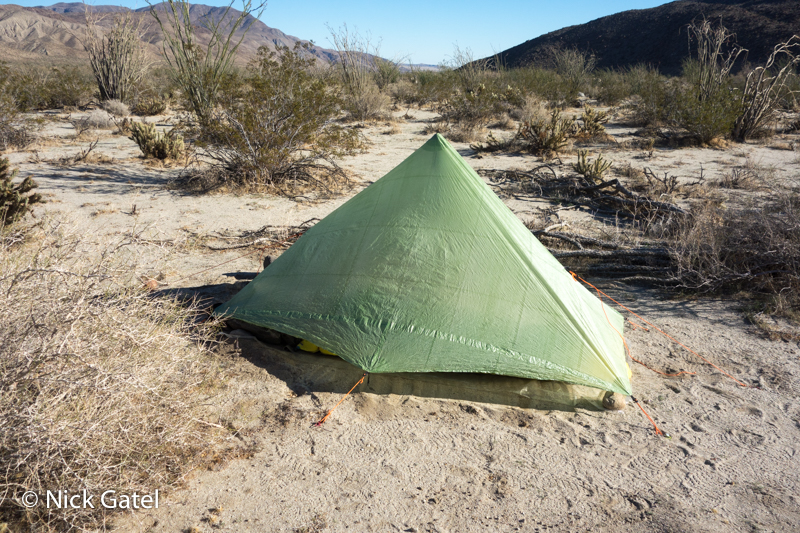
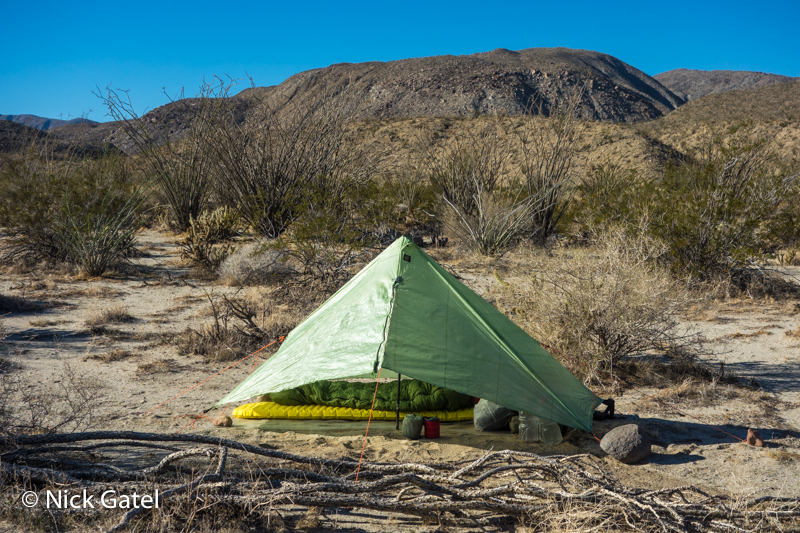
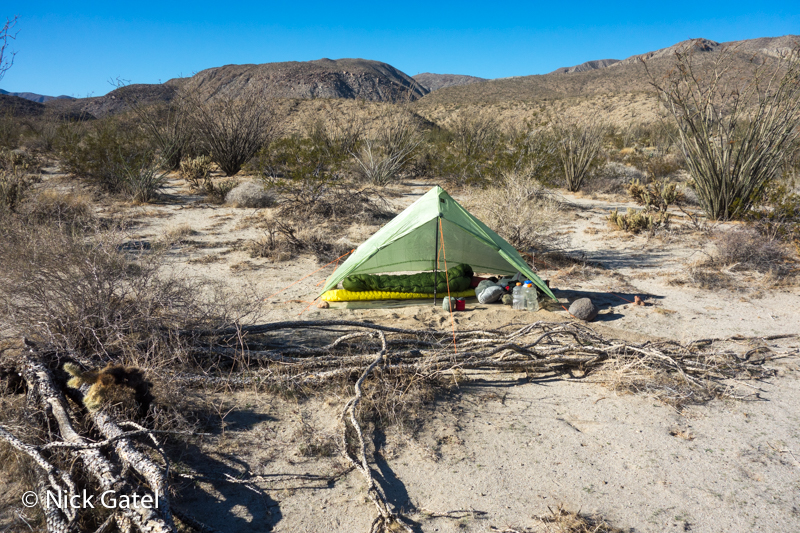
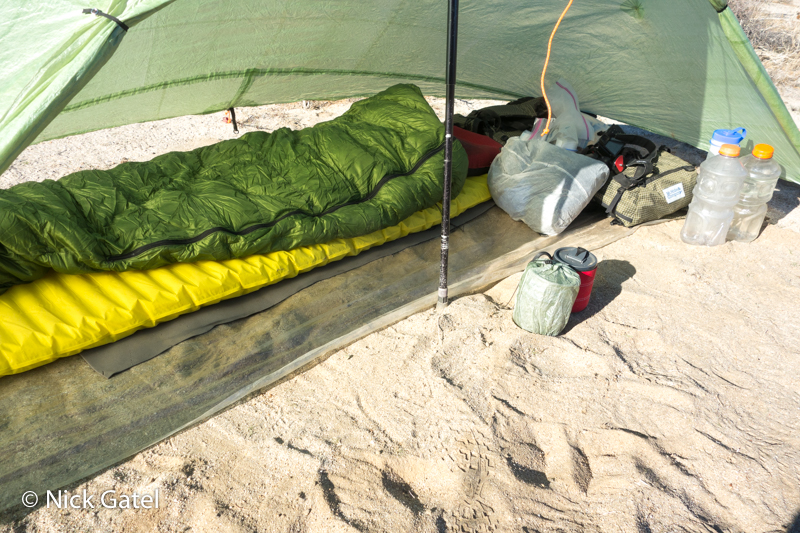
This website may be compensated for linking to other sites for sales of products at no additional cost to the purchaser.
My “GoTo” Predecessors
SIX MOON DESIGNS WILD OASIS
The Deschutes was not my first small “go to” pyramid tarp shelter. My first one was a Six Moon Designs Wild Oasis, that I bought in 2008. I wrote about it in this post:
With 35 square feet of coverage, it did a good job in most of my 3 season trips. Six Moon Designs no longer sells this shelter, but they do sell the Gatewood Cape that is the same size and design as the Wild Oasis, plus it can be turned into a poncho. The Wild Oasis was sil-nylon shelter, with perimeter netting to help control insects. I did not particularly care for the netting as it mostly got into my way. The big advantage of this shelter was its weight, a mere 14.4 ounces including seam sealing, guylines, and stuff sack.
zPacks HEXAMID SHELTER
Then in 2011 I bought a zPacks Hexamid Cuben Fiber shelter. It was almost identical to the Wild Oasis, but only weighed 3.63 ounces including the guylines.
This became my go to shelter until 2015, when I bought my Six Moon Designs Deschutes CF. The Deschutes is very similar in shape to both the Wild Oasis and the Hexamid, but larger at 44 square feet of coverage. The Deschutes coverage was 25% greater than the other two, which made a huge difference during wind-swept rainy nights. Eventually I gave the Wild Oasis to my son.
Deschutes CF 10 Year Anniversary
The Deschutes is now 10 years old. It has done everything I need in a 3 season shelter. But alas, it is made from Cuben Fiber (a.k.a DCF). Cuben Fiber is a laminate that will delaminate over time. It is not very resistant to abrasions. Even stuffing it into a stuff sack after every use will decrease its lifespan, which is why I always pack it into my pack without a stuff sack. This is the serious draw back to Cuben, other than its outrageous cost. Last year I wrote about this . . .
And now my Deschutes CF is showing its age. I’ve made several repairs to it with DCF repair tape. The needed repairs is not a reflection of the quality of manufacture, but a limitation in the material itself.
I’ve been very happy with my Deschutes, but it will need to be retired in the near future and I will need a new “go to” shelter for 3 season use. I haven’t decided what shelter to buy, but right now at the top of my list is the Six Moon Designs sil-poly Deschutes Ultralight Backpacking Tarp, with a weight of 13 ounces. Same exact design as my present Deschutes CF.