Viewing Expectations
In Part 1 of this series, I introduced several high level topics regarding telescopes. In this part we’ll take another look at expectations in greater detail.
Expectations Using the Astronomy Tools Website
If you can’t go to a star party or an astronomy club “show and tell” gathering, the website Astronomy Tools can help you visualize what a specific telescope and eyepiece will look like.
Schmidt-Cassegrain telescopes (SCT), which are a type of Newtonian Reflector, are very popular for their compactness, weight, and relative cost compared to other types of telescopes. They will be a good example to compare different sizes of telescopes.
Astronomy Tools Set Up Screen

In the picture above I have picked the following parameters from the drop-down menu boxes:
- Solar System Object = Saturn
- Telescope = Celestron C14 SCT
- Eyepiece = Baader – Hyperion – 24 mm
All the other specification are automatically calculated. Once set up, just click the “Add to View” button and the program will create a picture of what you can expect to view with this combination.
Telescope Comparison Exercise
Using the Astronomy Tools website, I have stacked the expected images of several Celestron SCTs all using a Baader Astronomy 24mm Hyperion eyepiece, which is a fairly good quality optic. 24mm is a good general size lens with not too much magnification.
Using Celestron’s model numbers, where the number is the diameter of the primary mirror, we can get an idea what an object (in this case Saturn) will appear in different sized telescopes. The samples I put together in ascending order include:
- NexStar 4se
- NexStar 5se
- NexStar 6se
- NexStar 8se
- Celestron 11 SCT
- Celestron 14 SCT
Looking at the smallest circle (blue) in the picture below, you can see the relative size of Saturn compared to the field of view in the large Celestron 14” Schmidt-Cassegrain.
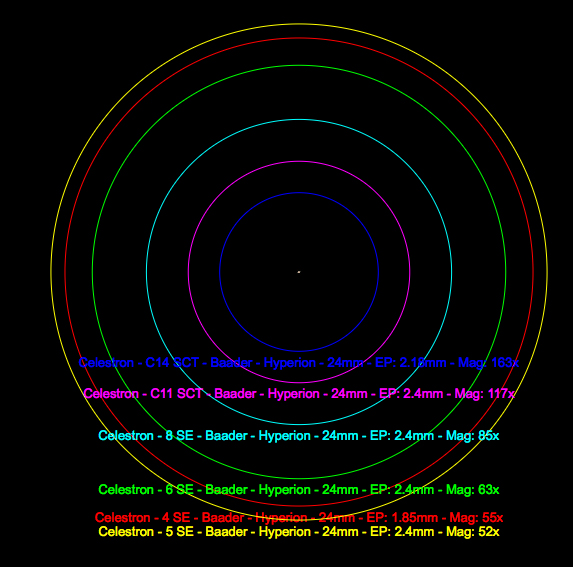
The large outer yellow circle is the field of view of the small Celestron 4” Schmidt-Cassegrain. However, the 14-inch SCT is significantly more expensive than the 4-inch.
4-Inch SCT vs. 14-inch SCT Using a 24mm Eyepiece
To better illustrate, the two pictures below compare just the NexStar 4se and the Celestron C14 SCT.
Below, Saturn is barely visible in the NexStar 4se using a 24 mm eyepiece.
Below, the Celestron C14 SCT has a nice view.
4-Inch SCT vs. 14-inch SCT Using an 8mm Eyepiece
To better illustrate, the two pictures below compare just the NexStar 4se and the Celestron 14 SCT.
NexStar 4se and a Baader Hyperion 8 mm eyepiece below.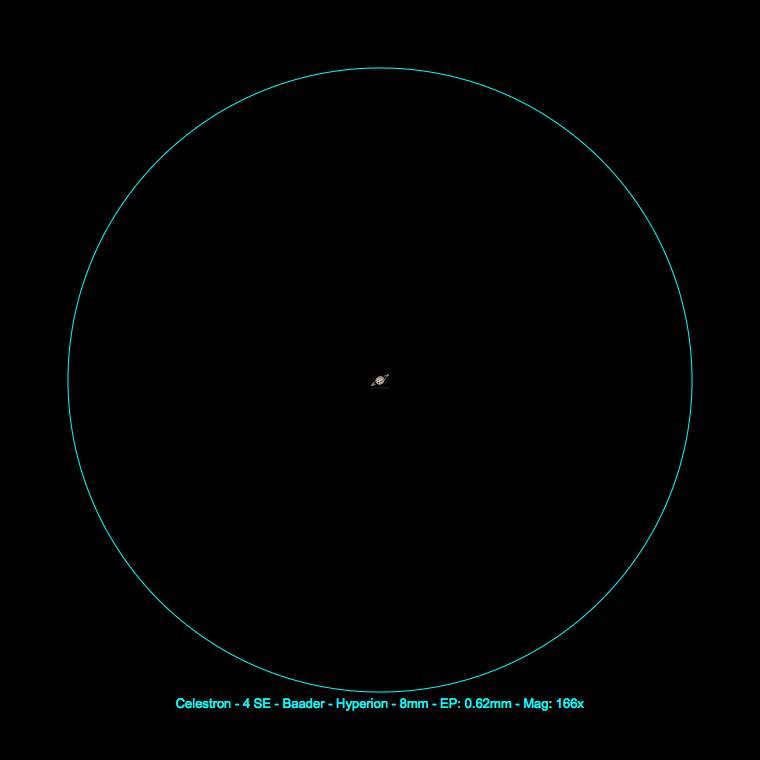
Obviously the much larger C14 SCT has the largest sharp view. But this comes at a cost, as it is much, much more expensive that the NexStar 4se.
Telescope Mounts
The purchase of a telescope has two important elements: The Optical Tube and the Telescope Mount. The easiest mount for beginners to use is an Alt-Azimuth mount. Let’s take a high-level look at both types of mounts.
Alt-Azimuth Mounts vs German Equatorial Mounts
Alt-Azimuth (Alt-Az) Mount
Moves in two simple directions: Altitude — up and down and Azimuth — left and right.
Alt-Az telescope mounts are good for visual observing, especially of the Moon, planets, and bright objects. They are know for beginner-friendly and quick setups — no polar alignment needed.
German Equatorial Mount (GEM)
A GEM telescope mount has two axes: Right Ascension (RA) that aligns with Earth’s rotational axis and Declination (Dec) that moves north/south in the sky. The RA axis must be polar-aligned (pointed toward the celestial pole) for accurate tracking.
GEMs are good for Astrophotography because unlike an Alt-Az mount, they track stars by moving only one axis (RA), reducing field rotation. They are great for long-exposure deep-sky imaging, high-precision tracking of celestial objects, and observing faint objects that require steady tracking.
Telescope Budget
This website may be compensated for linking to other sites for sales of products. As an Amazon Associate I earn a small fee from qualifying purchases at no additional cost to the purchaser.
Purchasing a telescope will start with your budget. To be honest, if you want good results with a telescope, a selection of eyepieces, and other accessories, you probably need to start with a minimum budget of around $1,000. The telescope links below will give you a range of prices you can expect for a quality entry-level telescope.
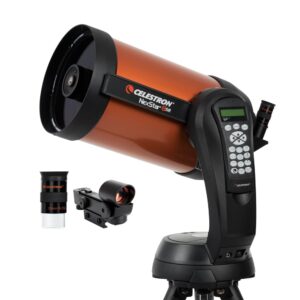
I have the NexStar 8se and highly recommend it for a first telescope. Less expensive (and smaller options) are the NexStar 4se and the NexStar 6se.
Celestron NexStar 4SE Computerized Telescope, 4-Inch Maksutov-Cassegrain Optical Tube, Alt-Az Mount
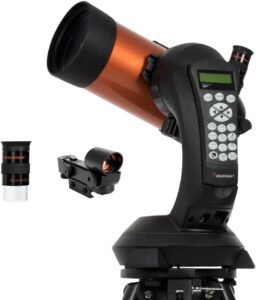

Celestron NexStar 6SE Computerized Telescope, 6-Inch Schmidt-Cassegrain Optical Tube, Alt-Az Mount
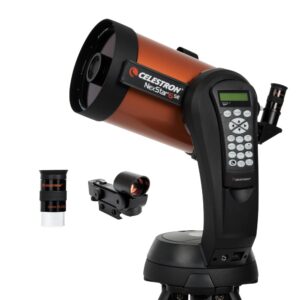
Celestron NexStar 8SE Computerized Telescope, 8-Inch Schmidt-Cassegrain Optical Tube, Alt-Az Mount
Eyepiece Budget
Most telescopes come with a single inexpensive eyepiece, usually a 24mm. Eyepieces are usually the first additional purchase budding amateur astronomers make. Below are some comparison prices. I prefer more specialized optics over the standard offerings of the mass-market telescope companies such a Celestron and Sky-Watcher. The Baader brand Hyperion eyepieces are of much higher quality, though they probably fall in the mid-range compared to higher end options.
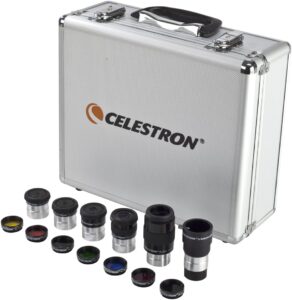
Celestron Accessory Kit with Five 1.25″ Plossl Eyepieces, 2X Barlow and Filter Set
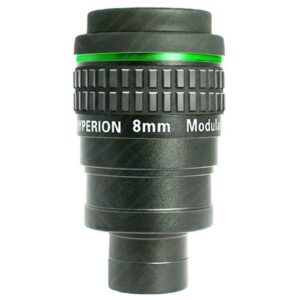
Baader 1.25″ & 2″ Hyperion Eyepiece – 8mm
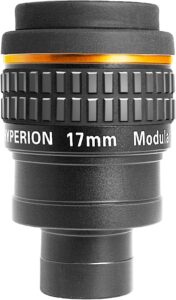
Baader 1.25″ & 2″ Hyperion Eyepiece – 17mm
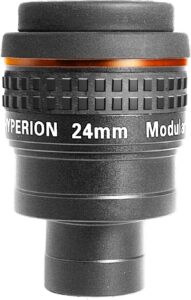
Baader 1.25″ & 2″ Hyperion Eyepiece – 24mm
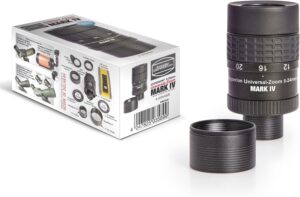
This my favorite: Baader 1.25″ & 2″ 8-24mm Hyperion Universal Mark IV Zoom Eyepiece
Astronomical “Seeing”
No telescope or eyepiece can overcome really poor seeing conditions. Astronomical “seeing” is a measurement of how much turbulence is in the air. Too much turbulence results in fuzzy views of the night sky objects. If the “seeing” is less than good, then I usually stay inside and read a book, unless there is a special object I want to view, such as a comet or a planet that is at opposition to the Earth, things that occur infrequently.
The website Clear Sky Chart, can help you determine and plan your observation sessions. This site has a location that is about 6 miles from my house. Clear Sky Chart has a lot of information about viewing conditions, weather, and other astronomy informal, plus an option for email notifications every day.
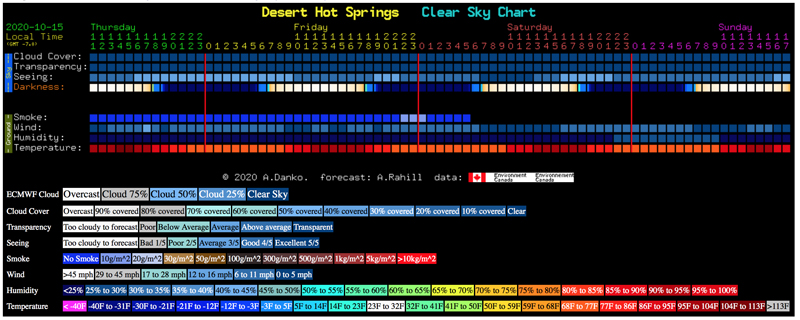
The third line in the chart is the “Seeing” conditions for tonight and the next three days, each by the hour. Tonight the “seeing” for me will be 3 out of a scale of 5. My experience is this is just okay and not conducive to astrophotography. Below are a couple pictures I recently took of Mars and Jupiter when the “seeing” was an average 3/5.
Mars

Jupiter
