Category Archives: Astrophotography

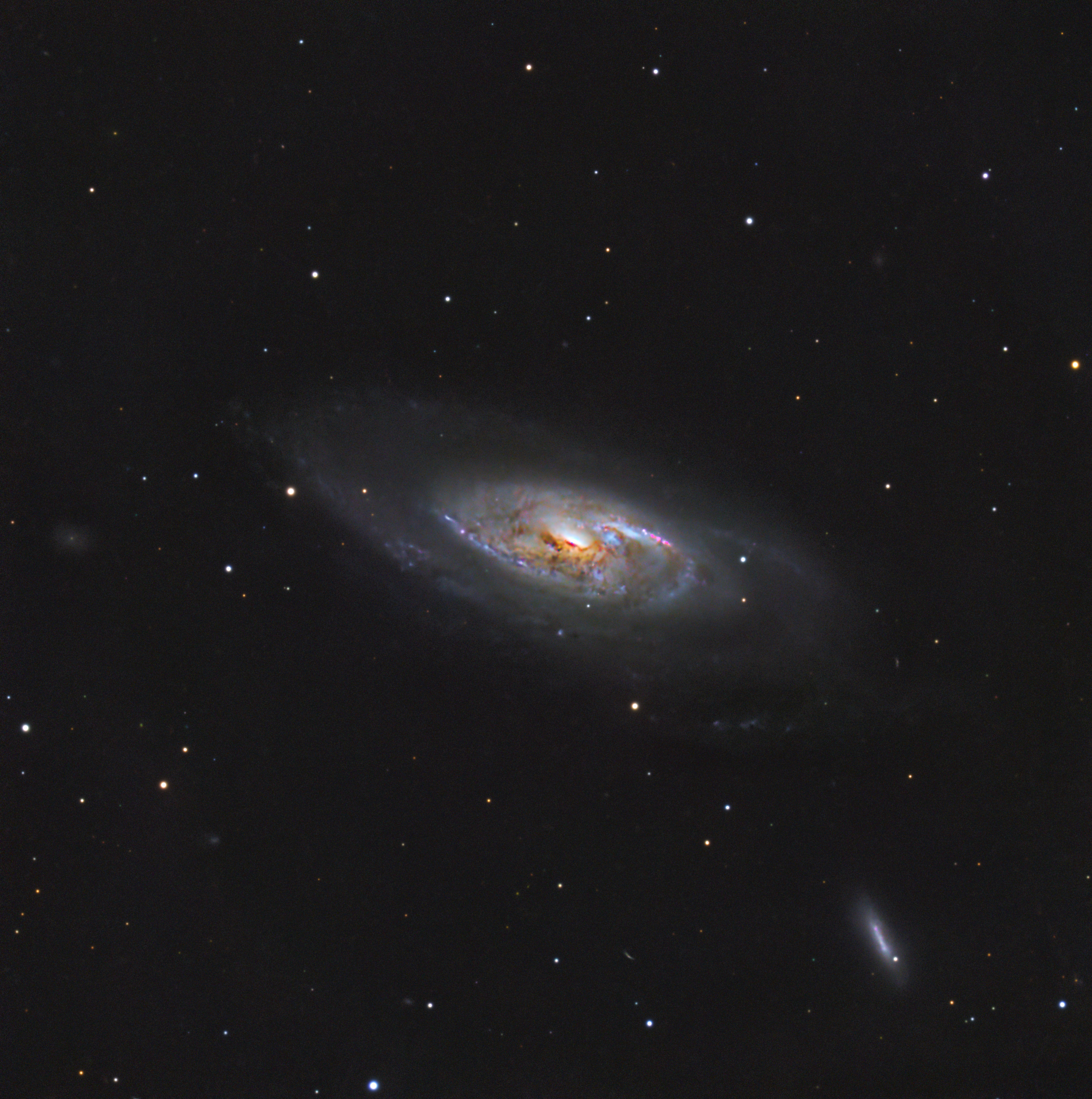
M106 a Galaxy in Canes

CLICK ON IMAGE TO VIEW A HIGH RESOLUTION VERSION


Messier 106 (M106) is a striking spiral galaxy located about 23 million light-years away in the constellation Canes Venatici. Classified as an intermediate barred spiral, M106 is notable for its bright core and two prominent spiral arms that sweep outward, threaded with dark dust lanes and regions of active star formation.

What makes M106 especially intriguing is its active galactic nucleus, powered by a supermassive black hole at its center. This activity produces powerful jets of energized gas that glow in radio and X-ray wavelengths, creating unusual “anomalous arms” that do not align with the galaxy’s visible spiral structure. These features reveal complex interactions between the black hole and the surrounding interstellar medium.

With an apparent magnitude of around 8.4, M106 is visible in small telescopes and is a rewarding target for astrophotographers, who can capture both its classic spiral beauty and subtle signs of its energetic core. As one of the dominant members of the M106 Group of galaxies, it offers astronomers valuable insight into how black holes influence the evolution of spiral galaxies.


Technical Details

Telescope: Celestron C8 SCT (8″ Schmidt-Cassegrain) with Celestron 0.63 Focal Reducer

Auto Focus: Celestron Electronic Auto Focuser

Astronomy Camera: ZWO ASI533MC Pro

Filter: Optolong UV-IR  cut filter; 600 exposures @ 60 seconds each (10 hours)

Total Integration Time: 10 hours


Off-Axis Auto Guiding: ZWO OAG-L

Auto Guiding Camera: ZWO ASI174MM Mini Guide Camera

Telescope Mount: Sky- Watcher EQ6-R Pro Equatorial Mount

Telescope Computer: BeeLink GK-55 Mini PC / Windows 10 Pro

Wireless Communication: GL-iNEt Beryl Travel Router


Telescope Control & Image Capture Software: Nighttime Imaging ‘N’ Astronomy (N.I.N.A.)

Image Integration Software: Astro Pixel Process, by Aries Productions

Image Post Processing Software:  PixInsight, by Pleiades Astrophoto


Images captured in Palm Springs, CA during May 2025. Dark sky classification = Bright suburban sky (Bortle 6).


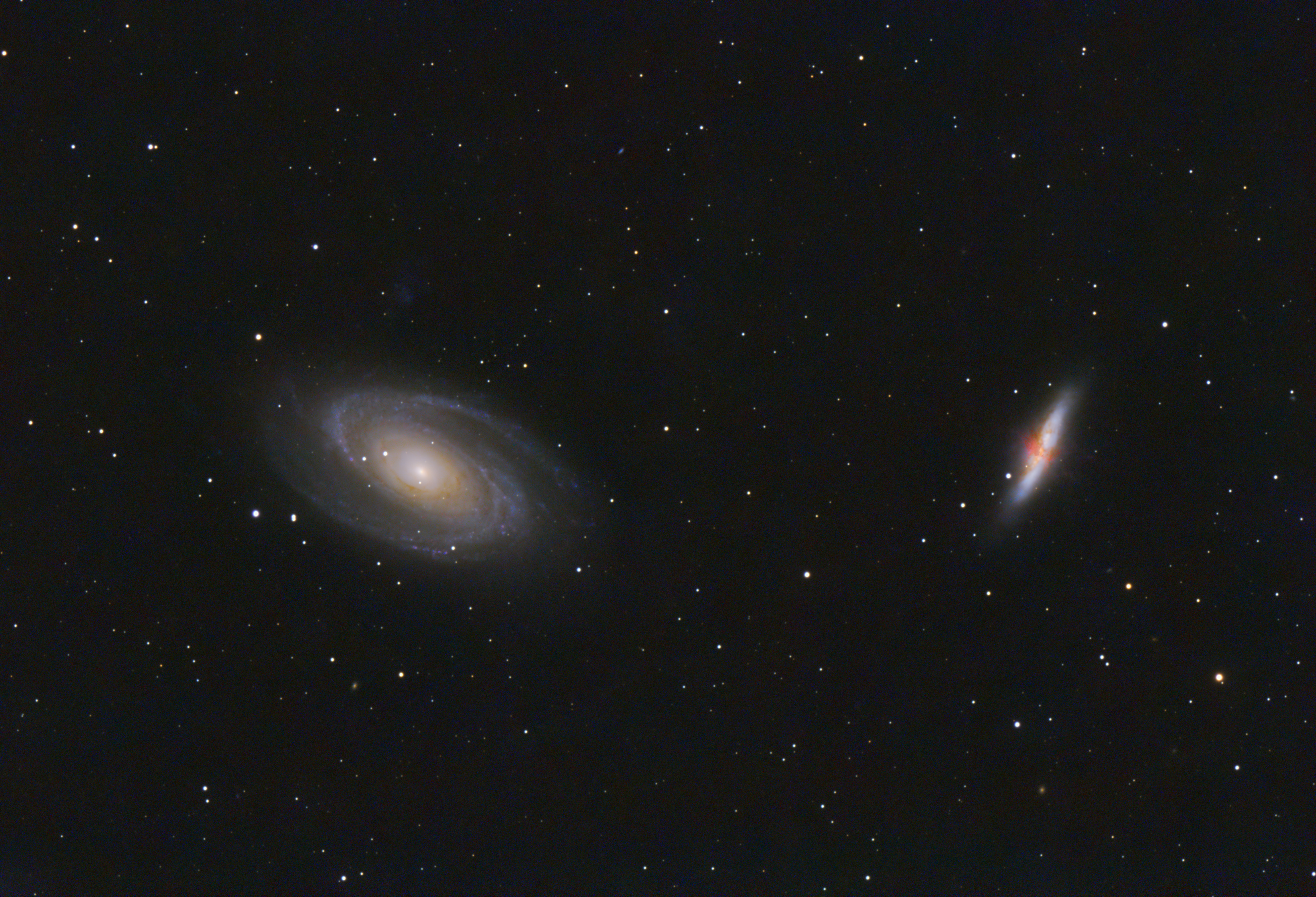
M81 Bode’s Galaxy and M82 Cigar Galaxy

CLICK ON IMAGE TO VIEW A HIGH RESOLUTION VERSION


Messier 81 (Bode’s Galaxy) and Messier 82 (the Cigar Galaxy) form a famous and contrasting pair of galaxies in the constellation Ursa Major, located about 12 million light-years from Earth. M81 is a classic grand-design spiral galaxy with a bright central core and well-defined spiral arms laced with dark dust lanes and regions of star formation. It appears smooth and orderly, making it one of the finest examples of a spiral galaxy visible to amateur telescopes.

Nearby M82 presents a dramatically different appearance. Classified as an irregular, starburst galaxy, it is seen edge-on as a narrow, elongated shape. Powerful gravitational interactions with M81 have triggered intense bursts of star formation in M82, driving enormous streams of gas and dust outward from its core. Together, M81 and M82 provide a vivid illustration of how galactic interactions can shape structure and activity, and they are a favorite target for observers and astrophotographers alike.


Technical Details

Telescope: Sky-Watcher Esprit 100ED Refractor

Auto Focus: ZWO Electronic Auto Focuser

Astronomy Camera: ZWO ASI183MC Pro

Filter: Optolong UV-IR  cut filter; 900 exposures @ 60 seconds each (15 hours)

Total Integration Time: 15 hours


Auto Guiding Software: PHD2

Auto Guiding: William Optics Uniguide 50 Guide Scope

Auto Guiding Camera: ZWO ASI20MM Mini Guide Camera

Telescope Mount: Celestron CGX Equatorial Mount

Telescope Computer: BeeLink GK-55 Mini PC / Windows 10 Pro

Wireless Communication: GL-iNEt Beryl Travel Router


Telescope Control & Image Capture Software: Nighttime Imaging ‘N’ Astronomy (N.I.N.A.)

Image Integration Software: Astro Pixel Process, by Aries Productions

Image Post Processing Software:  PixInsight, by Pleiades Astrophoto


Images captured in Palm Springs, CA during April 2024. Dark sky classification = Bright suburban sky (Bortle 6).

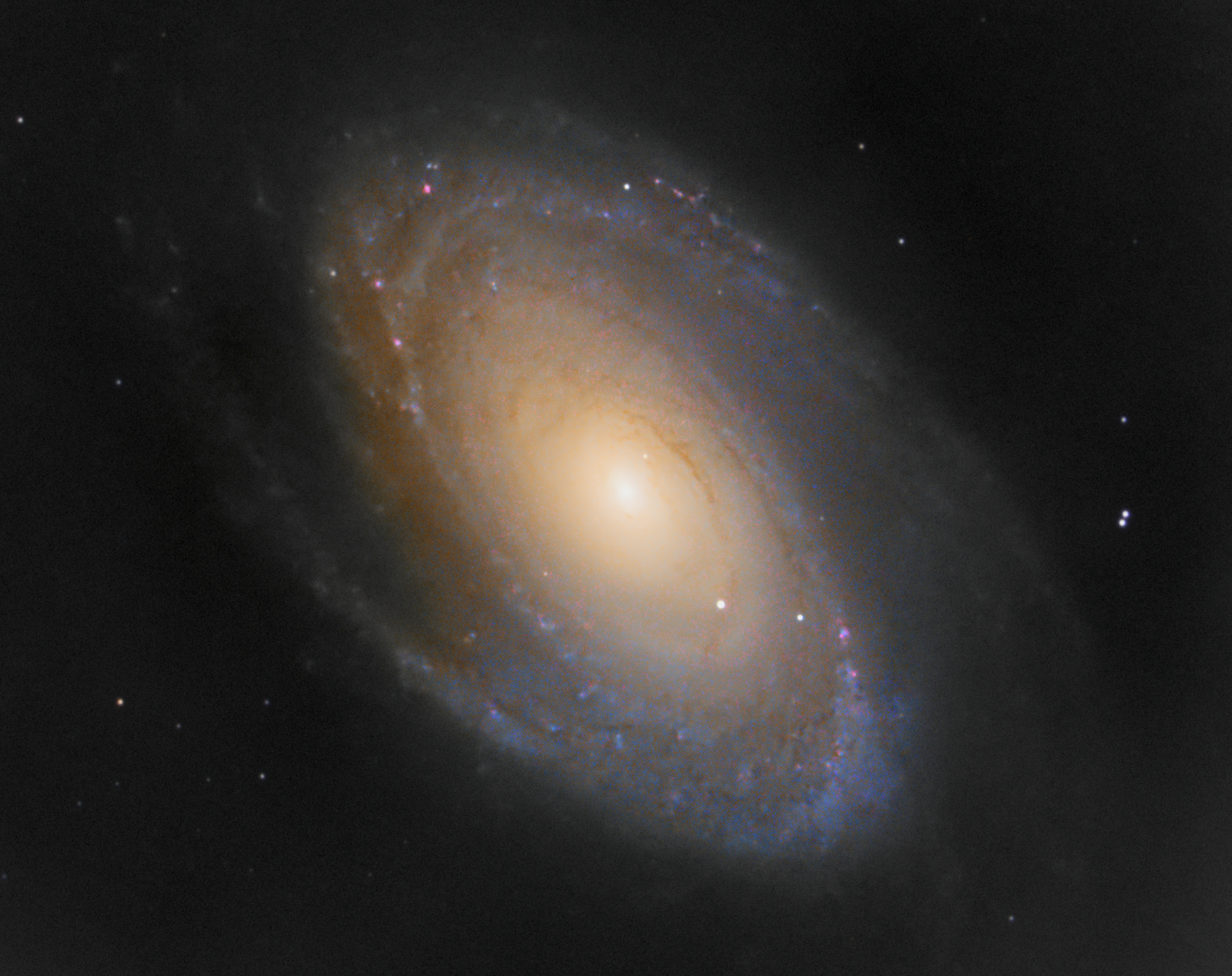
M81 Bode’s Galaxy

CLICK ON IMAGE TO VIEW A HIGH RESOLUTION VERSION


Messier 81, commonly known as Bode’s Galaxy, is a striking grand-design spiral galaxy located about 12 million light-years away in the constellation Ursa Major. One of the brightest galaxies visible from Earth, M81 can be seen with binoculars under dark skies as a soft oval glow, while telescopes reveal its bright, concentrated core and well-defined spiral arms. These arms show intricate dust lanes and regions of active star formation, giving the galaxy a classic spiral appearance. M81 is the dominant member of the M81 Group of galaxies and is gravitationally interacting with nearby companions, most notably Messier 82. These interactions have influenced its structure and star-forming activity, making Bode’s Galaxy a favorite target for both visual observers and astrophotographers.


Technical Details

Telescope: Celestron C8 SCT (8″ Schmidt-Cassegrain) with Celestron 0.63 Focal Reducer

Auto Focus: Celestron Electronic Auto Focuser

Astronomy Camera: ZWO ASI533MC Pro

Filter: Optolong UV-IR  cut filter; 1200 exposures @ 60 seconds each (20 hours)

Total Integration Time: 20 hours


Off-Axis Auto Guiding: ZWO OAG-L

Auto Guiding Camera: ZWO ASI174MM Mini Guide Camera

Auto Guiding Software: PHD2

Telescope Mount: Sky- Watcher EQ6-R Pro

Telescope Computer: BeeLink GK-55 Mini PC / Windows 10 Pro

Wireless Communication: GL-iNEt Beryl Travel Router


Telescope Control & Image Capture Software: Nighttime Imaging ‘N’ Astronomy (N.I.N.A.)

Image Integration Software: Astro Pixel Process, by Aries Productions

Image Post Processing Software:  PixInsight, by Pleiades Astrophoto


Images captured in Palm Springs, CA during February 2023. Dark sky classification = Bright suburban sky (Bortle 6)

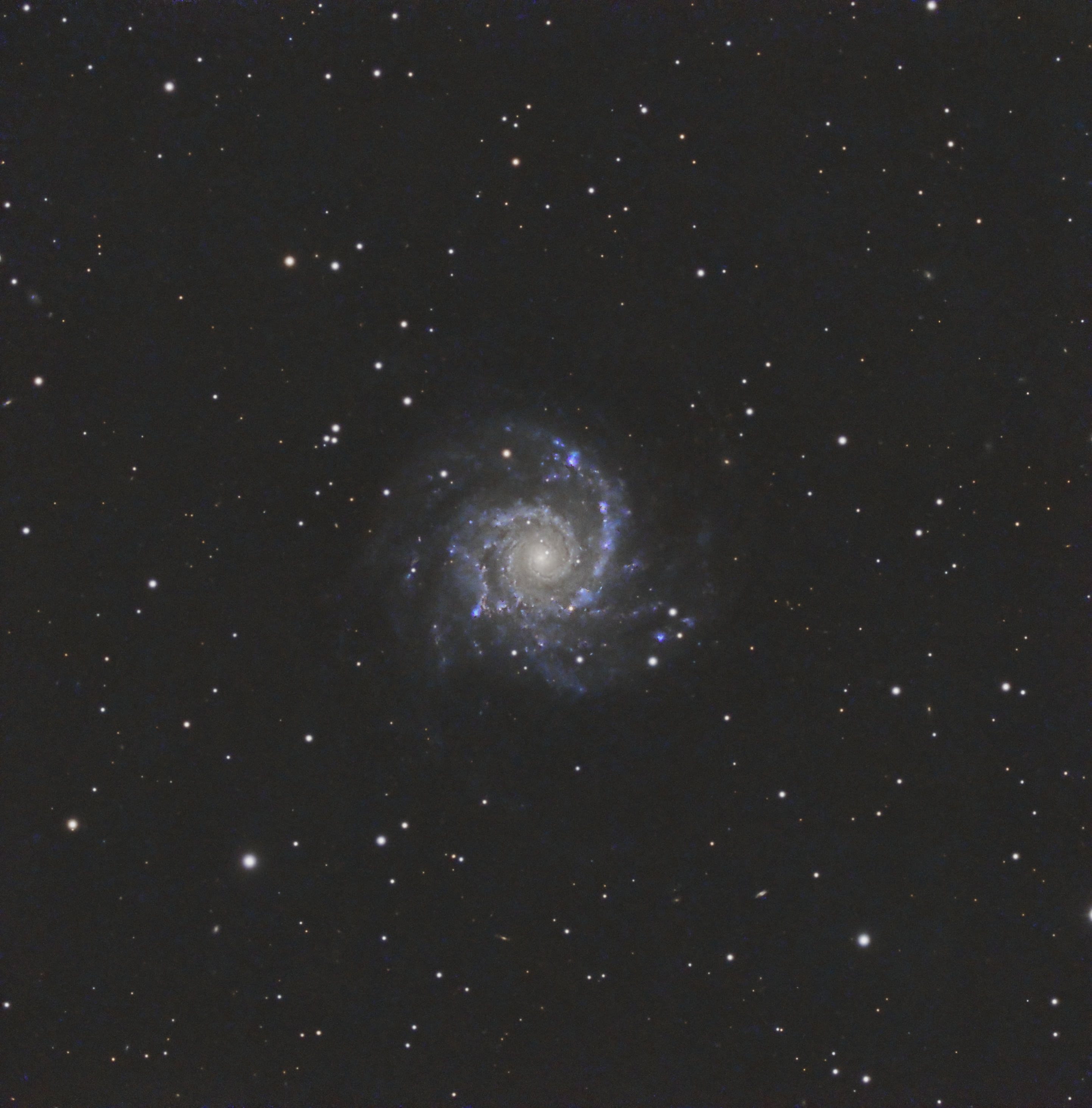
M74 Phantom Galaxy

CLICK ON IMAGE TO VIEW A HIGH RESOLUTION VERSION


M74, also known as the Phantom Galaxy, is a stunning face-on spiral galaxy located in the constellation Pisces. Situated roughly 32 million light-years from Earth, it spans about 95,000 light-years across, making it comparable in size to our own Milky Way. Its nickname, “Phantom Galaxy,” comes from its faint and diffuse appearance, which makes it challenging to observe through small telescopes, almost as if it were a ghostly presence in the night sky.

M74 features well-defined spiral arms rich in star-forming regions, glowing with clusters of young, hot stars and pinkish nebulae from hydrogen gas. Its structure and orientation make it a favorite target for astrophotographers, as the galaxy’s intricate spiral pattern can be captured beautifully under dark skies. M74 is also notable in astronomy as a type II-P supernova host, giving researchers insights into stellar evolution.

Despite its subtle appearance, M74 is an excellent example of a grand-design spiral galaxy, showcasing the elegance and complexity of galactic architecture in our universe.


Technical Details

Telescope: Celestron C8 SCT (8″ Schmidt-Cassegrain) with Celestron 0.63 focal reducer

Auto Focus: Celestron Electronic Auto Focuser

Astronomy Camera: ZWO ASI533MC Pro

Filter: Optolong UV-IR  cut filter; 600 exposures @ 60 seconds each (10 hours)

Total Integration Time: 10 hours


Off-Axis Auto Guiding: ZWO OAG-L

Auto Guiding Camera: ZWO ASI174MM Mini Guide Camera

Auto Guiding Software: PHD2

Telescope Mount: Sky- Watcher EQ6-R Pro

Telescope Computer: BeeLink GK-55 Mini PC / Windows 10 Pro

Wireless Communication: GL-iNEt Beryl Travel Router


Telescope Control & Image Capture Software: Nighttime Imaging ‘N’ Astronomy (N.I.N.A.)

Image Integration Software: Astro Pixel Process, by Aries Productions

Image Post Processing Software:  PixInsight, by Pleiades Astrophoto


Images captured in Palm Springs, CA during September 2024. Dark sky classification = Bright suburban sky (Bortle 6)


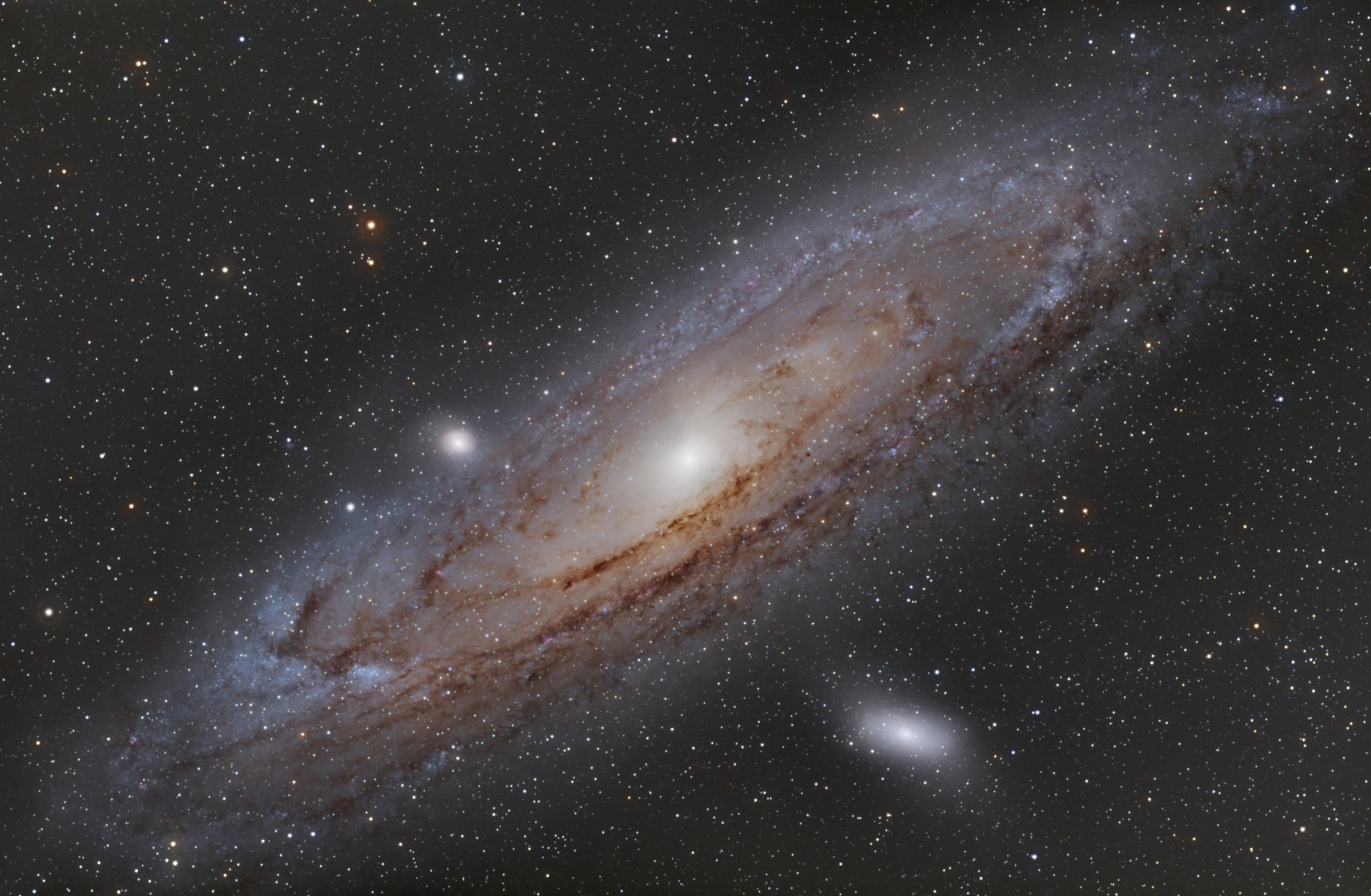
M31 Andromeda Galaxy

CLICK ON IMAGE TO VIEW A HIGH RESOLUTION VERSION


The Andromeda Galaxy (Messier 31, or M31) is a vast spiral galaxy located about 2.5 million light-years from Earth in the constellation Andromeda. It is the nearest major galaxy to the Milky Way and the largest member of the Local Group, spanning roughly 220,000 light-years across. To the naked eye under dark skies, M31 appears as a faint, elongated glow, making it the most distant object humans can see without optical aid. Through binoculars or a telescope, its bright central core, sweeping spiral arms, and prominent dust lanes become more apparent. Andromeda is on a slow collision course with the Milky Way, and the two galaxies are expected to merge in about four to five billion years, forming a massive elliptical galaxy.


Technical Details

Telescope: Sky-Watcher Esprit 100ED Refractor

Auto Focus: ZWO Electronic Auto Focuser

Astronomy Camera: ZWO ASI071MC Pro

Filter: Optolong UV-IR  cut filter; 900 exposures @ 60 seconds each (15 hours) — Palm Springs, CA

Filter: Optolong UV-IR  cut filter; 400 exposures @ 120 seconds each (13.3 hours) — Near Bridgeport, CA

Total Integration Time: 28.3 hours


Auto Guiding: William Optics Uniguide 50mm Guide Scope

Auto Guiding Camera: ZWO ASI120MM Mini Guide Camera

Auto Guiding Software: PHD2

Telescope Mount: Sky- Watcher EQ6-R Pro

Telescope Computer: BeeLink GK-55 Mini PC / Windows 10 Pro

Wireless Communication: GL-iNEt Beryl Travel Router


Telescope Control & Image Capture Software: Nighttime Imaging ‘N’ Astronomy (N.I.N.A.)

Image Integration Software: Astro Pixel Process, by Aries Productions

Image Post Processing Software:  PixInsight, by Pleiades Astrophoto


Images captured:

Palm Springs, CA during September 2022. Dark sky classification = Bright suburban sky (Bortle 6)

Near Bridgeport, CA September 2022. Dark sky classification = Rural (Bortle 3)