CLICK ON IMAGE TO VIEW A HIGH RESOLUTION VERSION
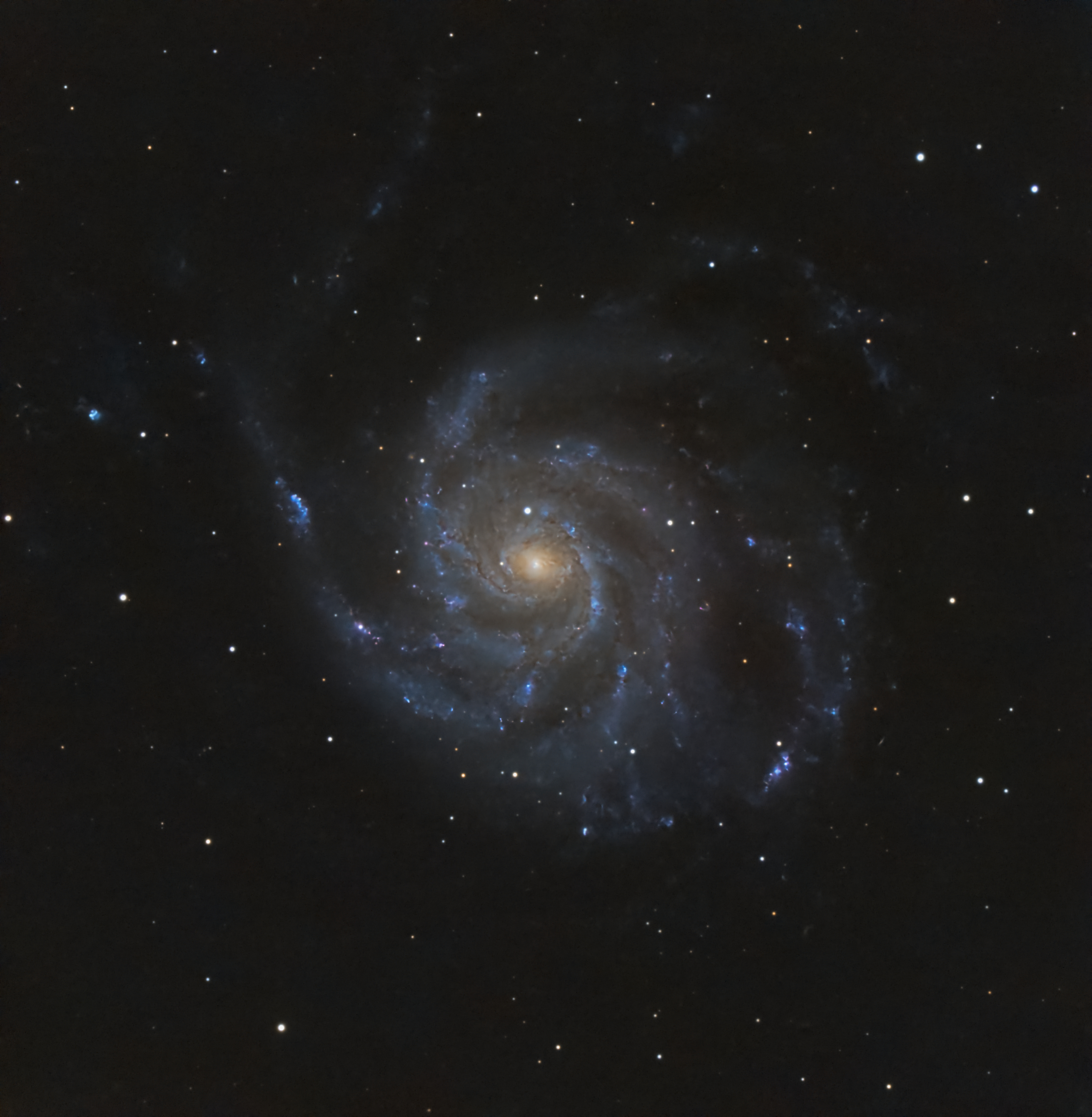
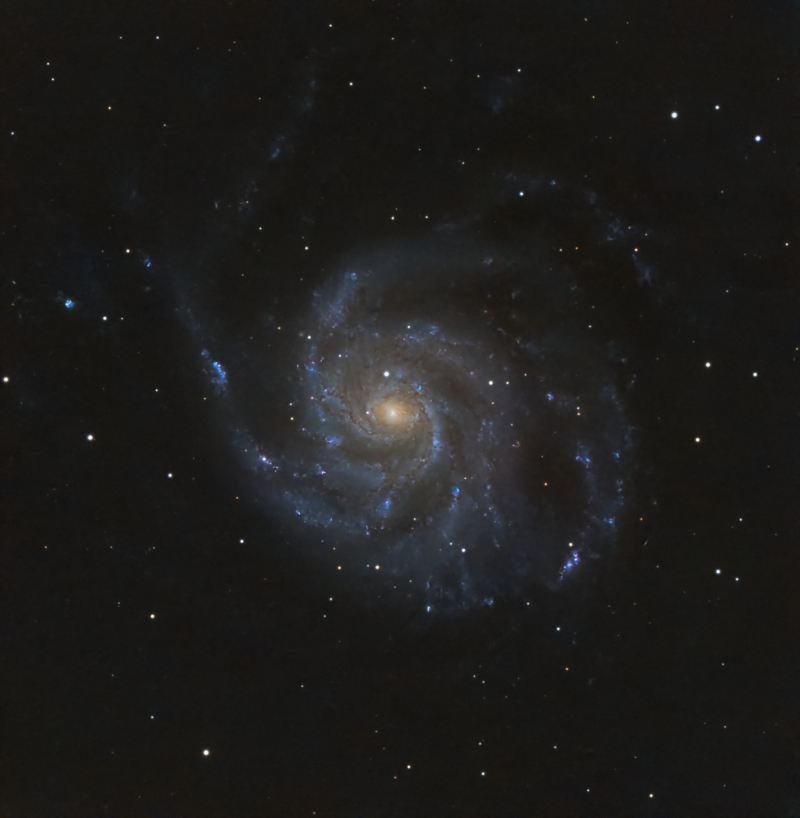
The M101 Pinwheel Galaxy is a magnificent face-on spiral galaxy located about 21 million light-years away in the constellation Ursa Major. Known for its enormous size—nearly twice the diameter of the Milky Way—M101 displays a classic “pinwheel” structure with long, gracefully sweeping spiral arms radiating from a relatively small, bright core.
These spiral arms are rich in star-forming regions, glowing pink from vast clouds of ionized hydrogen and dotted with brilliant blue clusters of young, hot stars. Dark lanes of cosmic dust thread through the arms, adding depth and contrast to the galaxy’s intricate design. The uneven appearance of the arms is thought to be the result of gravitational interactions with several nearby companion galaxies.
For astronomers and astrophotographers, M101 is a showcase of spiral galaxy evolution and active star birth. While its light is spread over a large area—making it somewhat challenging to observe visually—long-exposure images reveal one of the most detailed and beautiful spiral patterns in the night sky, earning M101 its evocative name, the Pinwheel Galaxy.
Technical Details
Telescope: Sky-Watcher Esprit 100ED Refractor
Auto Focus: ZWO Electronic Auto Focuser
Astronomy Camera: ZWO ASI533MC Pro
Filter: Optolong UV-IR cut filter; 360 exposures @ 60 seconds each (6 hours)
Filter: Optolong Lenhance dual-band, narrow-band filter ; 96 exposures @ 5 minutes each (8 hours)
Total Integration Time: 14 hours
Auto Guiding Software: PHD2
Auto Guiding: William Optics Uniguide 50 Guide Scope
Auto Guiding Camera: ZWO ASI20MM Mini Guide Camera
Telescope Mount: Celestron CGX Equatorial Mount
Telescope Computer: BeeLink GK-55 Mini PC / Windows 10 Pro
Wireless Communication: GL-iNEt Beryl Travel Router
Telescope Control & Image Capture Software: Nighttime Imaging ‘N’ Astronomy (N.I.N.A.)
Image Integration Software: Astro Pixel Process, by Aries Productions
Image Post Processing Software: PixInsight, by Pleiades Astrophoto
Images captured in Palm Springs, CA during May 2024. Dark sky classification = Bright suburban sky (Bortle 6).
CLICK ON IMAGE TO VIEW A HIGH RESOLUTION VERSION
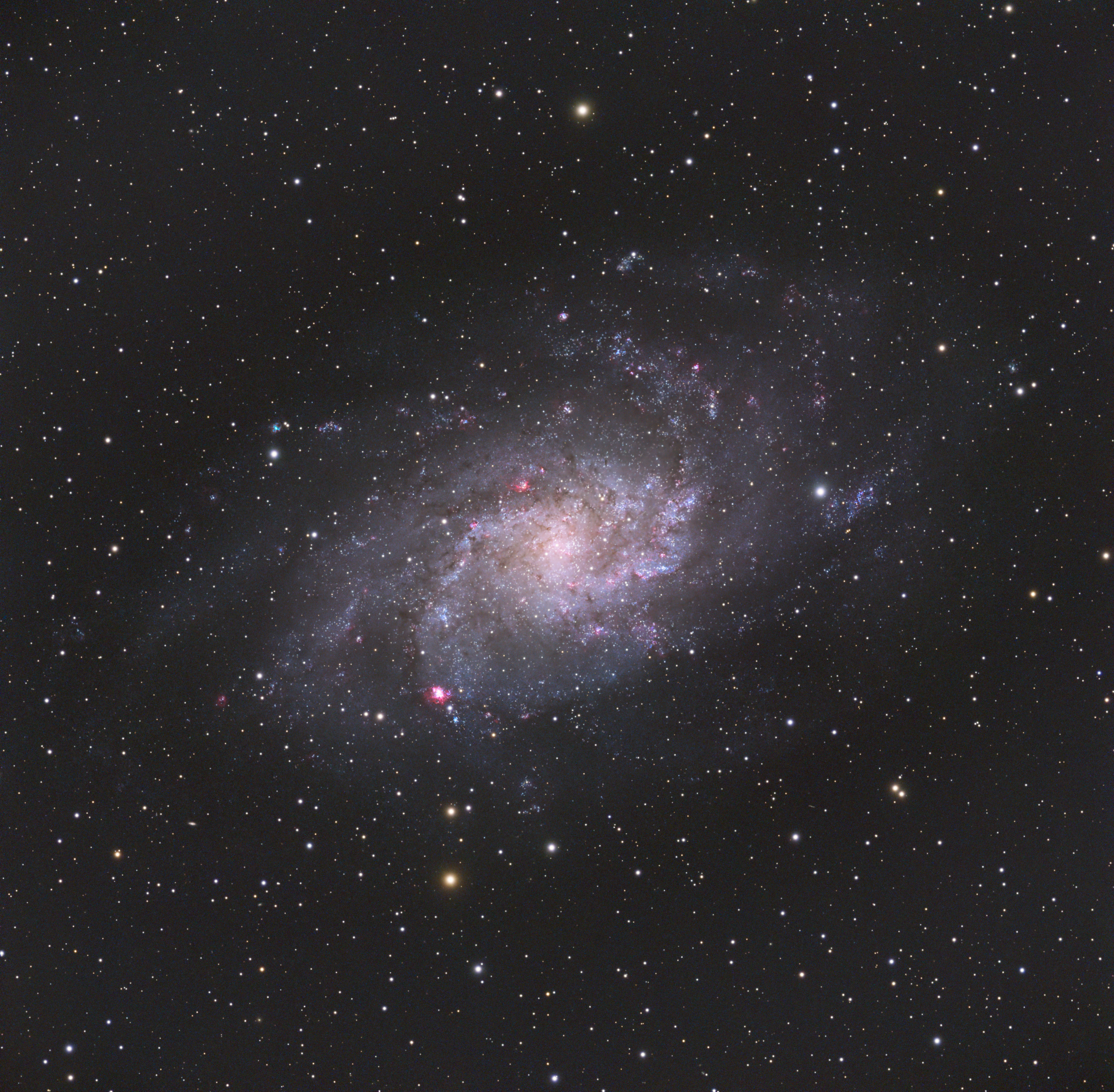
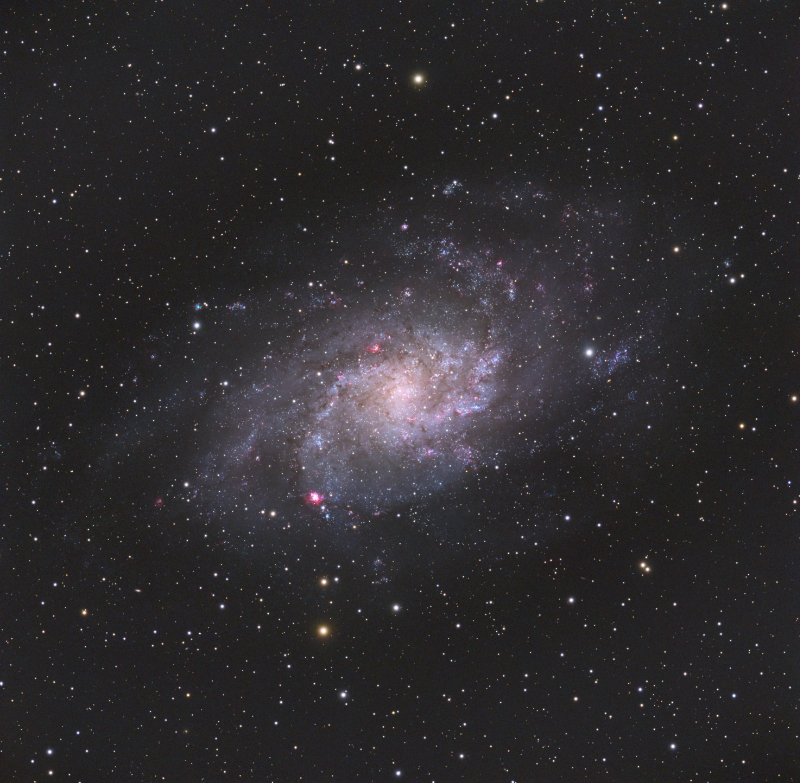
The Triangulum Galaxy (M33) is a stunning spiral galaxy located about 3 million light-years away in the constellation Triangulum. It is the third-largest member of our Local Group of galaxies, which includes the Milky Way and the Andromeda Galaxy (M31). M33 is notable for its loosely wound spiral arms, abundant star-forming regions, and a relatively small, bright central core.
With a diameter of roughly 60,000 light-years, M33 is smaller than both the Milky Way and Andromeda, but it is rich in young blue stars, nebulae, and open clusters, giving it a vibrant, patchy appearance through telescopes. One of its most famous features is NGC 604, a massive star-forming nebula that shines brightly across the galaxy’s disk.
Although M33 can be seen with the naked eye from very dark skies, it is better appreciated through binoculars or a telescope, where its spiral structure and glowing star-forming regions become more apparent. Its proximity and face-on orientation make M33 an important object for studying galaxy structure, star formation, and the dynamics of the Local Group.
Technical Details
Telescope: Celestron C8 SCT (8″ Schmidt-Cassegrain) with Celestron 0.63 focal reducer
Auto Focus: Celestron Electronic Auto Focuser
Astronomy Camera: ZWO ASI533MC Pro
Filter: Optolong UV-IR cut filter; 780 exposures @ 60 seconds each (11 hours)
Filter: Antlia ALP-T Dual Narrowband (Ha & Oiii) filter; 60 exposures @ 5 minutes each (5hours)
Total Integration Time: 16 hours
Off-Axis Auto Guiding: ZWO OAG-L
Auto Guiding Camera: ZWO ASI174MM Mini Guide Camera
Auto Guiding Software: PHD2
Telescope Mount: Sky- Watcher EQ6-R Pro
Telescope Computer: BeeLink GK-55 Mini PC / Windows 10 Pro
Wireless Communication: GL-iNEt Beryl Travel Router
Telescope Control & Image Capture Software: Nighttime Imaging ‘N’ Astronomy (N.I.N.A.)
Image Integration Software: Astro Pixel Process, by Aries Productions
Image Post Processing Software: PixInsight, by Pleiades Astrophoto
Images captured in Eastern Mojave Desert, CA during Oct 2024. Dark sky classification = Bright suburban sky (Bortle 6)
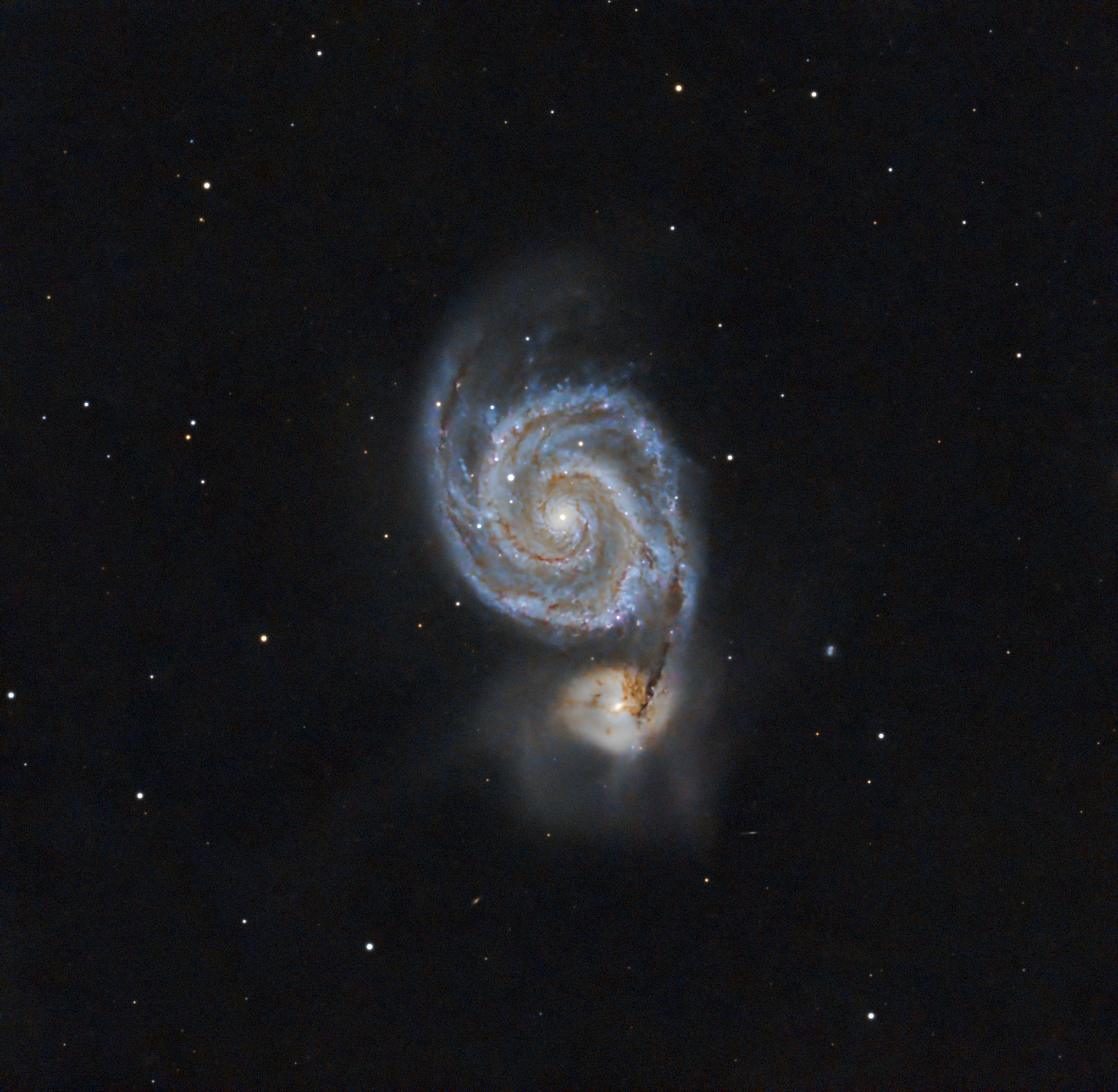
CLICK ON IMAGE TO VIEW A HIGH RESOLUTION VERSION
Messier 51, also known as the Whirlpool Galaxy, is a classic spiral galaxy located about 23 million light-years away in the constellation Canes Venatici. Famous for its well-defined spiral arms, M51 is interacting with a smaller companion galaxy, NGC 5195, creating waves of star formation and striking visual detail. It is one of the best examples of a grand-design spiral galaxy and a favorite target for both amateur and professional astronomers.
Technical Details
Telescope: Celestron C8 SCT (8″ Schmidt-Cassegrain) with Celestron 0.63 Focal Reducer
Auto Focus: Celestron Electronic Auto Focuser
Astronomy Camera: ZWO ASI183MC Pro
Filter: Optolong UV-IR cut filter; 205 exposures @ 60 seconds each (3.4 hours)
Filter: Optolong Lenhance Dual Narrowband Filter; 109 exposures @ 5 minutes each (9 hours)
Total Integration Time: 12.4 hours
Off-Axis Auto Guiding: ZWO OAG-L
Auto Guiding Camera: ZWO ASI174MM Mini Guide Camera
Telescope Mount: Sky- Watcher EQ6-R Pro
Telescope Computer: BeeLink GK-55 Mini PC / Windows 10 Pro
Wireless Communication: GL-iNEt Beryl Travel Router
Telescope Control & Image Capture Software: Nighttime Imaging ‘N’ Astronomy (N.I.N.A.)
Image Integration Software: Astro Pixel Process, by Aries Productions
Image Post Processing Software: PixInsight, by Pleiades Astrophoto
Images captured in Palm Springs, CA during May 2024. Dark sky classification = Bright suburban sky (Bortle 6).