CLICK ON IMAGE TO VIEW A HIGH RESOLUTION VERSION
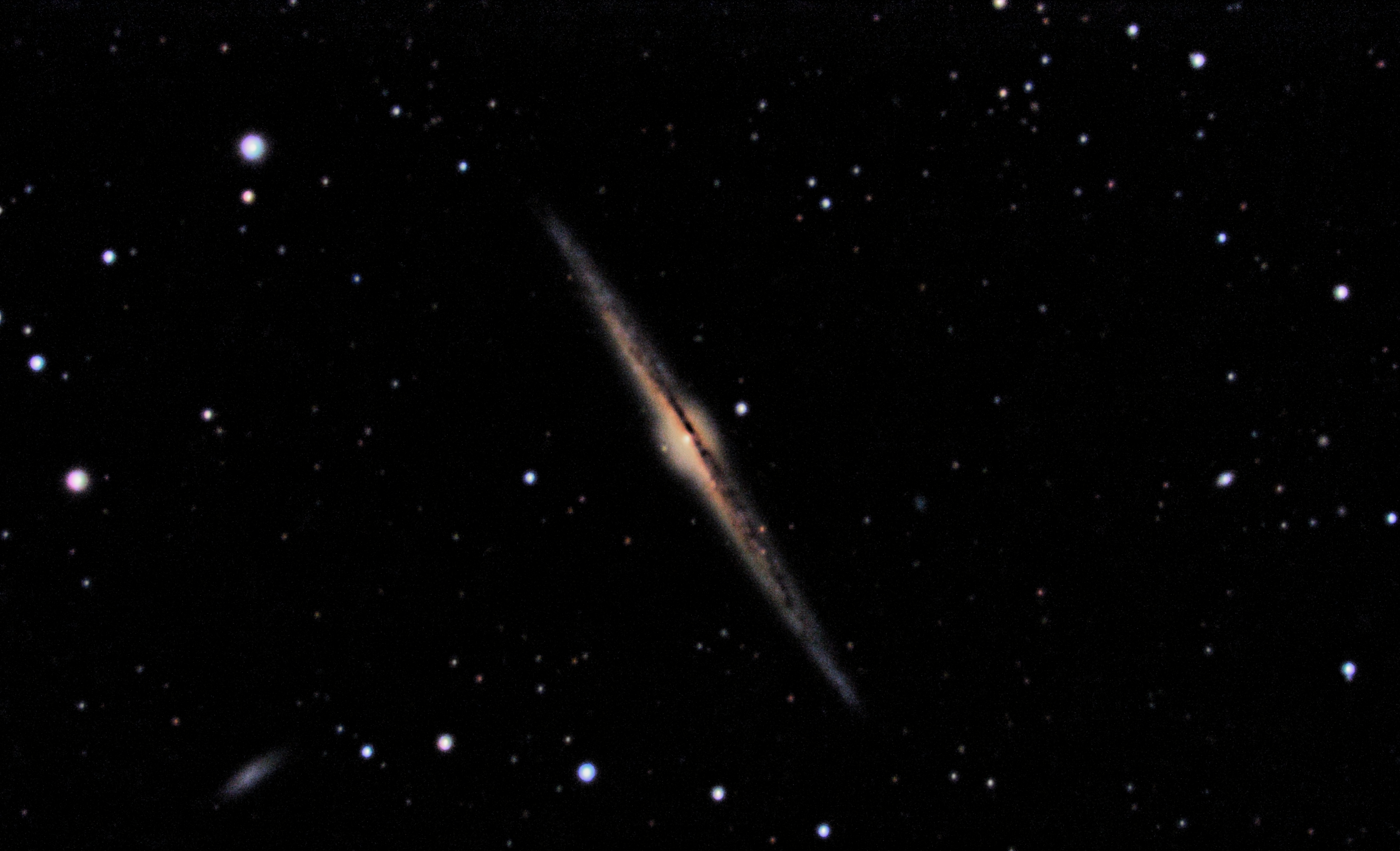
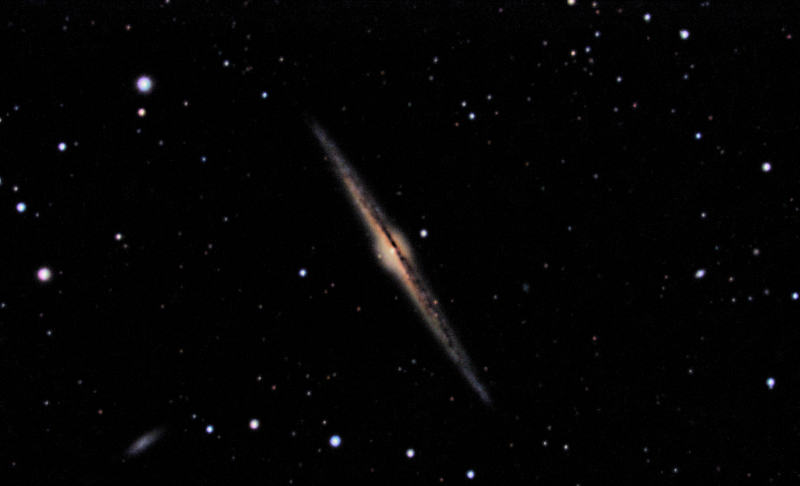
NGC 4565, commonly known as the Needle Galaxy, is one of the most striking edge-on spiral galaxies in the night sky. Located about 30–40 million light-years away in the constellation Coma Berenices, it appears as an ultra-thin sliver of light stretching across space, earning its needle-like nickname.
Viewed almost perfectly edge-on, NGC 4565 reveals a bright central bulge bisected by a dense, dark dust lane that runs the length of the galaxy. This dust lane marks vast regions of cold gas and interstellar dust where new stars are forming, contrasting sharply with the luminous glow of billions of older stars in the galactic disk.
Structurally, the Needle Galaxy is similar in size and mass to the Milky Way, spanning roughly 100,000 light-years from end to end. Its halo contains numerous globular clusters, hinting at a complex evolutionary history shaped by gravity and time.
For amateur astronomers, NGC 4565 is a favorite spring target. Through moderate to large telescopes under dark skies, it appears as a razor-thin streak with a subtly brighter core, while long-exposure astrophotography unveils its dramatic dust lane and faint outer extensions.
Elegant and minimalist in appearance, NGC 4565 offers a breathtaking perspective on spiral galaxies—showing what systems like our own might look like when viewed from the side rather than from within.
Technical Details
Telescope: Celestron C8 SCT (8″ Schmidt-Cassegrain) with Celestron 0.63 Focal Reducer
Auto Focus: Celestron Electronic Auto Focuser
Astronomy Camera: ZWO ASI1533MC Pro
Filter: Optolong UV-IR cut filter; 360 exposures @ 60 seconds each (6 hours)
Total Integration Time: 6 hours
Auto Guiding: Astronomics 60mm Guide Scope
Auto Guiding Camera: ZWO ASI120MM Mini Guide Camera
Telescope Mount: Celestron CGX Equatorial Mount
Telescope Computer: BeeLink GK-55 Mini PC / Windows 10 Pro
Wireless Communication: GL-iNEt Beryl Travel Router
Telescope Control & Image Capture Software: Nighttime Imaging ‘N’ Astronomy (N.I.N.A.)
Image Integration Software: Astro Pixel Process, by Aries Productions
Image Post Processing Software: PixInsight, by Pleiades Astrophoto
Images captured in Palm Springs, CA during March 2021. Dark sky classification = Bright suburban sky (Bortle 6).
CLICK ON IMAGE TO VIEW A HIGH RESOLUTION VERSION
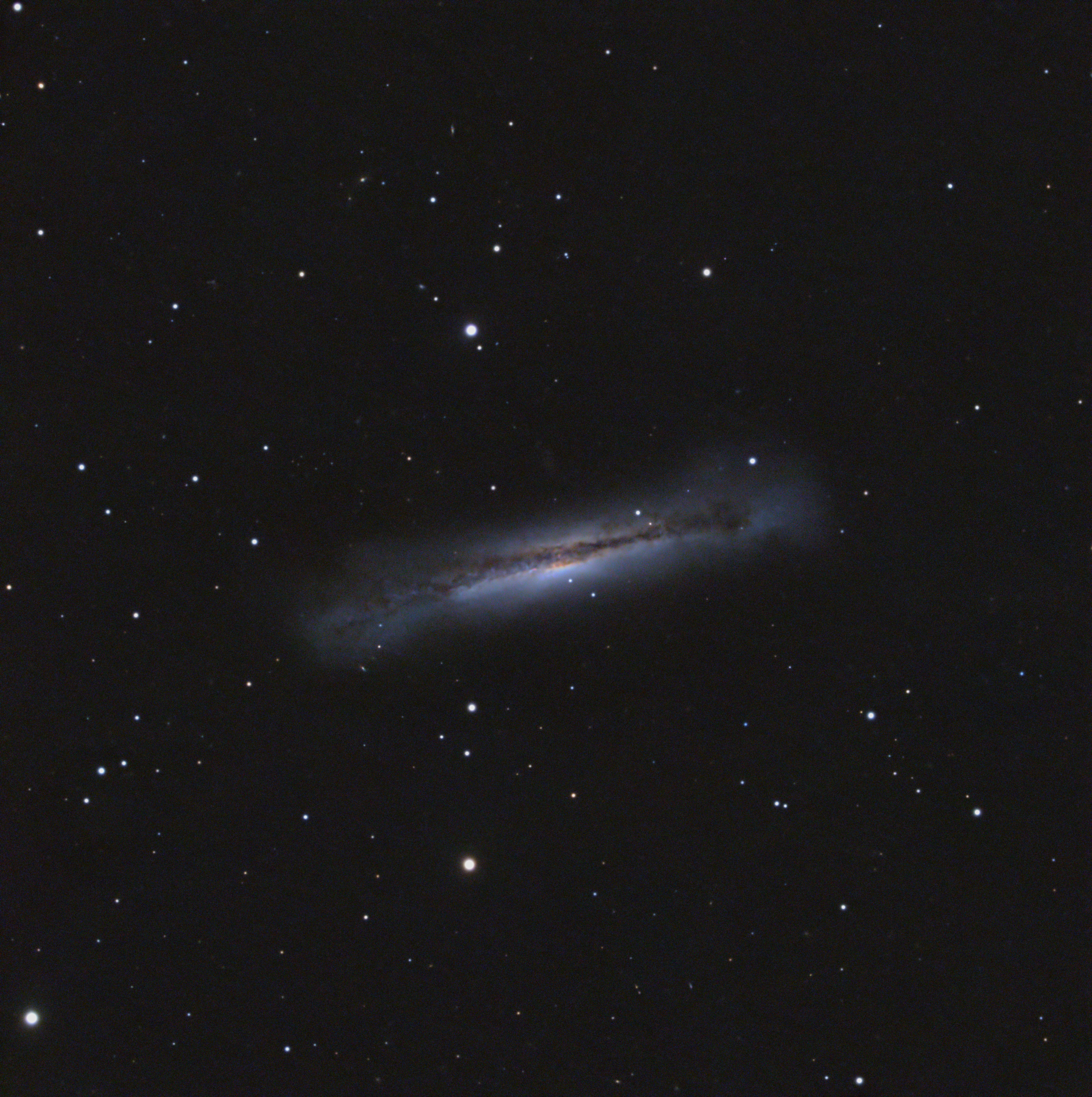
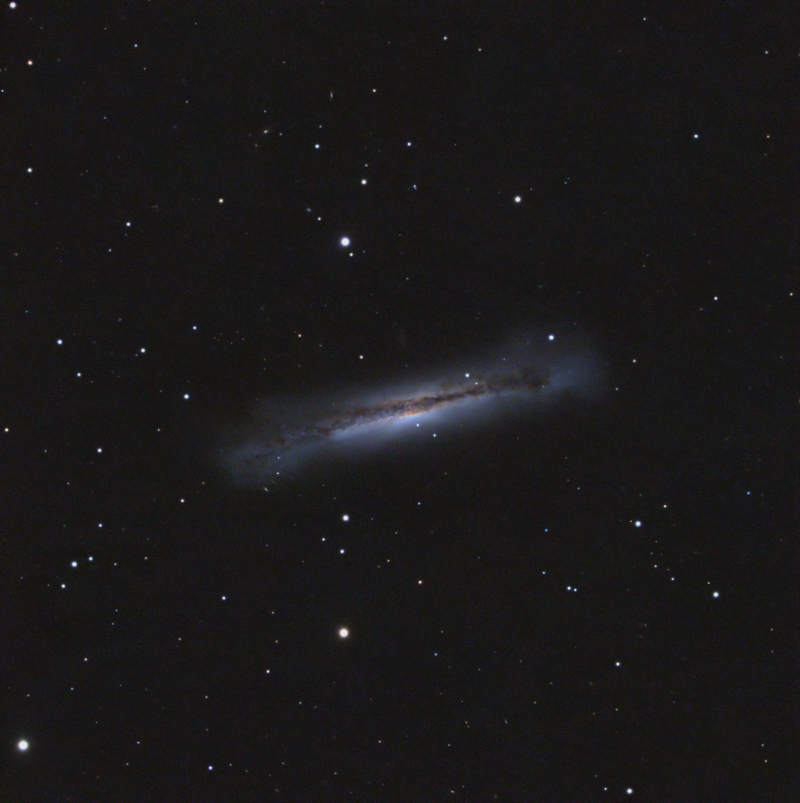
NGC 3628, commonly known as the Hamburger Galaxy, is a dramatic edge-on spiral galaxy located about 35 million light-years away in the constellation Leo. It is the third and dustiest member of the famous Leo Triplet, alongside Messier 65 and Messier 66.
Seen nearly perfectly edge-on, NGC 3628 is distinguished by a thick, dark dust lane that bisects its bright stellar disk, giving the galaxy its “hamburger” appearance. This prominent dust band obscures much of the galaxy’s central region, while the outer disk glows softly with countless stars. Subtle knots of star formation are hidden within the dust, hinting at ongoing stellar birth despite its subdued appearance.
Gravitational interactions with its neighboring galaxies have distorted NGC 3628’s shape, stretching its disk and pulling out long tidal streams of stars that extend far into space. These interactions are thought to have triggered bursts of star formation and contributed to the galaxy’s warped structure.
For observers and astrophotographers, the Hamburger Galaxy is a striking target, especially under dark skies, where its elongated form and dramatic dust lane stand out clearly. NGC 3628 offers a vivid example of how galactic interactions shape and transform spiral galaxies over cosmic time.
Technical Details
Telescope: Celestron C8 SCT (8″ Schmidt-Cassegrain) with Celestron 0.63 Focal Reducer
Auto Focus: Celestron Electronic Auto Focuser
Astronomy Camera: ZWO ASI533MC Pro
Filter: Optolong UV-IR cut filter; 300 exposures @ 60 seconds each (5 hours)
Total Integration Time: 5 hours
Off-Axis Auto Guiding: ZWO OAG-L
Auto Guiding Camera: ZWO ASI174MM Mini Guide Camera
Telescope Mount: Sky- Watcher EQ6-R Pro Equatorial Mount
Telescope Computer: BeeLink GK-55 Mini PC / Windows 10 Pro
Wireless Communication: GL-iNEt Beryl Travel Router
Telescope Control & Image Capture Software: Nighttime Imaging ‘N’ Astronomy (N.I.N.A.)
Image Integration Software: Astro Pixel Process, by Aries Productions
Image Post Processing Software: PixInsight, by Pleiades Astrophoto
Images captured in Palm Springs, CA during May 2024. Dark sky classification = Bright suburban sky (Bortle 6).
CLICK ON IMAGE TO VIEW A HIGH RESOLUTION VERSION
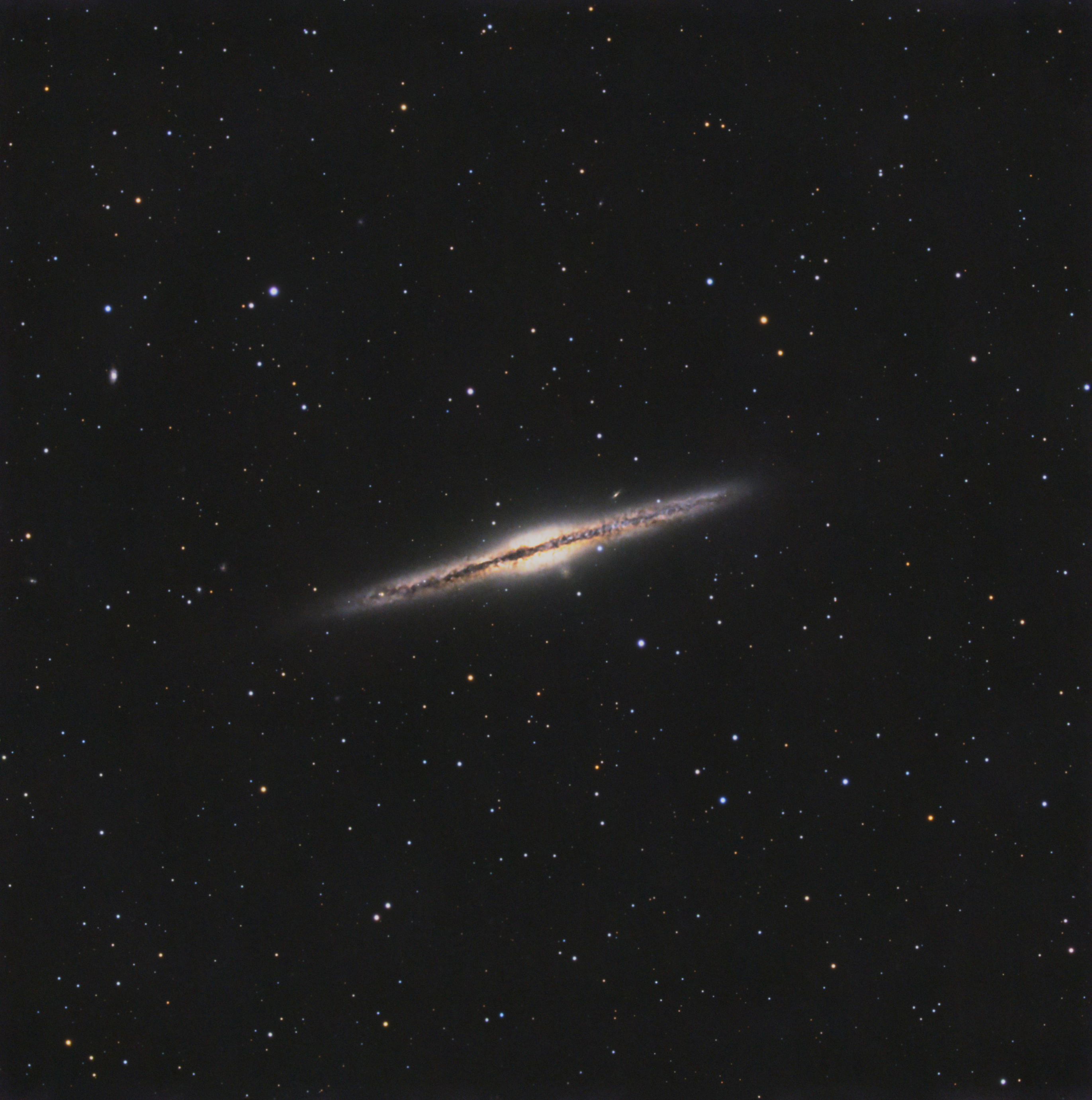
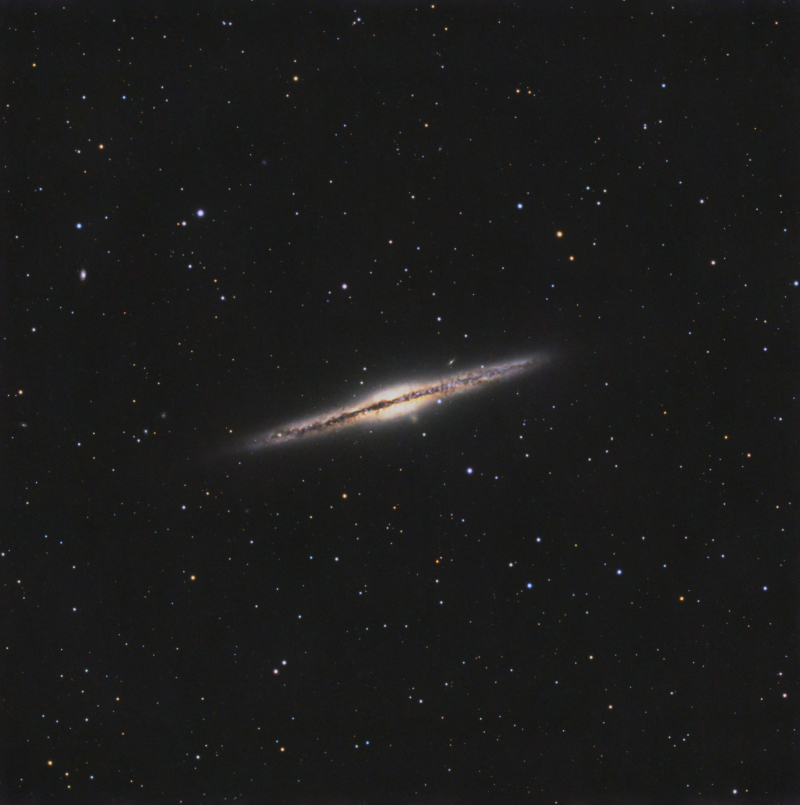
NGC 891 is a striking edge-on spiral galaxy located about 30 million light-years away in the constellation Andromeda. Often nicknamed the “Silver Sliver Galaxy” because of its long, razor-thin appearance, it is considered one of the best examples of a Milky Way–like spiral galaxy seen perfectly from the side.
From our viewpoint, NGC 891 reveals a bright, narrow disk bisected by a prominent lane of dark interstellar dust that stretches the full length of the galaxy. This dust lane blocks the light from countless stars behind it, creating a dramatic contrast against the galaxy’s silvery glow. Above and below the disk, faint halos of stars and dust can be seen, hinting at complex processes such as star formation and the circulation of gas within the galaxy.
Despite its elegant simplicity at first glance, NGC 891 is rich in detail. Long-exposure images show filaments of dust extending far above the galactic plane, likely driven by stellar winds and supernova explosions. Its orientation offers astronomers a valuable opportunity to study the structure of spiral galaxies, including how dust, gas, and stars are arranged in a disk like our own Milky Way.
For observers and astrophotographers, NGC 891 is a favorite autumn target in the Northern Hemisphere—subtle, refined, and beautiful, living up to its “silver sliver” name.
Technical Details
Telescope: Celestron C8 SCT (8″ Schmidt-Cassegrain) with Celestron 0.63 Focal Reducer
Auto Focus: Celestron Electronic Auto Focuser
Astronomy Camera: ZWO ASI533MC Pro
Filter: Optolong UV-IR cut filter; 1,800 exposures @ 60 seconds each (30 hours)
Total Integration Time: 30 hours
Off-Axis Auto Guiding: ZWO OAG-L
Auto Guiding Camera: ZWO ASI174MM Mini Guide Camera
Telescope Mount: Sky- Watcher EQ6-R Pro
Telescope Computer: BeeLink GK-55 Mini PC / Windows 10 Pro
Wireless Communication: GL-iNEt Beryl Travel Router
Telescope Control & Image Capture Software: Nighttime Imaging ‘N’ Astronomy (N.I.N.A.)
Image Integration Software: Astro Pixel Process, by Aries Productions
Image Post Processing Software: PixInsight, by Pleiades Astrophoto
Images captured in Palm Springs, CA during May 2024. Dark sky classification = Bright suburban sky (Bortle 6).
CLICK ON IMAGE TO VIEW A HIGH RESOLUTION VERSION
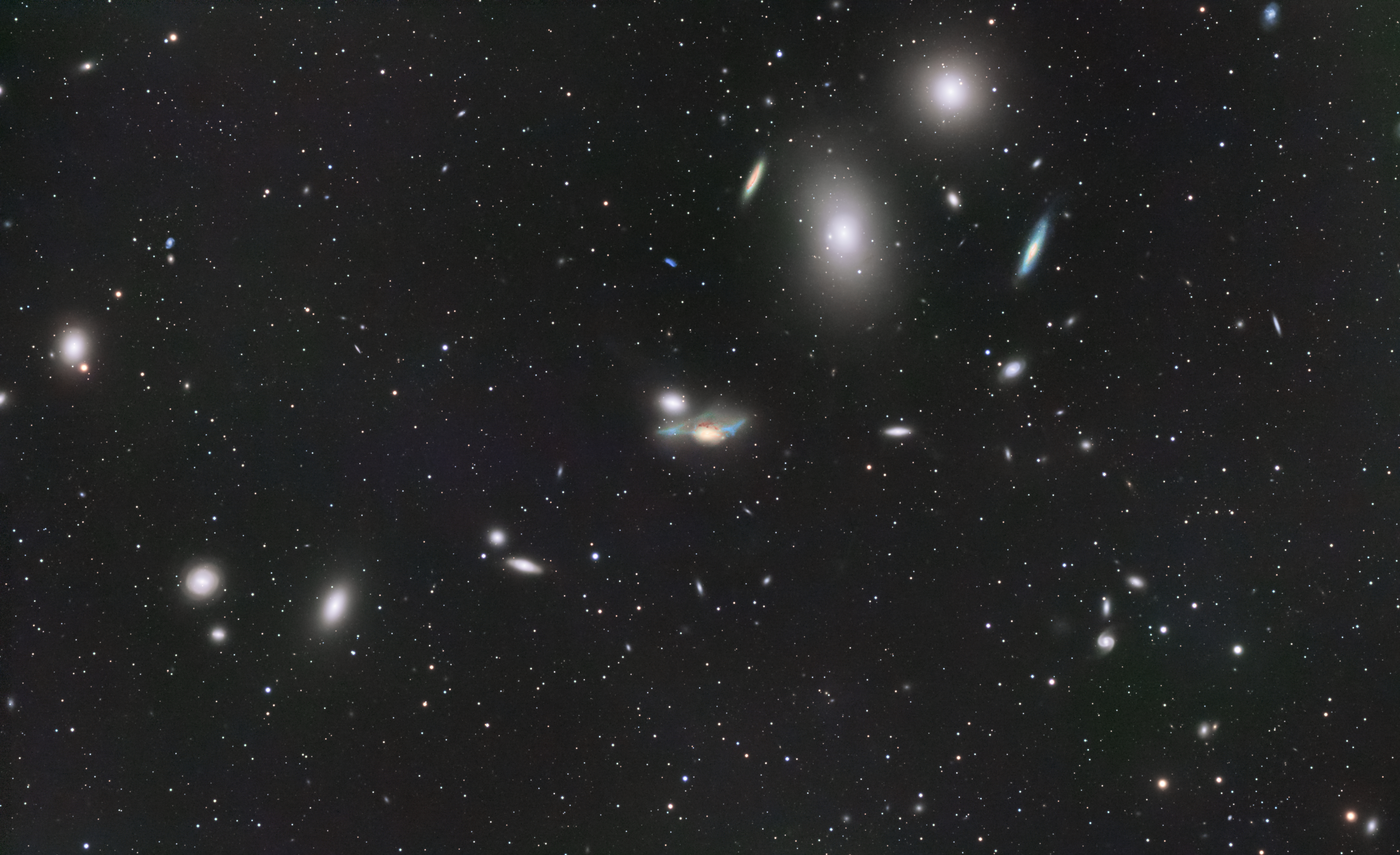
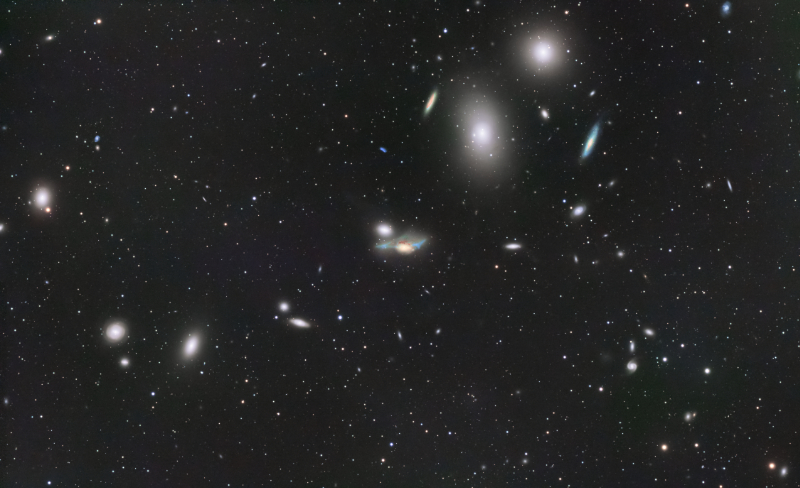
Markarian’s Chain is a striking, gently curving string of galaxies located in the heart of the Virgo Cluster, the nearest large galaxy cluster to the Milky Way. Seen from Earth, these galaxies appear linked together in a smooth arc, creating one of the most recognizable and photogenic groupings in the night sky.
The chain is dominated by large elliptical and lenticular galaxies, including Messier 84 and Messier 86, along with several fainter companions. Although they appear neatly aligned from our perspective, the galaxies are not physically connected in a straight line; instead, they lie at varying distances within the dense core of the Virgo Cluster. Their apparent alignment is a beautiful example of cosmic perspective.
Markarian’s Chain lies about 50–60 million light-years away and is shaped by the intense gravitational interactions common in galaxy clusters. Many of its members show evidence of past encounters, such as distorted shapes, extended halos, and stripped gas. These interactions play a key role in the evolution of cluster galaxies, often suppressing star formation and transforming spiral galaxies into smoother, more featureless ellipticals.
For amateur astronomers, Markarian’s Chain is a favorite springtime target in the Northern Hemisphere. Under dark skies, it can be traced visually through moderate-sized telescopes, while astrophotographers prize it for the way dozens of galaxies can be captured together in a single wide-field image—offering a vivid glimpse into the crowded, dynamic environment of a galaxy cluster.
Technical Details
Telescope: Sky-Watcher Esprit 100ED Refractor
Auto Focus: ZWO Electronic Auto Focuser
Astronomy Camera: ZWO ASI071MC Pro
Filter: Optolong UV-IR cut filter; 2,400 exposures @ 60 seconds each (40 hours)
Total Integration Time: 40 hours
Auto Guiding Software: PHD2
Auto Guiding: William Optics Uniguide 50 Guide Scope
Auto Guiding Camera: ZWO ASI20MM Mini Guide Camera
Telescope Mount: Celestron CGX Equatorial Mount
Telescope Computer: BeeLink GK-55 Mini PC / Windows 10 Pro
Wireless Communication: GL-iNEt Beryl Travel Router
Telescope Control & Image Capture Software: Nighttime Imaging ‘N’ Astronomy (N.I.N.A.)
Image Integration Software: Astro Pixel Process, by Aries Productions
Image Post Processing Software: PixInsight, by Pleiades Astrophoto
Images captured in Eastern Mojave Desert April 2023. Dark sky classification = Rural sky (Bortle 6)
CLICK ON IMAGE TO VIEW A HIGH RESOLUTION VERSION
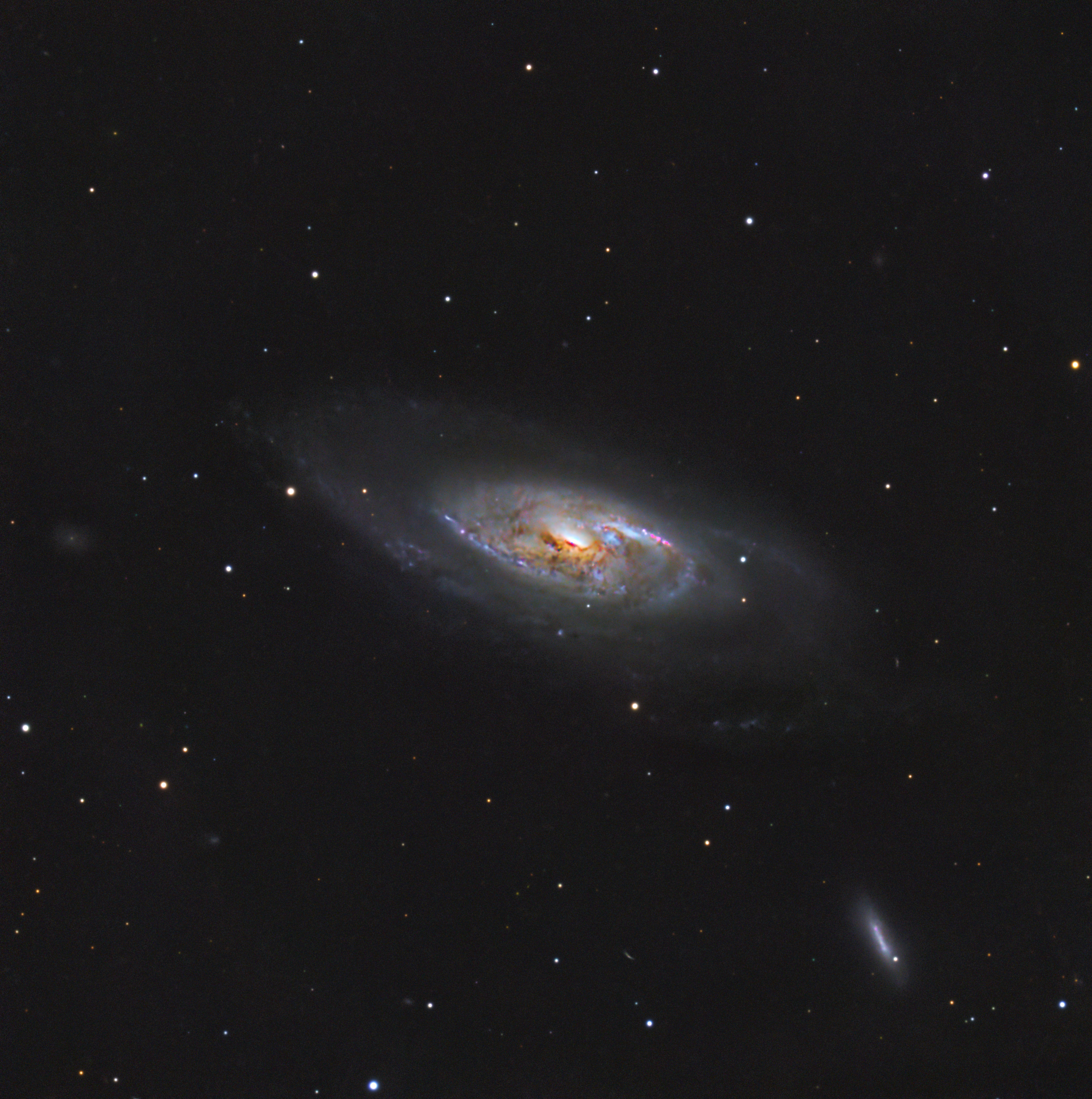
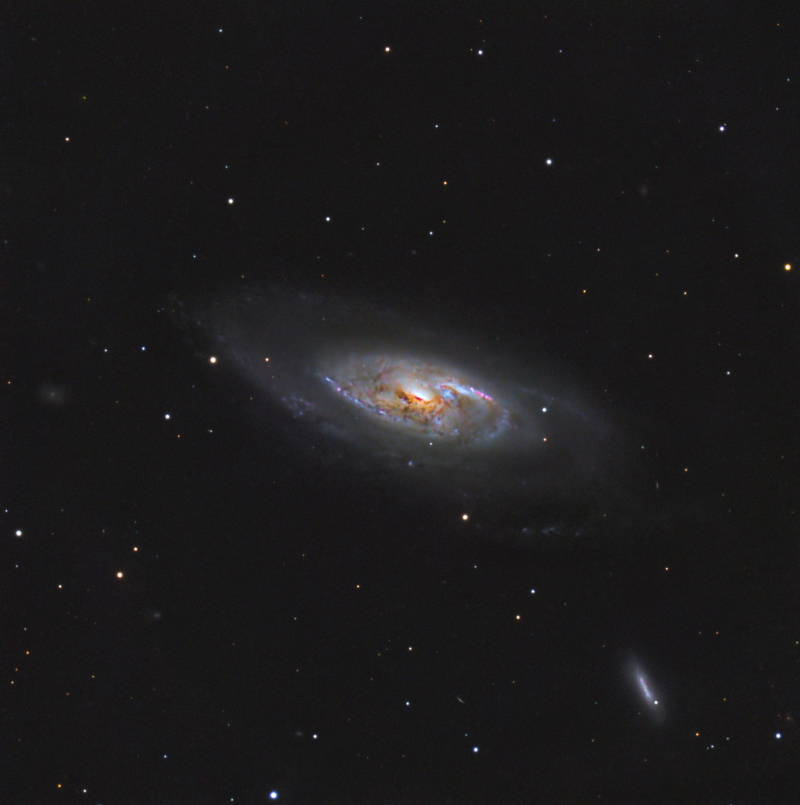
Messier 106 (M106) is a striking spiral galaxy located about 23 million light-years away in the constellation Canes Venatici. Classified as an intermediate barred spiral, M106 is notable for its bright core and two prominent spiral arms that sweep outward, threaded with dark dust lanes and regions of active star formation.
What makes M106 especially intriguing is its active galactic nucleus, powered by a supermassive black hole at its center. This activity produces powerful jets of energized gas that glow in radio and X-ray wavelengths, creating unusual “anomalous arms” that do not align with the galaxy’s visible spiral structure. These features reveal complex interactions between the black hole and the surrounding interstellar medium.
With an apparent magnitude of around 8.4, M106 is visible in small telescopes and is a rewarding target for astrophotographers, who can capture both its classic spiral beauty and subtle signs of its energetic core. As one of the dominant members of the M106 Group of galaxies, it offers astronomers valuable insight into how black holes influence the evolution of spiral galaxies.
Technical Details
Telescope: Celestron C8 SCT (8″ Schmidt-Cassegrain) with Celestron 0.63 Focal Reducer
Auto Focus: Celestron Electronic Auto Focuser
Astronomy Camera: ZWO ASI533MC Pro
Filter: Optolong UV-IR cut filter; 600 exposures @ 60 seconds each (10 hours)
Total Integration Time: 10 hours
Off-Axis Auto Guiding: ZWO OAG-L
Auto Guiding Camera: ZWO ASI174MM Mini Guide Camera
Telescope Mount: Sky- Watcher EQ6-R Pro Equatorial Mount
Telescope Computer: BeeLink GK-55 Mini PC / Windows 10 Pro
Wireless Communication: GL-iNEt Beryl Travel Router
Telescope Control & Image Capture Software: Nighttime Imaging ‘N’ Astronomy (N.I.N.A.)
Image Integration Software: Astro Pixel Process, by Aries Productions
Image Post Processing Software: PixInsight, by Pleiades Astrophoto
Images captured in Palm Springs, CA during May 2025. Dark sky classification = Bright suburban sky (Bortle 6).